
The Vanishing of Agatha Christie
The World's Most Famous Mystery Writer Became Her Own Greatest Mystery
On December 3, 1926, crime writer Agatha Christie left her home. Her car was found at Newlands Corner in Surrey the next morning. Finding a car without its driver gave police an urgent problem: where had she gone?
For eleven days, police and volunteers searched while newspapers circulated Christie’s photograph. The attention spread far beyond the countryside around her abandoned car.
Eleven days later, Christie was found at a Harrogate hotel, registered under the surname Neele. In 1928 she published an account involving loss of memory, but the episode still attracts competing interpretations.
This is the mystery that even Agatha Christie couldn't — or wouldn't — solve.
Dec 3–14, 1926
Agatha Christie vanished from her home in Sunningdale, Berkshire after an argument with her husband about his affair. Her car was found at Newlands Corner, Surrey, the next morning — without its driver. She was found eleven days later in a Harrogate hotel, registered as someone else entirely.
11
A widely publicised search concentrated on Surrey while Christie was in Yorkshire.
Police and public
Police, volunteers and aircraft took part in the search.
1928
Her later autobiography omits the episode. However, she did give a newspaper account in 1928; saying she never explained anything is misleading.
The Evidence
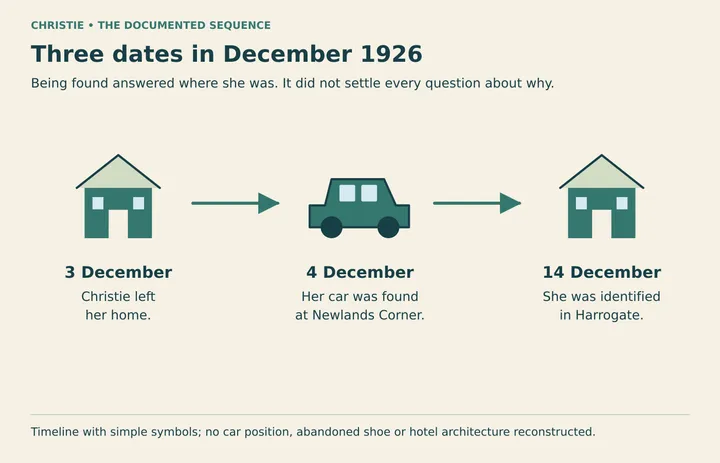
Three December Dates
A timeline separates Christie’s departure, the discovery of her car and her identification in Harrogate. The symbols reconstruct no car scene or private actions.
Her abandoned Morris Cowley became a focus of the search. Later dramatic accounts add details that need careful checking against contemporary records. The car alone cannot establish why she left.
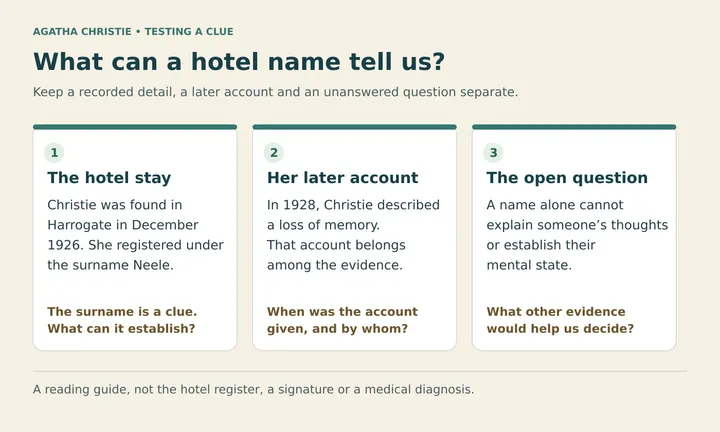
Mrs Theresa Neele
On the same day her car was found in Surrey, a woman checked into the Hydro Hotel in Harrogate, far away. She gave her name as "Mrs Theresa Neele, from Cape Town, South Africa." Neele was the exact surname of Nancy Neele — the woman Archie Christie planned to marry. The guest was Agatha Christie.
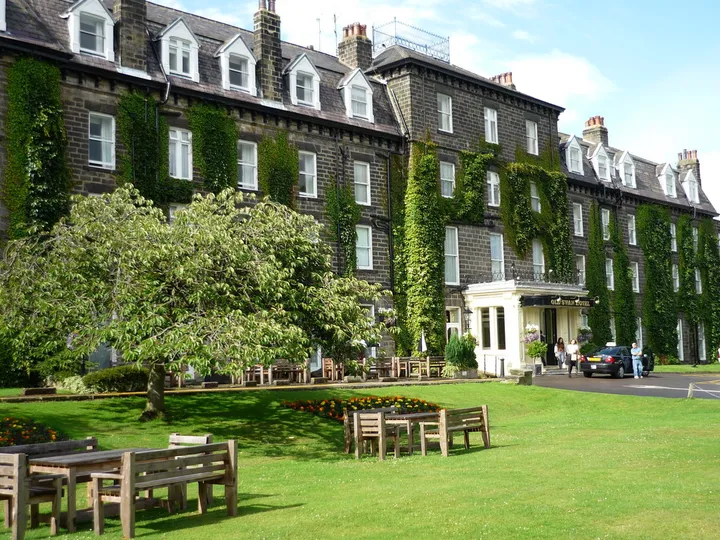
The Old Swan Hotel
The Old Swan Hotel in Harrogate, photographed in 2009. This is the real building associated with Christie’s stay, shown long after 1926. Photo: Graham Hogg / Geograph, CC BY-SA 2.0; unchanged.

Christie stayed at the hotel under the surname Neele. Reports that she joined ordinary hotel activities do not, by themselves, establish what she remembered or why she had travelled there.
How the Mystery Unfolded
The First Blow
Agatha Christie's mother Clara dies after a long illness. Agatha had been nursing her through her final weeks. Clara was the person closest to her in the world. The grief is profound — and before it has any chance to ease, Agatha discovers her husband is in love with someone else.
The Argument
Agatha and Archie argue about his affair with Nancy Neele. Archie leaves to spend the weekend with friends — including Nancy. Agatha is alone in the house with her sleeping daughter. Sometime after 9 PM, she gets in her car and drives away. Nobody sees her go.
The Car Is Found
The abandoned car is discovered at Newlands Corner. Police and newspapers appeal for information, while Christie travels to Harrogate and registers under another name.
The Great Hunt
Volunteers and police search the Surrey countryside. Aircraft assist, and writers Arthur Conan Doyle and Dorothy L. Sayers take an interest. Public attention brings many theories but no immediate answer.
Found
Hotel musicians recognise Christie from newspaper photographs, and police are informed. After she is found, she goes to her sister’s home, Abney Hall in Cheshire.
The Divorce
Agatha and Archie divorce in 1928. That year she travels to Ur; on a return visit in 1930, she meets archaeologist Max Mallowan.
A New Life
Agatha marries Max Mallowan. She continues writing at a remarkable pace. The Mousetrap opens in 1952 and is still running in London today. She becomes the bestselling fiction writer in human history.
The Mystery Sealed
Christie dies aged 85 in 1976. Her autobiography omits the disappearance, but the newspaper account she gave in 1928 remains evidence about it.
The People in This Story
Agatha Christie
Born 1890 in Torquay. The most famous mystery writer in Britain by 1926, already the creator of Hercule Poirot. Under enormous personal pressure — her mother had just died and her husband was leaving her — she vanished for eleven days and later described a loss of memory. She went on to become the bestselling fiction writer in human history.
Colonel Archie Christie
A Royal Flying Corps pilot who married Agatha in 1914. By 1926 he had fallen in love with Nancy Neele and asked Agatha for a divorce. He was with Nancy on the night Agatha disappeared. The press made him their prime suspect. He maintained he had no idea where Agatha was — and, eventually, this was believed. He married Nancy Neele in 1928.
Dorothy L. Sayers
One of the greatest mystery writers of the era — creator of Lord Peter Wimsey — who drove to Newlands Corner to examine the scene personally when Agatha disappeared. She walked the chalk hillside, studied the car's resting place, and spoke to witnesses. She reached no firm conclusion. Her interest did not solve the case.
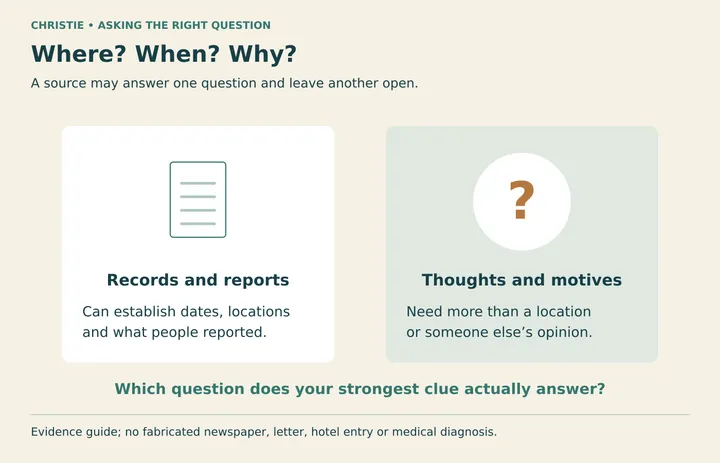
The Question That Remains
How should we compare Christie’s later account, contemporary witness reports and later speculation? A century-old disappearance cannot be diagnosed simply from a hotel register.
Loss of memory has been proposed, including in Christie’s own later account. The surname Neele is a clue, but cannot diagnose her condition or prove a revenge plan. Outwardly ordinary behaviour also does not settle her mental state.
Read the full book to weigh the key clues and competing explanations — then decide: which conclusions are supported, and which would require evidence we do not have?
Get the Full Book
The complete Agatha Christie mystery. 9 chapters of evidence, theories, and a question only you can answer.
Part of the Vanished Volume
Ships found empty at sea. Explorers who never came home. Settlements whose people moved on, leaving questions behind. The clues are still out there.
See all books in this volume →Keep investigating
Check the evidence
What the evidence supports
Agatha Christie disappeared in December 1926 and was found alive at a hotel. Police records document the search.
Where to be careful
An investigator’s opinion about her motives is not a proven diagnosis or an account of her private thoughts.
Explore the sources
These selected sources support this guide and offer further reading. Some are written for adults; explore them with a parent or teacher.
The story and illustrations are modern retellings. Imagined scene details are not historical evidence. These sources are a starting point, not citations for every narrative detail.
Evidence guide reviewed 8 September 2026.