
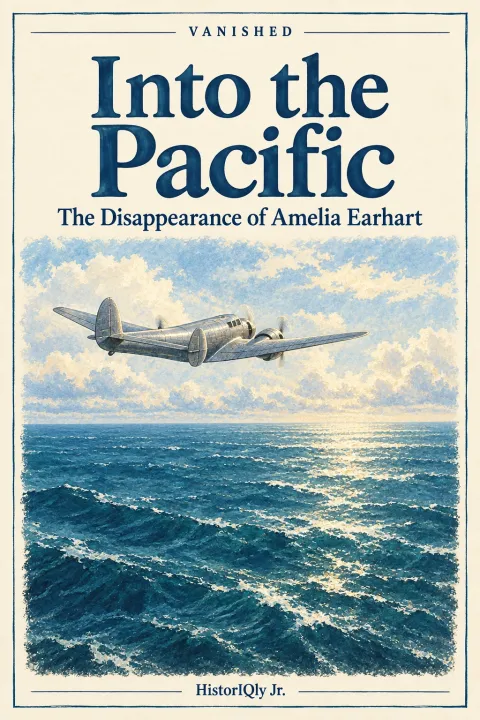
Into the Pacific
The Disappearance of Amelia Earhart
At 8:43 in the morning on July 2, 1937, a radio operator aboard a US Coast Guard ship heard a woman's voice — tense, urgent, and lost — crackle through his headphones. It was the most famous pilot in the world. It was the last anyone ever heard from her.
The United States launched the largest search in its history. Nine ships. Sixty-five aircraft. 250,000 square miles of ocean searched.
They found nothing. Not a wing. Not a life raft. Not a single piece of metal. The mystery has never been solved.
1937
Earhart and navigator Fred Noonan vanished on the final leg of an attempt to fly around the world along the equator — 22,000 miles completed, 7,000 miles remaining. The destination: a two-mile island in the middle of the Pacific Ocean.
22,000
Before she vanished. More than any woman had ever flown in a single journey.
250,000 sq mi
The largest peacetime search in US Navy history at that point.
87+ Years
No verified wreckage. No confirmed remains. The mystery endures.
The Evidence
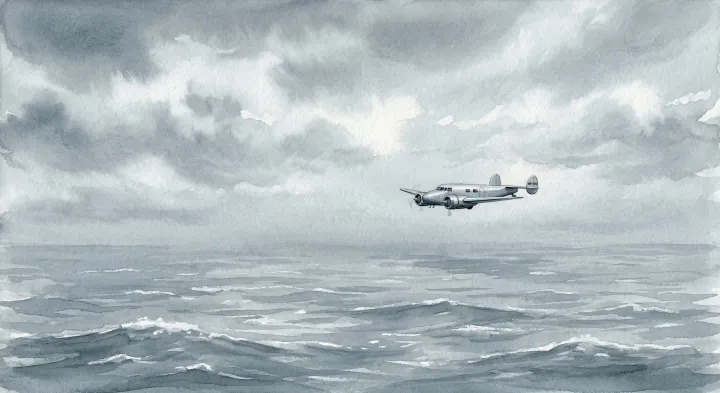
The Final Transmissions
The crew of the Itasca received Earhart's voice clearly — but she could not hear their responses. Her last message referenced "line 157 337," a navigational position. Then silence. A radio problem may have cost her everything.
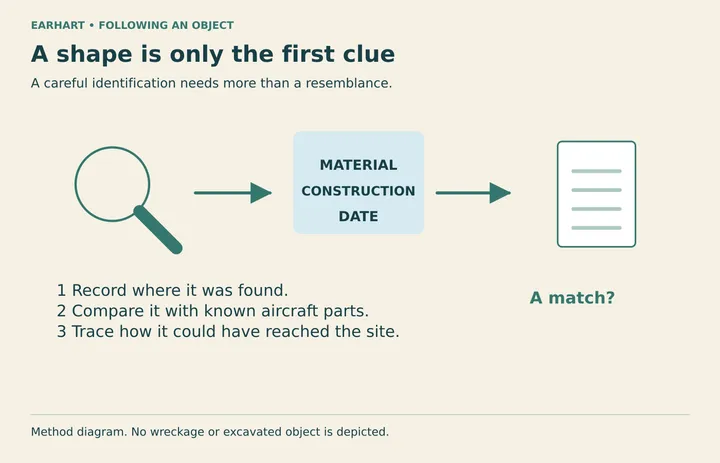
Testing a Possible Find
A diagram of the checks needed to identify a possible aircraft part. It depicts no recovered Earhart wreckage.
The final reported line of position has led some researchers to consider Nikumaroro. Bones found there in 1940 were later lost. Other objects have been proposed as clues, but none has been conclusively linked to Earhart or Noonan.

Checking a Promising Lead
An imagined archive scene. Researchers check where a record came from and what it actually establishes; this picture contains no reproduced Earhart evidence.
A sonar target reported after a 2023 search briefly looked promising. Closer investigation in 2024 showed a natural rock formation, not Earhart’s aircraft. That particular lead is closed.
The Road to the Pacific
First Atlantic Crossing
Earhart crosses the Atlantic — as a passenger. She calls herself "just baggage." The experience drives her to do it herself.
Solo Atlantic
She flies the Atlantic alone through storms and engine fire. She lands in an Irish farmer's field. "Have you come far?" he asks. "From America," she replies.
Pacific Records
Solo Hawaii to California. Solo Los Angeles to Mexico City. Solo Mexico City to New York. She becomes the most record-breaking aviator in history.
The Circumnavigation Begins
Earhart and navigator Fred Noonan depart Miami in the Lockheed Electra. Their route: west to east, along the equator, around the entire world.
The Last Transmission
At 8:43 AM, the Itasca receives Earhart's final message — "line 157 337" — and then silence. She is never seen or heard from again.
Declared Dead
The Navy ended its extensive search on July 18, 1937. No confirmed trace of the aircraft had been found; private searches followed.
The People in This Story
Amelia Earhart
Born 1897 in Kansas. First woman to fly solo across the Atlantic. Holder of numerous flight records. She flew at a time when women were told they could not — and kept proving them wrong.
Fred Noonan
Former sea captain and one of the best navigators in the world. He helped chart the first trans-Pacific commercial air routes for Pan American Airways. He vanished alongside Earhart on July 2, 1937.
The USCGC Itasca
The US Coast Guard cutter stationed near Howland Island to guide Earhart in by radio. The crew heard her voice clearly — but the radio connection was one-way. They could not reach her. They searched for her for days.
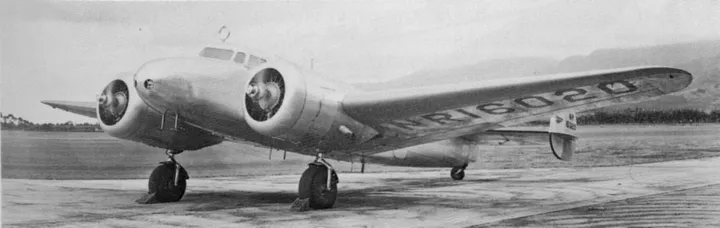

Three Theories. No Proof.
Did she crash into the ocean near Howland Island and sink to the bottom? Did she land on Nikumaroro and survive for weeks as a castaway? Was she captured — and the evidence hidden?
Running out of fuel near Howland remains the leading explanation. A Nikumaroro landing is a hypothesis with disputed clues; stories of Japanese capture lack convincing evidence. These explanations do not carry equal weight.
Read the full book to examine every clue — then decide which theory you believe.
Get the Full Book
The complete Amelia Earhart mystery. 9 chapters of evidence, theories, and a question only you can answer.
Part of the Vanished Volume
Ships found empty at sea. Explorers who never came home. Settlements whose people moved on, leaving questions behind. The clues are still out there.
See all books in this volume →Keep investigating
Check the evidence
What the evidence supports
Amelia Earhart and Fred Noonan disappeared during their 1937 attempt to fly around the world. The search did not establish their final location.
Where to be careful
A proposed wreck, photograph or island find needs independent identification before it can settle their fate.
Explore the sources
These selected sources support this guide and offer further reading. Some are written for adults; explore them with a parent or teacher.
The story and illustrations are modern retellings. Imagined scene details are not historical evidence. These sources are a starting point, not citations for every narrative detail.
Evidence guide reviewed 8 September 2026.