
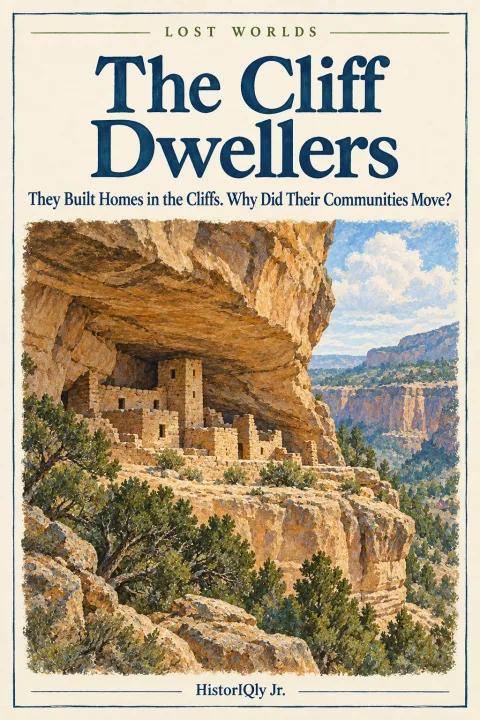
The Cliff Dwellers
They Built Cities in the Side of Cliffs. Then They Were Gone.
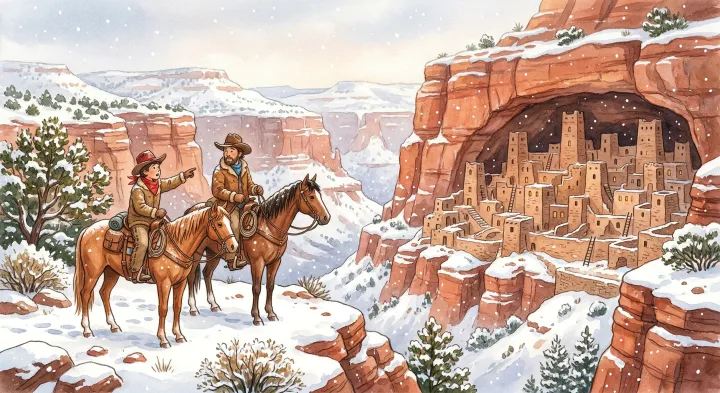
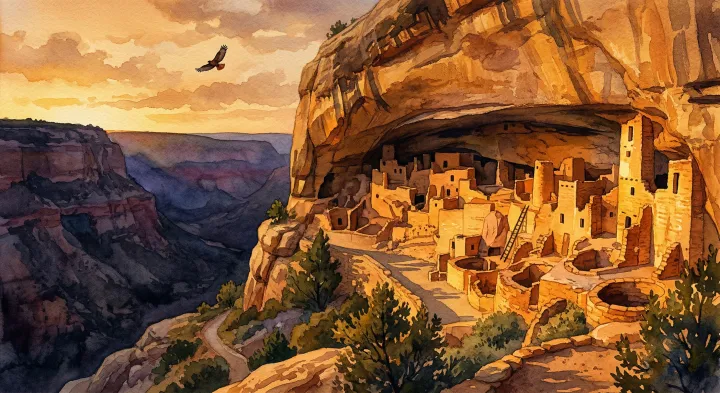
On December 18, 1888, two cowboys searching for stray cattle in a Colorado snowstorm looked across a canyon and saw something impossible: an entire city, built into the side of a cliff. Stone walls. Towers four storeys high. Windows staring out at nothing. It had been empty for nearly six hundred years.
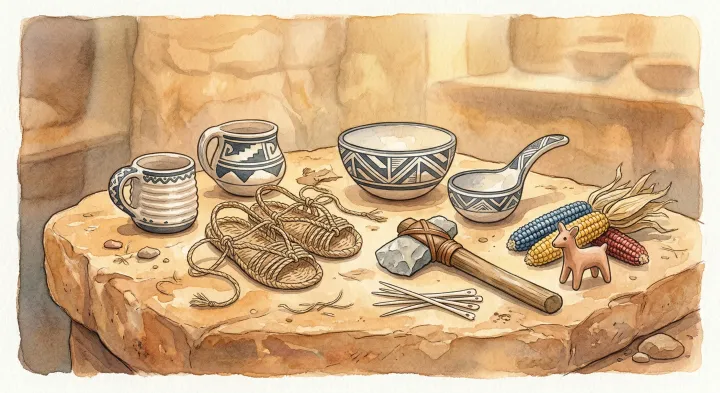
Inside, pottery sat on the floors. Tools lay where they had been put down. Corn cobs were stacked in storage rooms. It looked like the people who lived there had simply stood up and walked away.
They had. The question is: why?
~1300 CE
The Ancestral Puebloans spent decades building extraordinary cliff cities — 150 rooms, 23 kivas, towers four storeys high — then abandoned everything and migrated south. Their descendants, modern Pueblo communities, still live in the region today.
150 rooms
The largest cliff dwelling in North America, with towers reaching 27 feet.
~600
Cliff dwellings at Mesa Verde — from single rooms to entire villages.
23 years
Tree rings indicate a prolonged dry period in the late 1200s. This means reduced moisture, not twenty-three rainless years.
The Evidence
Cliff Palace
150 rooms, 23 kivas, and towers four storeys high — all built into a natural alcove in the cliff face. Constructed mainly in the late 1100s and 1200s using only stone tools. Remaining objects do not establish a sudden departure.
The Drought Record
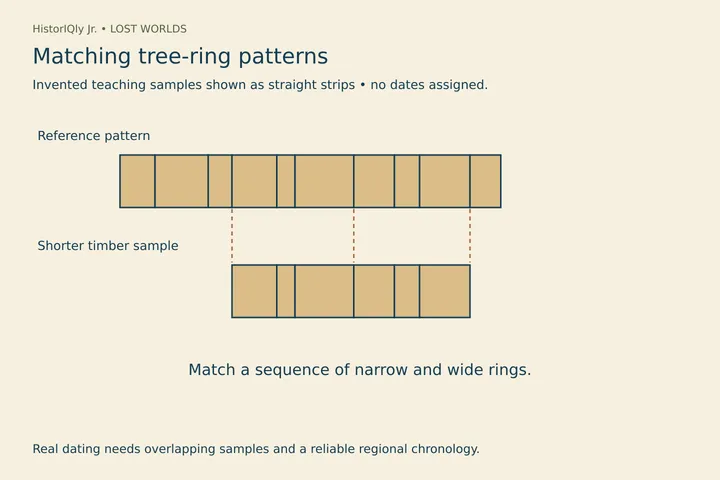
Dendrochronology — the science of tree-ring dating — helped date suitable building timbers and reconstruct drought in the late 1200s. Regional beam dates extend into the 1280s; there was no universal early-1260s construction cutoff.
The Pottery Trail
Mesa Verde pottery styles appear in sites along the Rio Grande around 1300 CE. The same building techniques, kiva designs, and farming methods continued in the new settlements. The cliff dwellers did not vanish — they migrated south.
A Civilisation Rises and Departs
The First Homes
Ancestral Puebloans begin building pit houses — partly underground dwellings — on the mesa tops. They grow corn, beans, and squash.
Above Ground
They move to above-ground stone pueblos. Communities grow. Pottery becomes more elaborate. Trade networks expand across the region.
Into the Cliffs
A dramatic shift: the Ancestral Puebloans begin building inside cliff alcoves. Cliff Palace, with 150 rooms and 23 kivas, is built and modified during the late 1100s and 1200s.
Construction Stops
Tree-ring dates vary across sites. Researchers compare them with other occupation evidence and climate records to investigate change.
The Great Drought
Twenty-three years of devastating drought. Crops fail. Springs dry up. The departure accelerates. By about 1300, communities have largely left the Mesa Verde region.
Rediscovery
Cowboys Richard Wetherill and Charlie Mason spot Cliff Palace through falling snow while searching for stray cattle. The world learns about the cliff dwellers.
The People in This Story
Richard Wetherill
A Colorado rancher who spotted Cliff Palace through falling snow in December 1888. He spent years exploring the ruins and guiding scientists to them — but also removed artefacts, sparking the first debates about preservation.
Gustaf Nordenskiöld
A 23-year-old Swedish scientist who made the first scientific study of Mesa Verde in 1891. He was arrested, but the prosecution did not prevent the collection from leaving the country. His arrest helped inspire the Antiquities Act of 1906.
A.E. Douglass
An astronomer who invented dendrochronology — the science of tree-ring dating. In 1929, he bridged the gap in his timeline, allowing suitable timbers to be dated and helping reconstruct past growing conditions.
The Question That Remains
The cliff dwellers did not vanish. Their descendants — Pueblo communities — are still here. But the reason they left remains one of the most debated questions in American archaeology.
Were they driven out by drought, exhausted soil, and conflict? Or did they choose to leave — guided by their beliefs — to start a new chapter somewhere else?
Read the full book to investigate the key clues and competing explanations — then decide for yourself.
Get the Full Book
The complete Cliff Dwellers mystery. 9 chapters of evidence, theories, and a question only you can answer.
Part of the Lost Worlds Volume
Ancient cities, remarkable structures, and the communities who built them. Explore the evidence and the living histories behind the ruins.
See all books in this volume →Keep investigating
Check the evidence
What the evidence supports
Ancestral Pueblo people moved away from Mesa Verde in the late 1200s. Their descendants include living Pueblo communities.
Where to be careful
They did not vanish overnight or become an extinct people. The reasons for migration can include several interacting pressures.
Explore the sources
These selected sources support this guide and offer further reading. Some are written for adults; explore them with a parent or teacher.
The story and illustrations are modern retellings. Imagined scene details are not historical evidence. These sources are a starting point, not citations for every narrative detail.
Evidence guide reviewed 8 September 2026.