
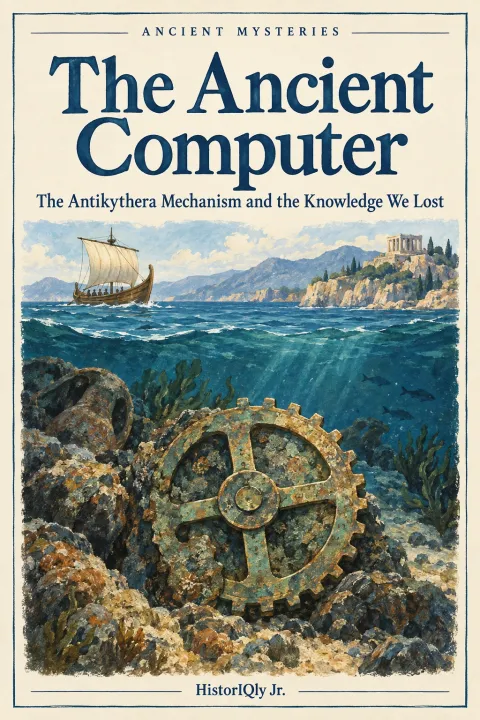
The Ancient Computer
The Antikythera Mechanism and the Knowledge We Lost
In 1901, sponge divers off the coast of a tiny Greek island hauled up the corroded remains of something nobody could explain. Hidden inside a lump of green bronze were dozens of interlocking gears — precise, deliberate, and two thousand years old.
Its gears and inscriptions reveal astronomical calculations, including eclipse cycles and lunar motion. Reconstructions explore missing parts of the display; they must distinguish surviving evidence from proposed components.
The surviving instrument reveals sophisticated ancient mechanical astronomy. Its maker and complete design are uncertain; missing later examples do not prove that every associated skill disappeared.
~150 BC
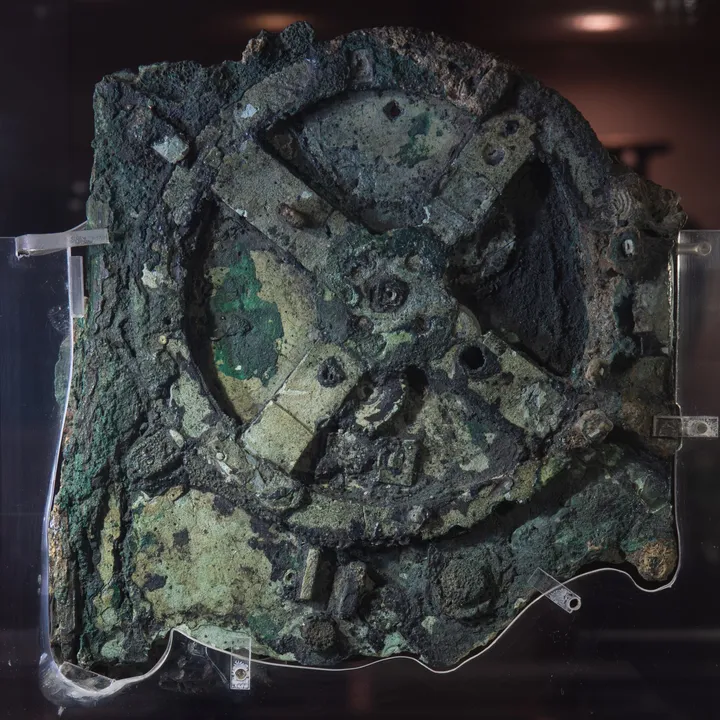
The surviving fragments contain about thirty bronze gears. Their tooth counts and arrangement help researchers reconstruct astronomical calculations.
30 survive
Complete models include proposed missing components; their total gear counts depend on the reconstruction.
82 pieces
Surviving fragments preserve parts of a sophisticated ancient astronomical instrument.
2005 Scans
New imaging revealed hidden inscriptions and mechanical details, allowing earlier models to be tested.
The Evidence

Precision Bronze Gears
An imagined examination of corroded fragments. Recognising gear teeth helped reveal that this was a machine; the scene is not a record of Stais’s exact actions.
Around thirty gears survive. The relationship between their tooth counts helps explain how linked wheels could model astronomical cycles.
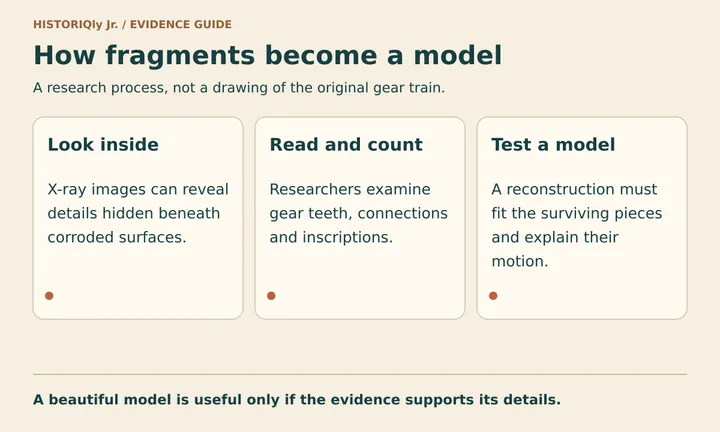
Reading Hidden Evidence
A guide to reconstruction. Count teeth in documented scans or photographs, not in an artist’s invented gear train.
CT scanning in 2005 revealed ancient Greek text buried under layers of corrosion — instructions describing the movements of the sun, moon, and all five planets known in antiquity.
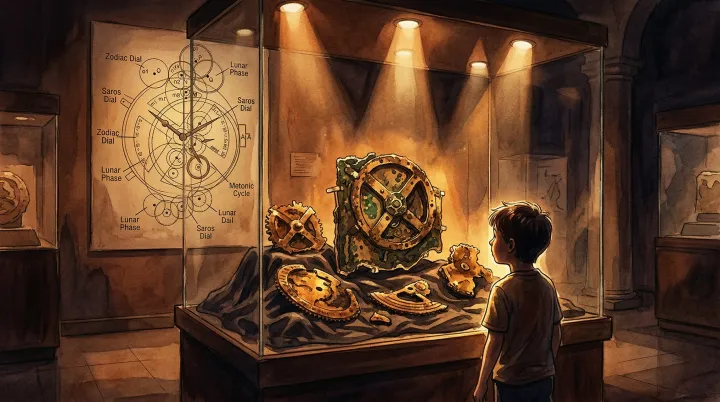
Reconstructing a Bronze Computer
A child explores an imagined museum display. Compare a reconstruction with documented fragments: which parts survive, and which parts has a model-maker supplied?
Reconstructions explain eclipse prediction and lunar phases, while inscriptions offer clues to planetary and games displays. Different features have different amounts of surviving mechanical evidence.
How the Mystery Unfolded
The Device Is Built
Somewhere in the Greek world — possibly Corinth, Rhodes, or Syracuse — a craftsman builds a bronze mechanism containing dozens of precision gears that can model the cosmos.
The Shipwreck
A cargo ship carrying valuable objects sinks near Antikythera. The mechanism is preserved among the wreck’s remains; its presence does not by itself tell us how the cargo was acquired.
The Discovery
Sponge diver Elias Stadiatis finds the wreck. His captain, Dimitrios Kondos, confirms the find. The Greek navy begins a dangerous salvage expedition.
The Gears Are Found
Gear teeth noticed in 1902 helped launch investigations into the damaged object. Early researchers debated its purpose before later imaging revealed more.
Gears from the Greeks
Derek de Solla Price uses X-ray evidence to develop an astronomical interpretation. Later imaging and research revise parts of his reconstruction.
CT Scanning Breakthrough
The research project uses CT scanning to reveal hidden gear details and inscriptions, advancing the explanation of astronomical functions.
The People in This Story
Valerios Stais
The archaeologist who first spotted gear wheels inside a corroded lump of bronze in 1902. His observation helped launch a long investigation into the fragmentary machine.
Derek de Solla Price
A British physicist at Yale who spent decades proving the mechanism was an astronomical computer. He published the landmark study "Gears from the Greeks" in 1974.
Tony Freeth
A Cambridge-trained mathematician who led the 2005 CT scanning project and proposed a reconstruction of the mechanism’s front display in 2021.
.webp)
The Question That Remains
The bronze instrument combines astronomical calculations with skilled metalwork. A surviving fragment tells us something different from a complete modern reconstruction.
Choose one feature of a reconstruction. Which surviving clue supports it, and which part would need more evidence?
Read the full book to investigate the key clues and competing explanations — then decide for yourself.
Get the Full Book
The complete Antikythera Mechanism mystery. 9 chapters following the fragments, researchers and tests behind the reconstructions.
Part of the Ancient Mysteries Volume
Desert drawings, undeciphered writing, and ingenious ancient machines. Discover what the evidence explains — and which questions remain open.
See all books in this volume →Keep investigating
Check the evidence
What the evidence supports
Surviving gears and inscriptions show that the mechanism modelled astronomical cycles.
Where to be careful
UCL’s 2021 reconstruction is a proposed model constrained by incomplete remains. It does not recover every missing part with certainty.
Explore the sources
These selected sources support this guide and offer further reading. Some are written for adults; explore them with a parent or teacher.
- UCL: A mechanical cosmos for the ancient computer
- Antikythera Research Project: Early research history
- National Archaeological Museum: research history
The story and illustrations are modern retellings. Imagined scene details are not historical evidence. These sources are a starting point, not citations for every narrative detail.
Evidence guide reviewed 8 September 2026.