
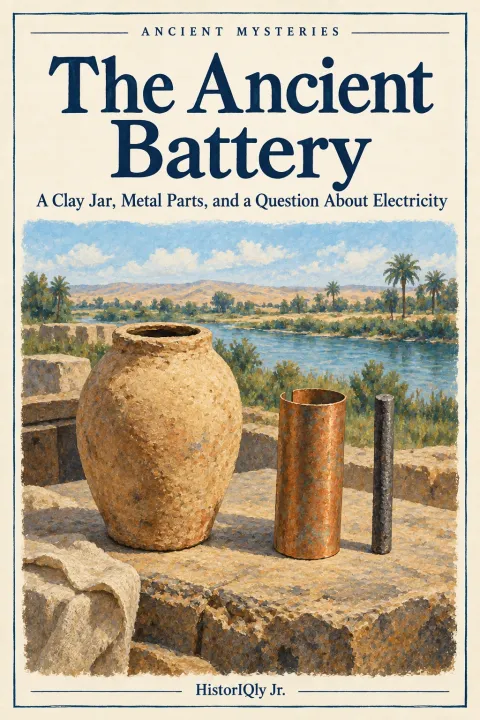
The Ancient Battery
A Clay Jar, Metal Parts, and a Question About Electricity
In 1938, Wilhelm König proposed that an ancient clay jar containing copper, iron and an asphalt seal might have served as a battery. The components are observations; their proposed electrical purpose is a separate claim.
Some replicas produce electricity when assembled and filled for that purpose. Archaeological evidence still has to establish how the ancient object was used. Reports link its disappearance with the Iraq Museum’s 2003 looting; this account does not verify its present location.
Nobody has ever settled what these jars were for. The debate has lasted over eighty years — and it is not over.
Ancient
The jar has been assigned an ancient date, but its precise context and age require care. Its metal components prompted the battery hypothesis. Comparisons with containers from other sites offer alternatives.
1.5–2 volts
Reported output from some replicas; results depend on their materials and test conditions.
1800 CE
Volta’s documented invention provides a comparison; the ancient jar’s use remains unproved.
Lost
Reported missing following the Iraq Museum’s 2003 looting; present whereabouts are not verified here.
The Evidence
The Reported Components
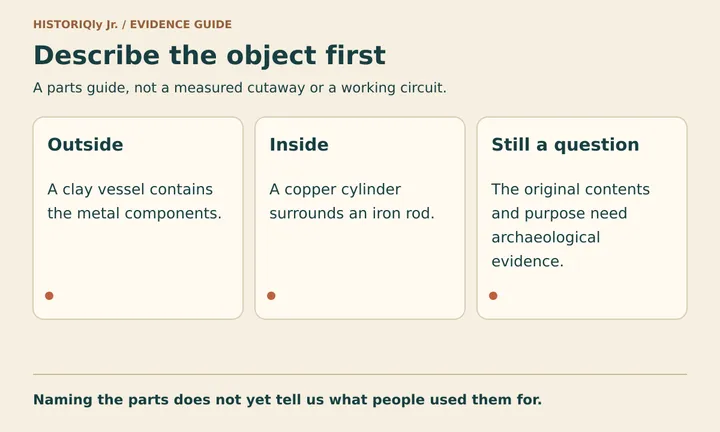
The reported components, separated for clarity. No liquid, wire or circuit has been added to make the ancient object look like a working battery.
A clay jar containing a copper cylinder, an iron rod, and an asphalt plug — matching the basic structure of an electrochemical cell. The iron rod sits inside the copper tube without touching it. The gap between them is the key.
What a Replica Can Show
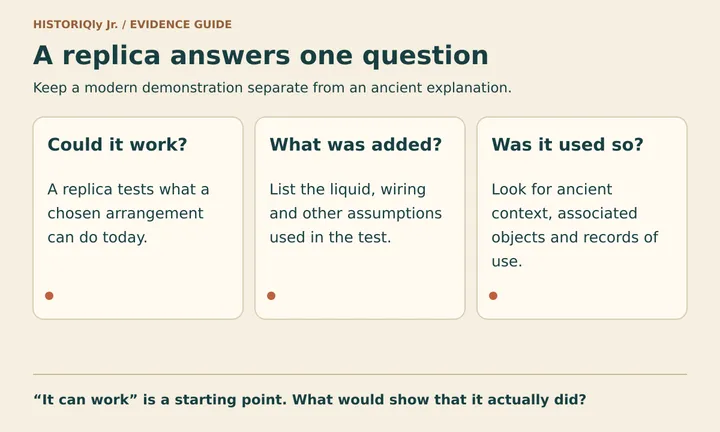
A guide comparing experimental and archaeological questions.
Researchers have built replicas that generate small voltages when supplied with suitable liquid. Results depend on the replica and test conditions. Demonstrating an electrical arrangement does not establish ancient electrical use.
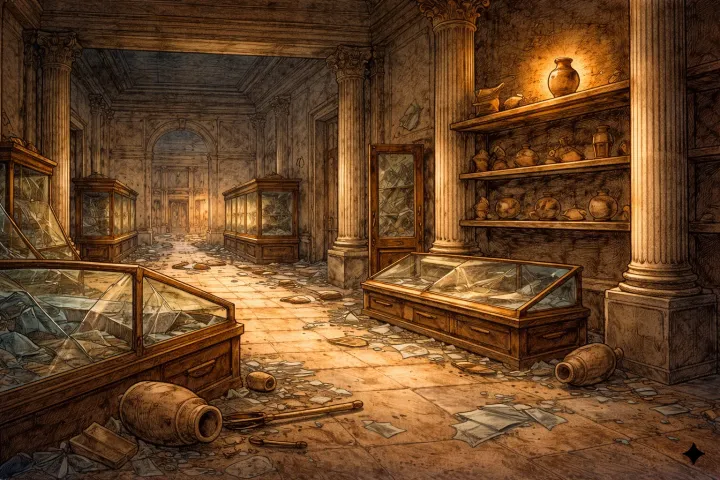
Reported Missing
An imagined scene of museum damage. It illustrates the loss of access to objects and records; it is not a photograph or an inventory of what was taken in 2003.
The reported loss complicates further testing. Residue analysis and study of original materials could help, but this account does not establish which tests have already been performed or confirm the object’s current whereabouts.
How the Mystery Unfolded
The Jars Are Made
The jar is assigned to an ancient Iraqi context. Published accounts differ over aspects of its dating and discovery; no surviving record describes its assembly as a battery.
The Excavation
The object is associated in accounts with finds near Baghdad. Its excavation history should be checked against original records rather than reconstructed as a witnessed discovery scene.
König's Discovery
Wilhelm König examines the object and proposes that its components could form a simple battery. Recognising a possible arrangement is different from identifying an ancient use.
The Publication
König publishes his theory in Im verlorenen Paradies, arguing the jars were used for electroplating — coating objects with gold using electricity.
The First Replica
Willard F. M. Gray builds a replica to test an electrical arrangement. Its output depends on the materials, liquid and connections used.
Museum Looting
The Iraq Museum is looted in 2003, and the jar is reported among missing objects. Its present location is not verified here. A reported disappearance should not become a claim that recovery is impossible.
The People in This Story
Wilhelm König
An Austrian researcher working at the Iraq Museum who proposed an electrical interpretation in 1938. His hypothesis prompted later experiments and debate.
Willard F.M. Gray
An experimenter whose replica tested whether an arrangement of metal components and liquid could produce electricity. This tests chemistry, not the original jar’s historical purpose.
Dr. St John Simpson
A British Museum curator associated with the proposal that comparable vessels held scrolls or documents. Comparison offers an alternative to test; it does not settle the original jar’s use by itself.

The Question That Remains
A working replica establishes a possible use, not the original purpose. Connections, residues, comparable finds and excavation records would help distinguish the electrical claim from other explanations.
What evidence would show that the jar was actually used to generate electricity? Which alternative use best fits the surviving objects and records, and what would help test it?
Read the full book to investigate the key clues and competing explanations — then decide for yourself.
Get the Full Book
The complete Ancient Battery mystery. 9 chapters of evidence, theories, and a question only you can answer.
Part of the Ancient Mysteries Volume
Desert drawings, undeciphered writing, and ingenious ancient machines. Discover what the evidence explains — and which questions remain open.
See all books in this volume →Keep investigating
Check the evidence
What the evidence supports
The object combines a ceramic jar with metal components. Modern experiments explore whether a reconstruction can function as a cell.
Where to be careful
A working modern replica does not establish ancient electrical use. The original context and purpose must be investigated independently.
Explore the sources
These selected sources support this guide and offer further reading. Some are written for adults; explore them with a parent or teacher.
- Technical study: The Baghdad Battery—Myth or Reality?
- Bazes2026: experimental reconstruction and interpretation
- Smithsonian conservation abstract: comparable Mesopotamian finds
The story and illustrations are modern retellings. Imagined scene details are not historical evidence. These sources are a starting point, not citations for every narrative detail.
Evidence guide reviewed 8 September 2026.