
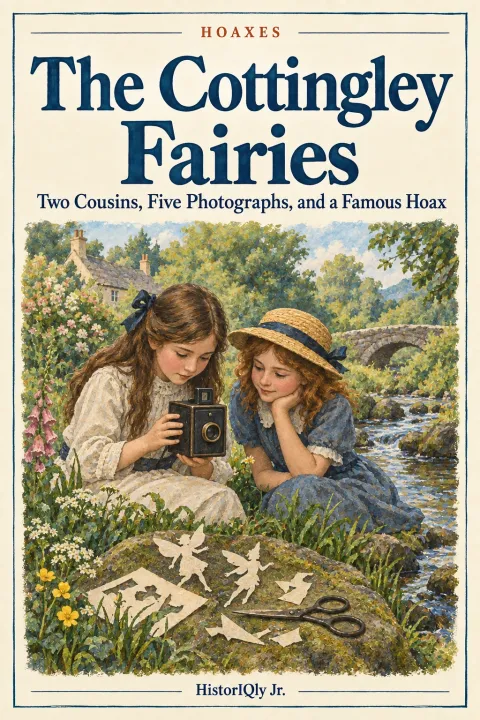
The Cottingley Fairies
Two Cousins, Five Photographs, and a Famous Hoax
Get the full EPUB
Drop your email and the EPUB downloads straight to your device. We’ll also ping you when the next case file lands — unsubscribe any time.
Your email is already on file — enjoy the read.
Download the EPUBIn the summer of 1917, two cousins borrowed a camera, went down to the bottom of their garden, and came back with a photograph of fairies. Real ones. Dancing by a stream.
Within three years, the most famous writer in England declared the photographs genuine. Millions believed. Scientists were baffled.
They were all wrong. And the truth stayed hidden for sixty-six years.
1917
Two cousins — Elsie Wright, 16, and Frances Griffiths, 9 — photograph "fairies" in their garden in Cottingley, Yorkshire. Their tool kit: paper cutouts, watercolour paints, and hatpins from a sewing box.
5
Five fairy photographs taken between 1917 and 1920.
Millions
Including Sir Arthur Conan Doyle, creator of Sherlock Holmes.
66 Years
Elsie and Frances did not confess until 1983.
The Evidence
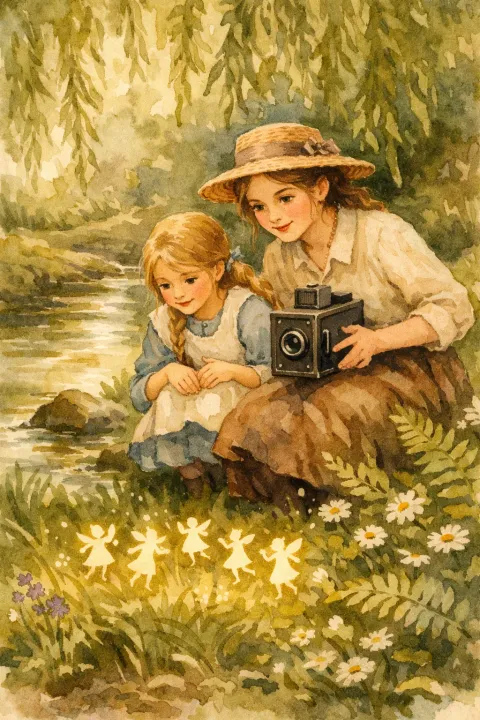
The Five Photographs
Two pictures were made in 1917 and three in 1920. Some examiners supported them; others suspected staging. A photograph without darkroom changes can still record paper props.
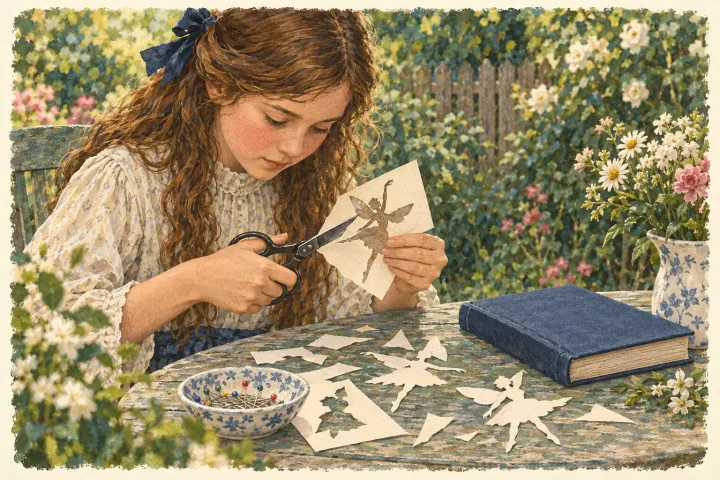
Making Paper Props
Paper, scissors and pins in an imagined crafting scene. The illustration shows a possible staging method; it does not reproduce the cousins’ original cutouts or source book.
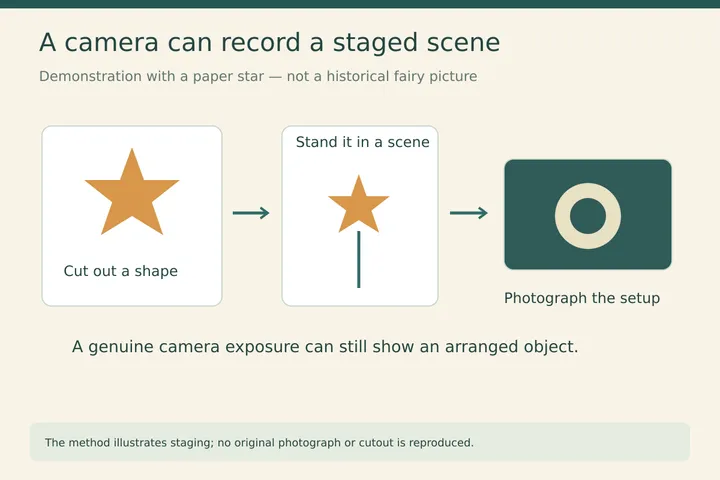
A camera can record a staged scene
Demonstration with a paper star — not a historical fairy picture. The method illustrates staging; no original photograph or cutout is reproduced.
How the Hoax Unfolded
The First Photograph
Elsie and Frances borrow Arthur Wright's camera and take the first fairy photograph at Cottingley Beck. Arthur develops the glass plate that evening and thinks it is a prank.
The Second Photograph
The girls take a second photograph showing Elsie with a winged gnome. Arthur refuses to lend the camera again. But Polly Wright begins to wonder.
The Meeting
Polly Wright mentions the photographs at a meeting about fairies. Word reaches Edward Gardner of the Theosophical Society — and then Sir Arthur Conan Doyle.
The Strand Magazine
Conan Doyle publishes the first photographs in The Strand Magazine. The cousins had taken three more that summer. His support brings the pictures to a wider audience.
The Book
Conan Doyle publishes The Coming of the Fairies. It sells thousands of copies. The girls say nothing.
The Confession
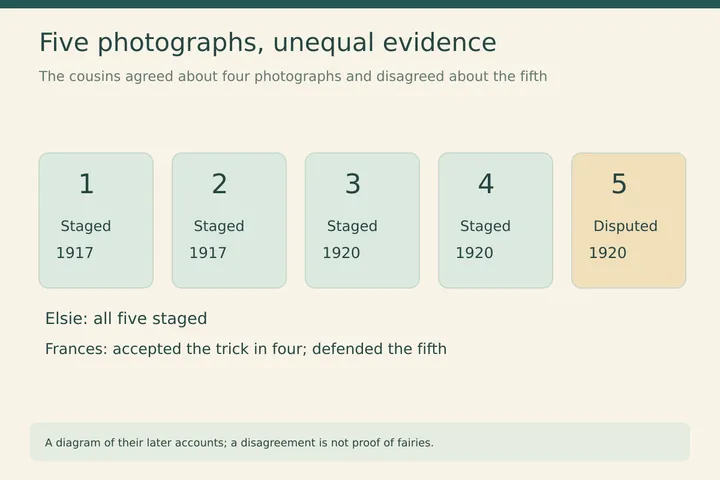
Now elderly women, both Elsie and Frances finally admit the truth: the fairies were paper cutouts. But Frances insists the fifth photograph was real — and never changes her mind.
The People in This Story
Elsie Wright
Aged 16 in 1917. Worked at a photography studio in Bradford. Drew the fairy cutouts, planned the photographs, and kept the secret for sixty-six years.
Frances Griffiths
Aged 9 in 1917. Said she saw real fairies by the stream. Admitted the first four photographs were faked — but insisted the fifth was genuine until her death in 1986.
Sir Arthur Conan Doyle
Creator of Sherlock Holmes — history's greatest fictional detective. He believed completely in the fairy photographs. The man who invented a character famous for seeing through lies was fooled by two children.
The Question That Remains
Elsie admitted everything. Frances admitted almost everything. But she insisted, until the day she died, that the fifth photograph showed real fairies.
Was she telling the truth? Had she believed her own story for so long that she could not tell the difference? Or could she simply not bear to say it was all a lie?
Read the full book to investigate the key clues and competing explanations — then decide for yourself.
FREE Get the Full Book
The complete Cottingley Fairies mystery. 9 chapters of evidence, theories, and a question only you can answer.
Part of the Hoaxes Volume
From fake fossils to trick photographs, we investigate the greatest hoaxes in history — and ask how clever people were fooled for so long.
See all books in this volume →Keep investigating
Check the evidence
What the evidence supports
Elsie Wright and Frances Griffiths made staged fairy photographs. Their later accounts explain the paper figures and pins.
Where to be careful
Frances continued to defend the fifth photograph. A personal belief does not establish that a photograph shows a real fairy.
Explore the sources
These selected sources support this guide and offer further reading. Some are written for adults; explore them with a parent or teacher.
The story and illustrations are modern retellings. Imagined scene details are not historical evidence. These sources are a starting point, not citations for every narrative detail.
Evidence guide reviewed 8 September 2026.