
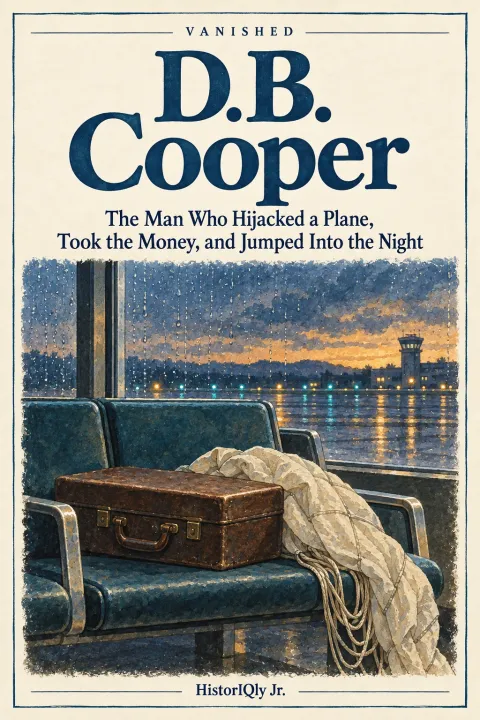
The Man Who Hijacked a Plane, Took the Money, and Jumped Into the Night
On the day before Thanksgiving, 1971, a man in a dark suit and sunglasses bought a one-way plane ticket from Portland to Seattle. He sat in the back row. He ordered a bourbon. Then he passed a note to the flight attendant.
The note said he had a bomb. He wanted $200,000 in cash, four parachutes, and a fuel truck waiting in Seattle. If he didn't get them, he would blow up the plane.
He got everything he asked for. He let the passengers go. Then, somewhere over the dark forests of the Pacific Northwest, he jumped out of the back of the plane and vanished forever.
Nobody has ever found him. Nobody knows who he really was. And he remains, to this day, an unresolved case in FBI history.
Nov 24, 1971
A man calling himself "Dan Cooper" — later misreported as "D.B. Cooper" — hijacked Northwest Orient Flight 305. With 36 passengers on board, he calmly negotiated his ransom from the back of a Boeing 727, then disappeared into a rainstorm at 10,000 feet.
$200,000
The bills’ serial numbers were recorded so recovered money could be identified.
10,000 ft
In the dark. In the rain. In a business suit and loafers, with no helmet.
45 Years
The FBI redirected resources in 2016 and preserved the evidence. His identity remains unresolved.
The Evidence
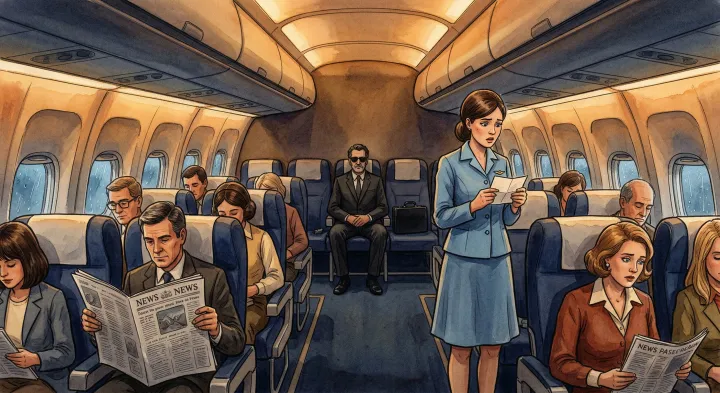
The Bomb Threat
Cooper handed Florence Schaffner a note announcing a bomb threat. She then carried dictated demands for money and parachutes to the pilots. The original note was not recovered.

The Tena Bar Discovery
An imagined riverbank scene around Brian Ingram’s 1980 discovery. The damaged banknotes are deliberately not pictured; their serial numbers linked them to the ransom.
On 10 February 1980 — more than eight years after the hijacking — an eight-year-old boy named Brian Ingram found money on the banks of the Columbia River: three bundles of rotting banknotes. The serial numbers matched Cooper's ransom exactly: $5,800 of the $200,000. The rest has never been found.
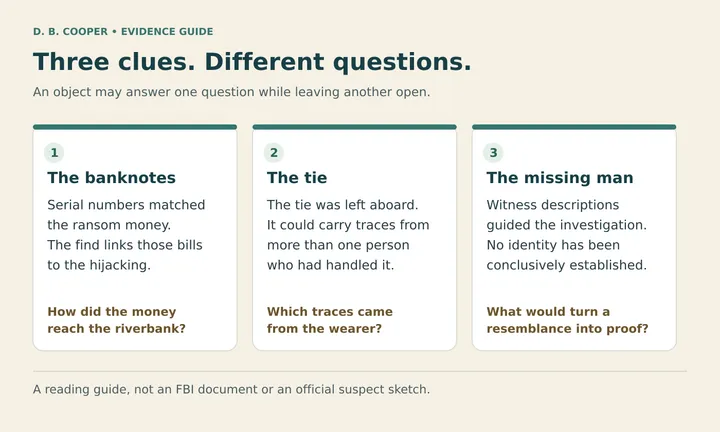
Different Kinds of Clue
The FBI made sketches from witness descriptions and investigated hundreds of suspects. Cooper knew useful details about the Boeing 727, but that does not establish his parachuting experience. No suspect has been conclusively identified.
How the Hijacking Unfolded
Boarding
A man using the name "Dan Cooper" buys a one-way ticket for $20 cash at Portland International Airport and boards Northwest Orient Flight 305. He takes seat 18C — the back of the plane. He orders a bourbon and soda.
The Note
Shortly after takeoff, Cooper passes his note to flight attendant Florence Schaffner. He shows her what appears to be a bomb in his briefcase: red cylinders, wires, a battery. He is completely calm.
The Handoff
The plane lands in Seattle. People on the ground arrange the exchange while the crew protect the passengers. FBI agents deliver the cash in a canvas bag — 10,000 unmarked twenty-dollar bills — along with four parachutes. Cooper releases all 36 passengers. Four crew members remain for the second flight.
The Jump
Somewhere over the dark, rainy forest between Seattle and Reno, Cooper lowers the rear stairs of the plane and jumps. The crew feel a bump. When the FBI boards the plane in Reno, he is gone — along with the money and two of the parachutes.
NORJAK
The FBI launches "NORJAK" — the Northwest Hijacking investigation. They search thousands of square miles of forest. They find nothing: no parachute, no body, no trace of the money. Not yet.
Tena Bar
Eight-year-old Brian Ingram finds $5,800 of the ransom money rotting on the banks of the Columbia River. The serial numbers match. Its journey to the riverbank remains uncertain. The discovery does not establish the landing site or prove whether Cooper survived.
Case Suspended
After 45 years and over 1,000 suspects investigated, the FBI officially suspends the active NORJAK investigation. Evidence is preserved and specific physical clues may still be reported. Cooper has never been definitively identified.
The People in This Story
D.B. Cooper
The alias used in press reports. His real name is still unknown. Witnesses described him as calm, polite, well-dressed, and knowledgeable about aircraft. His manner does not establish whether he had committed a similar crime before.
Florence Schaffner
The crew member who received Cooper's note and negotiated with him. She described his manner to investigators, helping them reconstruct the threat and his demands. Flight attendant Tina Mucklow remained aboard after Schaffner left in Seattle.
Ralph Himmelsbach
The lead FBI investigator who spent years hunting for Cooper. He believed Cooper almost certainly died in the jump — the forest below was dense, the weather was terrible, and a parachute landing in the dark without training is often fatal. He emphasised the danger of the crime and the jump.
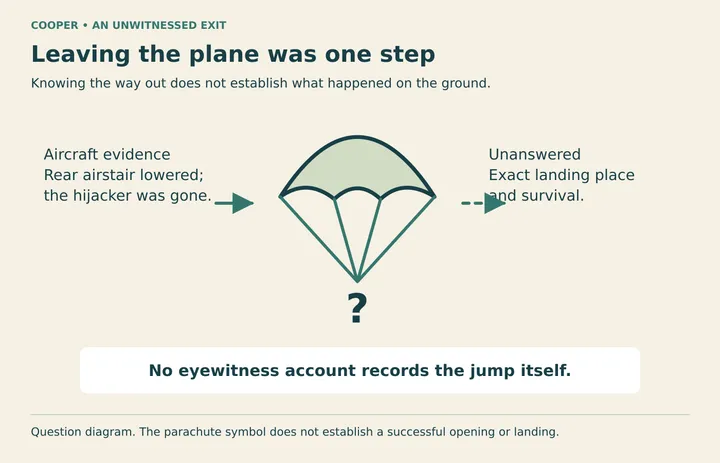
The Question That Remains
Did Cooper survive? He jumped at night over difficult terrain with unsuitable clothing. The parachute he apparently used was a non-steerable main parachute; he also took an unusable training reserve.
FBI investigators considered the jump extremely dangerous. The money on the riverbank adds a puzzle about where the bundles travelled, but does not prove either survival or death. No confirmed body or parachute has settled the question.
Read the full book to compare the key clues and explain what would settle his identity or survival.
Get the Full Book
The complete D.B. Cooper mystery. 9 chapters of evidence, suspects and questions to investigate.
Part of the Vanished Volume
Ships found empty at sea. Explorers who never came home. Settlements whose people moved on, leaving questions behind. The clues are still out there.
See all books in this volume →Keep investigating
Check the evidence
What the evidence supports
The hijacker obtained $200,000 and released 36 passengers. His exit location was estimated, and $5,800 was identified by serial numbers in 1980. The FBI redirected investigative resources in July 2016.
Where to be careful
His identity, landing and survival were not established. The money’s discovery site does not reveal its complete journey. Trace evidence must be linked to a source before it identifies a person.
Explore the sources
These selected sources support this guide and offer further reading. Some are written for adults; explore them with a parent or teacher.
- FBI: D.B. Cooper hijacking
- FBI: 2016 investigation update
- FAA history: Passenger screening changes, PDF pages 45–48
The story and illustrations are modern retellings. Imagined scene details are not historical evidence. These sources are a starting point, not citations for every narrative detail.
Evidence guide reviewed .