
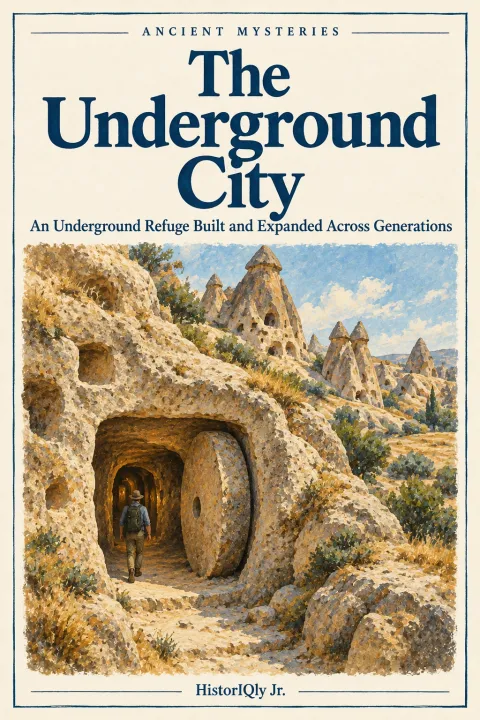
The Underground City
An Underground Refuge Built and Expanded Across Generations
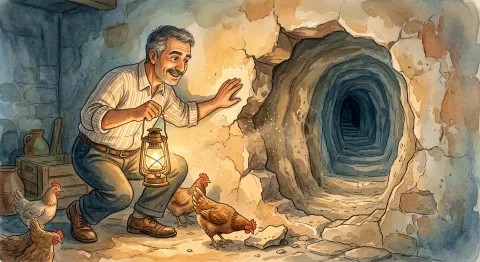
In 1963, a man in central Turkey knocked down his basement wall during a renovation. Behind it, he found a steep tunnel carved from solid rock — leading down into darkness. That tunnel opened into an underground city at least eight levels deep, with rolling stone doors, ventilation shafts, churches, schools, and stables.
It could hold twenty thousand people. It had been hidden beneath a quiet Turkish town for decades. And nobody could agree on who built it — or exactly when.
Derinkuyu was enlarged and reused over time. Its builders did not leave a dated plan, and assigning each level to a named people is uncertain. Only part of the complex is open to visitors.
Derinkuyu
An underground city in Cappadocia, Turkey, carved from volcanic tuff rock over thousands of years by multiple civilisations. Rediscovered in 1963 when a man broke through his basement wall and found a tunnel that led 85 metres underground.
85 metres
Eighteen storeys deep — taller than most buildings, but going down.
Estimated capacity
Large capacity figures are estimates; rooms, storage and water access show how refuge was possible.
Many entrances
Concealed behind bushes, in courtyards, and inside people's homes.
The Evidence
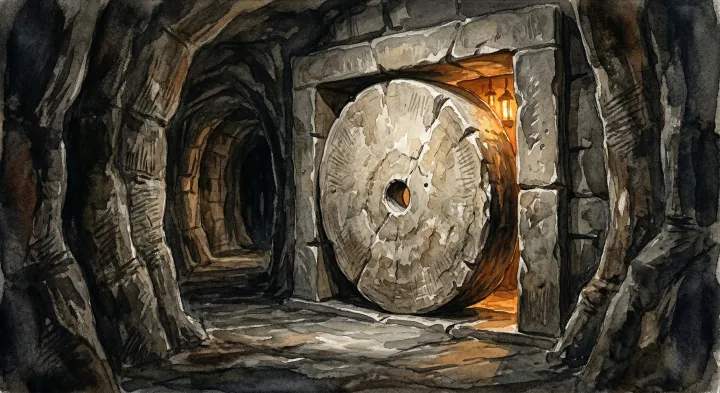
The Rolling Stone Doors
An illustrated rolling stone door. The central opening is visible, but the picture alone cannot tell us every way it was used or how much the stone weighed.
Circular discs of rock weighing up to 500 kilograms — openable only from the inside. Each floor could be sealed independently. Small holes allowed defenders to thrust spears at attackers while keeping the door shut.
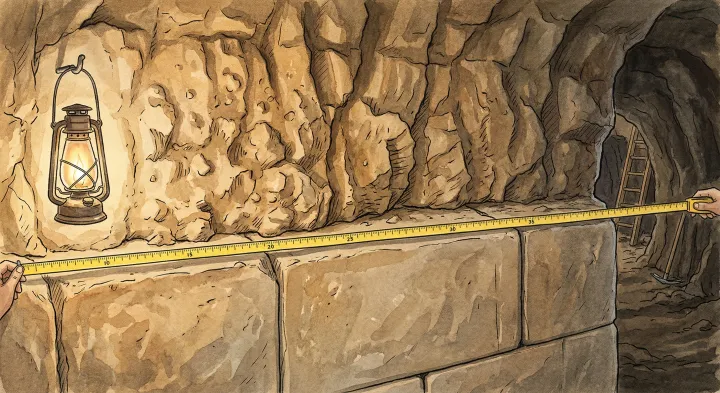
Investigating Construction Layers
An imagined survey of a rock surface. Different marks can prompt questions about tools and alterations, but this drawing supplies neither measurements nor a dated building sequence.
Rooms, passages and religious spaces reflect repeated use and enlargement. Carving style alone cannot assign every level to a named civilisation or a precise century.
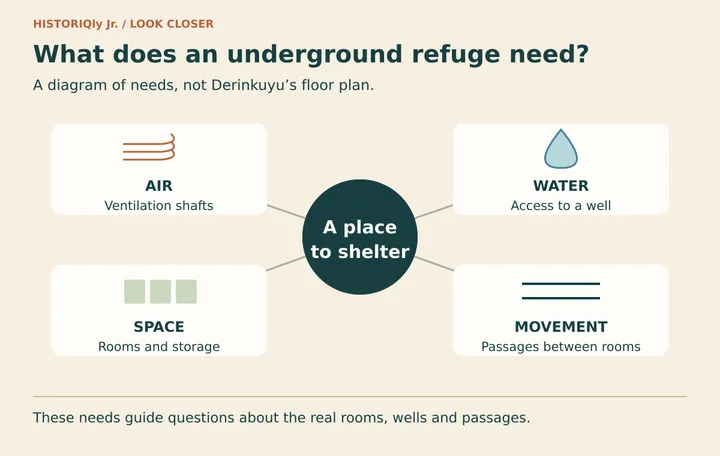
The Underground Network
Air, water, space and movement: four needs of an underground refuge. The diagram connects questions to ask about Derinkuyu, rather than inventing a plan of its levels.
Shafts and passages helped make underground occupation possible. Their extent and proposed connections require surveys; a large network does not establish that every space was inhabited at once.
Three Thousand Years Underground
The Hittites Arrive
People in Cappadocia used workable volcanic rock for shelters and storage. Claims that a particular people began Derinkuyu at this date are uncertain.
The Phrygians Build
Iron Age construction has been proposed for early phases, but the exact starting date and builders remain debated.
Xenophon's Account
Xenophon described underground homes in Armenia after his journey in 401–400 BCE. This is useful comparison evidence, not a description of Derinkuyu.
Christians Expand
Christian communities used and altered underground spaces. Religious features provide evidence of use without identifying the date of every earlier excavation.
The Byzantine Fortress
Underground refuge was useful during periods of conflict. Christian spaces show later use, but do not date every passage or prove that a single expansion created the full complex.
The Population Exchange
The 1923 population exchange displaced Christian communities from the region. That disrupted local knowledge, but does not establish that every entrance was forgotten at once.
The Rediscovery
A man knocks down his basement wall and finds a tunnel leading to a vast underground city at least eight levels deep. Derinkuyu is rediscovered.
The People in This Story
Xenophon of Athens
A Greek soldier who described underground dwellings in Armenia, based on his journey in 401–400 BCE — over two thousand years before Derinkuyu was officially rediscovered.
Andrea De Giorgi
An archaeologist who discusses the region’s long history of rock-cut construction. Proposed Phrygian origins should not be treated as an agreed date for Derinkuyu’s deeper levels.
Richard MacGillivray Dawkins
The linguist Richard MacGillivray Dawkins recorded sheltering at Axo in Cappadocia in 1909. This is evidence from another settlement, not an eyewitness account of Derinkuyu.
The Question That Remains
The city’s many phases make a single-builder answer unlikely. Its later religious spaces provide evidence of Christian use, while the date of its earliest excavation remains uncertain.
Who truly built Derinkuyu — and when a mystery has been carved into by so many hands over so many centuries, is it even possible to give a single answer?
Read the full book to investigate the key clues and competing explanations — then decide for yourself.
Get the Full Book
The complete Derinkuyu mystery. 9 chapters of evidence, theories, and a question only you can answer.
Part of the Ancient Mysteries Volume
Desert drawings, undeciphered writing, and ingenious ancient machines. Discover what the evidence explains — and which questions remain open.
See all books in this volume →Keep investigating
Check the evidence
What the evidence supports
Derinkuyu contains many underground levels with rooms for shelter, storage, worship and other needs.
Where to be careful
Its development involved more than a single building event. Popular population capacities are estimates, not an ancient census.
Explore the sources
These selected sources support this guide and offer further reading. Some are written for adults; explore them with a parent or teacher.
- Türkiye Ministry of Culture and Tourism: Derinkuyu
- Turkish Ministry of Culture: Derinkuyu description and dating
The story and illustrations are modern retellings. Imagined scene details are not historical evidence. These sources are a starting point, not citations for every narrative detail.
Evidence guide reviewed 8 September 2026.