
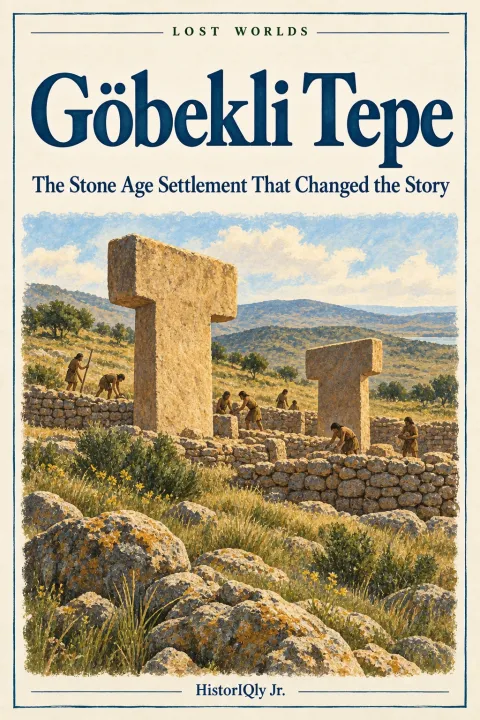
Göbekli Tepe
The Stone Age Settlement That Changed the Story
In 1994, Klaus Schmidt investigated a hill in southeastern Turkey where an earlier survey had recognised prehistoric material. Excavation revealed monumental buildings and raised new questions about settlement, ceremony and farming.
Massive T-shaped stone pillars, carved with foxes, vultures, and scorpions, arranged in circles — built over 12,000 years ago during the early Neolithic, as ways of life were changing.
It is an early monumental settlement. How did daily life and ceremony fit together?
12,000 Years Old
Göbekli Tepe was built around 9600 BCE by hunter-gatherers — roughly 6,000 years before Stonehenge and 7,000 years before the Egyptian pyramids. It is among the earliest known places with monumental stone buildings.
5.5 metres
The central pair in Enclosure D weigh about 8–10 tonnes each — shaped with stone tools.
<5 %
Surveys suggest additional buried buildings; only excavation can establish their full form and history.
2018
Recognised as a World Heritage Site of outstanding universal value.
The Evidence
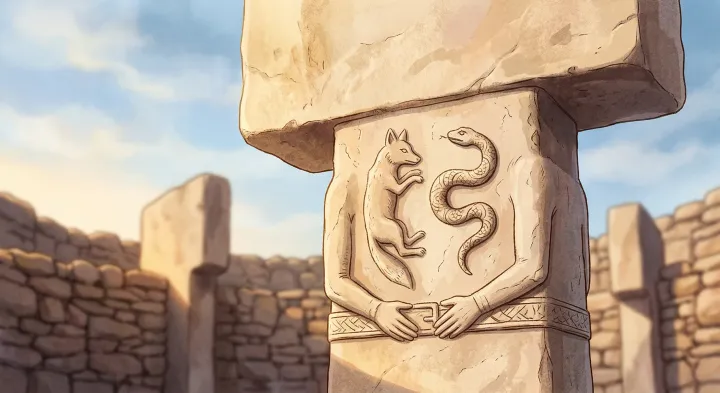
T-shaped Pillars
Illustration — a composite T-shaped pillar with imagined arrangements of animal and human features. It is not a copy of an excavated pillar, and its marks cannot be used to interpret any actual carving.
Excavated limestone pillars carved into a distinctive T shape — believed to represent stylised human figures. Many have arms and hands carved into their sides. Decorated with foxes, snakes, vultures, scorpions, and other animals.
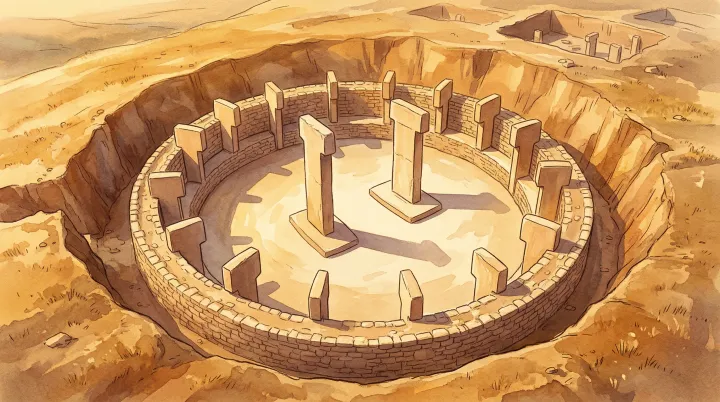
Circular Structures
Multiple circular enclosures with rings of pillars set into stone walls, two larger pillars standing at each centre. Later research also documents domestic activity, changing the older view of a temple with no settlement.
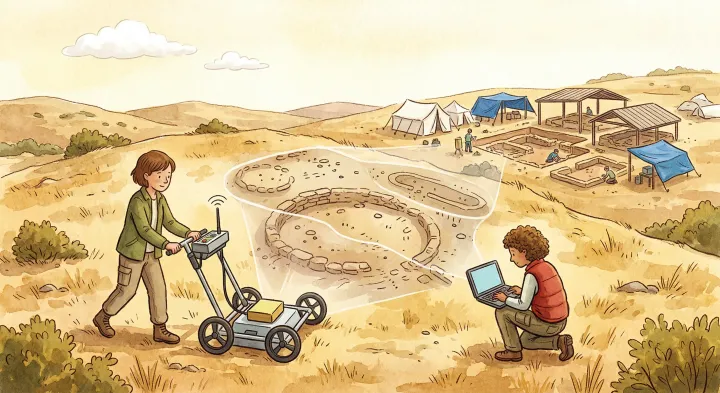
Deliberately Buried
Buildings filled with rubble and sediment over time. Researchers investigate deliberate infilling alongside collapse and other processes. The site should not be pictured as one entire complex buried in a single mysterious operation.
12,000 Years in the Making
Construction Begins
Hunter-gatherers begin building the first circular enclosures at Göbekli Tepe. The oldest structures — Layer III — are the largest and most elaborate, with the finest carvings.
Deliberately Buried
After more than a thousand years of use, the entire complex is systematically filled with earth and rubble. The site disappears under a hill of debris. Nobody knows why.
First Survey
A joint Istanbul–Chicago survey records prehistoric material at the hill. Its monumental buildings are not yet understood.
Schmidt's Discovery
German archaeologist Klaus Schmidt visits the site and immediately recognises the carved fragments as Neolithic. He begins planning a full excavation.
Schmidt Dies
Klaus Schmidt dies near Şanlıurfa aged 61. He spent twenty years excavating the site. Less than 5% has been uncovered. Lee Clare continues the work.
UNESCO World Heritage
Göbekli Tepe is officially recognised as a World Heritage Site — one of the most important places on Earth. Excavation continues.
The People in This Story
Klaus Schmidt
German archaeologist (1953–2014) who recognised Göbekli Tepe as a prehistoric site in 1994 and spent twenty years excavating it. He proposed the revolutionary idea that temple-building came before farming.
Peter Benedict
Researcher involved in the 1963 survey that recorded Neolithic material at Göbekli Tepe. Excavation decades later revealed the scale of the buildings.
Lee Clare
Archaeologist with the German Archaeological Institute who took over the excavation after Schmidt's death in 2014. Under his leadership, new technologies continue to reveal surprises beneath the hill.
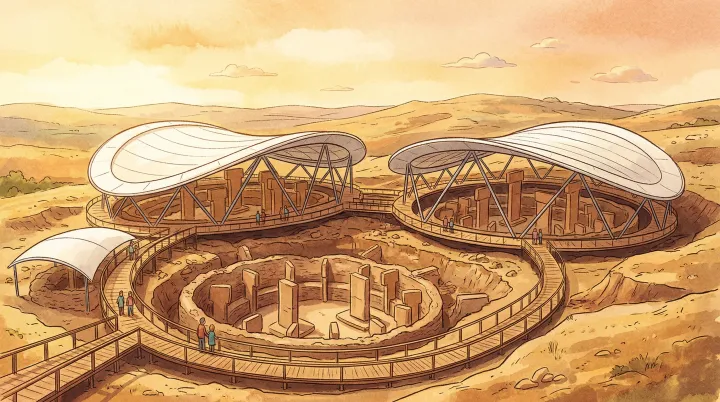
The Question That Remains
Hunter-gatherers built an exceptionally early monumental site. They carved enormous pillars with stone tools and decorated them with mysterious animals. They kept building for over a thousand years.
The buildings changed, fell out of use and became filled. Which traces reveal daily life, ceremonies or natural collapse?
Read the full book to investigate the key clues and competing explanations — then decide for yourself.
Get the Full Book
The complete Göbekli Tepe mystery. 9 chapters of evidence, theories, and a question only you can answer.
Part of the Lost Worlds Volume
Ancient cities, remarkable structures, and the communities who built them. Explore the evidence and the living histories behind the ruins.
See all books in this volume →Keep investigating
Check the evidence
What the evidence supports
Göbekli Tepe contains monumental buildings from the early Neolithic. Excavation also provides evidence for domestic life.
Where to be careful
The research team now interprets it as a settlement with a strong ritual component. “Temple only, with nobody living there” is an outdated certainty.
Explore the sources
These selected sources support this guide and offer further reading. Some are written for adults; explore them with a parent or teacher.
- German Archaeological Institute: Tepe Telegrams research updates
- Research paper: Context and formation of the building fill
The story and illustrations are modern retellings. Imagined scene details are not historical evidence. These sources are a starting point, not citations for every narrative detail.
Evidence guide reviewed 8 September 2026.