
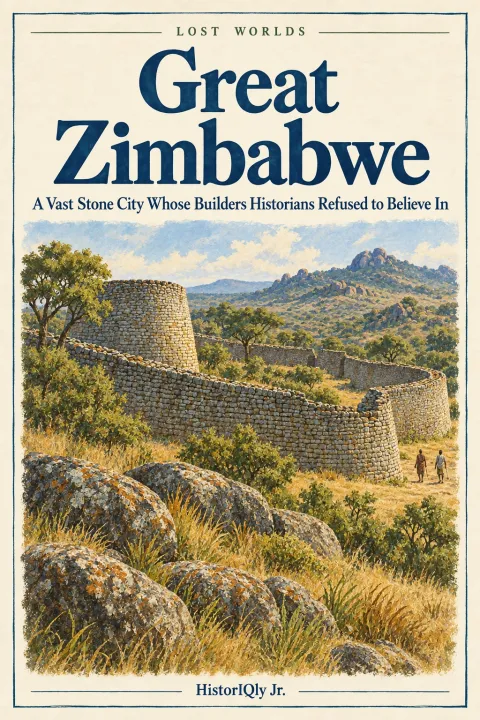
Great Zimbabwe
A Vast Stone City Whose Builders Historians Refused to Believe In
In 1871, a German explorer stumbled upon the ruins of a vast stone city in the heart of southern Africa. Walls eleven metres high, built from carefully fitted granite blocks without a single drop of mortar. A conical tower rising ten metres into the sky. The remains of a civilisation that may once have housed many thousands of people.
He looked at the evidence — and decided that Black Africans could not possibly have built it. For the next century, colonists, politicians, and even governments would fight to suppress the truth.
The evidence was there all along. The question was whether people had the courage to see it.
~1100 AD
Construction began around 1100 AD by ancestors of the Shona people. The city grew for over three centuries into the largest stone structure in sub-Saharan Africa — the capital of a gold-trading empire.
11 metres
Taller than a three-storey building. Built without mortar — every block held in place by weight and precision.
18,000 people
One estimate of its peak population; the number is uncertain.
100+ years
From Mauch's false claims in 1871 to Zimbabwean independence in 1980.
The Evidence
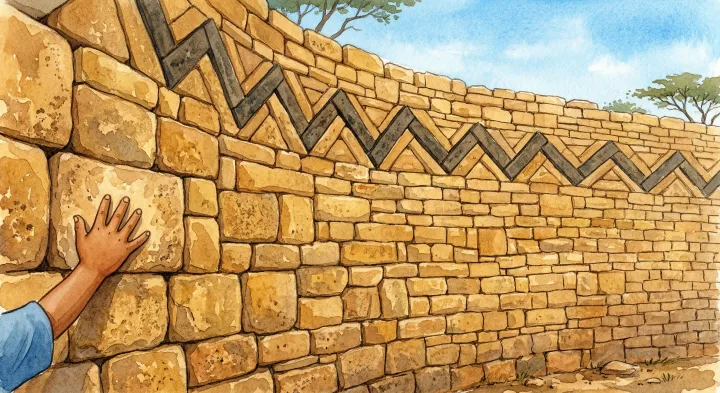
Dry-Stone Masonry
Illustration — an invented wall detail inspired by chevron patterns. It is not a masonry record of the Great Enclosure. Compare real photographs and measured drawings when studying the builders’ stone arrangements.
Granite blocks fitted without mortar form distinctive curved walls. Related building traditions appear at other sites in the region. Dating, pottery and local construction patterns identify the builders more reliably than resemblance to a distant monument.
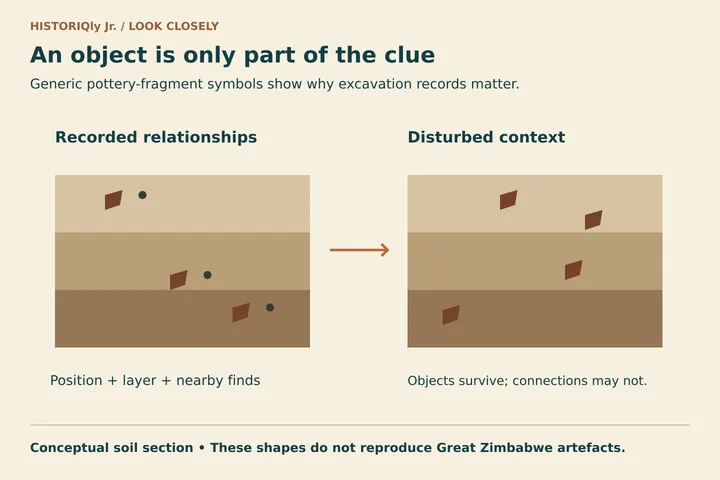
More Than an Object
Generic pottery fragments show why recording layers matters. Treasure hunting can keep an object while destroying the evidence of where it lay and what surrounded it. These symbols are not actual finds.
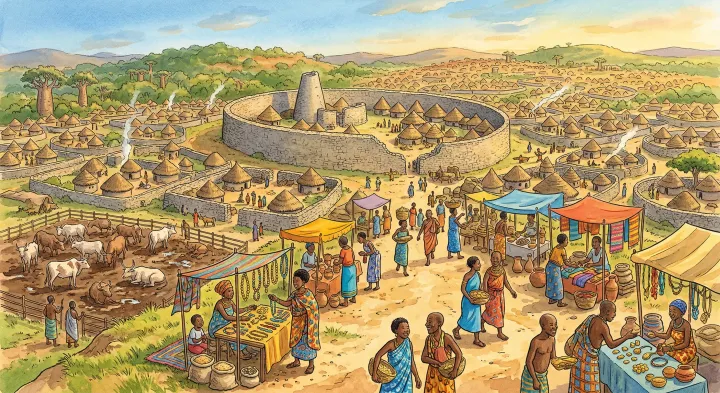
An International Trading Hub
Chinese Ming Dynasty porcelain, Persian glass beads, and coins from Kilwa — found alongside local Shona pottery. The imported goods prove trade, not foreign builders. Imported objects show connections; they do not identify the builders.
A City Built, Denied, and Reclaimed
Construction Begins
Ancestors of the Shona people begin building stone enclosures on the Zimbabwe plateau. The Hill Complex — probably a royal residence — is the first major structure.
The City's Peak
Great Zimbabwe reaches its height, with a population estimated in the thousands, a thriving gold trade, and connections to ports across the Indian Ocean. The Great Enclosure — with walls 250 metres around and 11 metres high — is completed.
Abandonment
The city is gradually abandoned. Environmental pressure, shifting trade routes, and political fragmentation likely all play a role. Successor states emerge at Khami and Mutapa.
Mauch Arrives
German geologist Karl Mauch becomes the first European to document the ruins. He immediately claims they were built by Phoenicians or the Queen of Sheba — ignoring all evidence to the contrary.
Randall-MacIver's Proof
Archaeologist David Randall-MacIver proves the ruins are medieval and African. The settler community rejects his findings.
Caton-Thompson Confirms
Gertrude Caton-Thompson's meticulous excavation confirms African origin beyond any doubt. Some audience members walk out during her presentation.
The Rhodesian Cover-Up
The white minority government censors museum displays and punishes archaeologists who state the truth. Peter Garlake is forced to leave the country.
Zimbabwe Is Born
The country gains independence and renames itself Zimbabwe — "houses of stone." The soapstone birds are returned and become the national emblem.
The People in This Story
Karl Mauch
German geologist who documented Great Zimbabwe in 1871. He refused to believe Africans had built it and attributed the ruins to Phoenicians or the Queen of Sheba — setting the tone for a century of denial.
Gertrude Caton-Thompson
In 1929, she proved conclusively that Great Zimbabwe was built by African people. Her meticulous excavation settled the scientific debate — even as settlers refused to accept it. She lived to ninety-seven and never changed her conclusion.
Peter Garlake
Archaeologist who published the definitive study of Great Zimbabwe in 1973. The Rhodesian government forced him to leave the country for telling the truth. His book was banned — but it was never disproved.
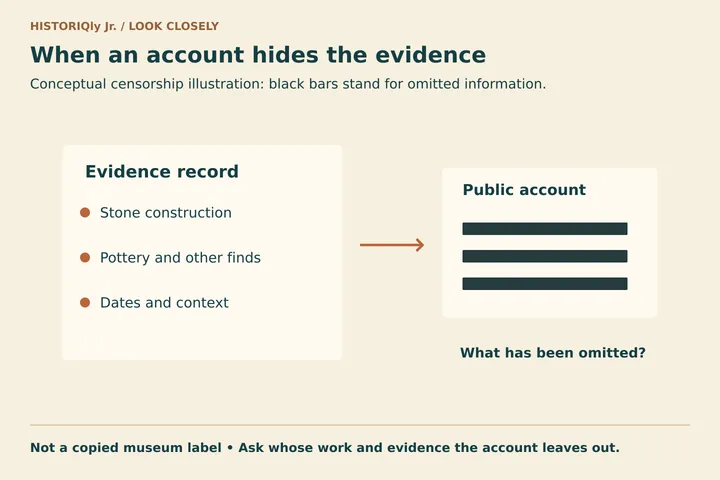
The Question That Remains
The builders of Great Zimbabwe are no longer a mystery. The Shona people built a major centre of regional power and long-distance trade. The evidence was always there.
But why was a vast civilisation abandoned around 1450? Environmental collapse? Shifting trade? Political upheaval? And what does the century-long denial teach us about how prejudice shapes what people are willing to believe?
Read the full book to investigate the key clues and competing explanations — then decide for yourself.
Get the Full Book
The complete Great Zimbabwe mystery. 9 chapters of evidence, theories, and a question only you can answer.
Part of the Lost Worlds Volume
Ancient cities, remarkable structures, and the communities who built them. Explore the evidence and the living histories behind the ruins.
See all books in this volume →Keep investigating
Check the evidence
What the evidence supports
Great Zimbabwe was built by African communities ancestral to the Shona. Its buildings and trade goods record a major regional centre.
Where to be careful
Foreign trade goods show contact; they do not mean foreigners built the city. Colonial denial of African authorship was not an equally supported theory.
Explore the sources
These selected sources support this guide and offer further reading. Some are written for adults; explore them with a parent or teacher.
The story and illustrations are modern retellings. Imagined scene details are not historical evidence. These sources are a starting point, not citations for every narrative detail.
Evidence guide reviewed 8 September 2026.