
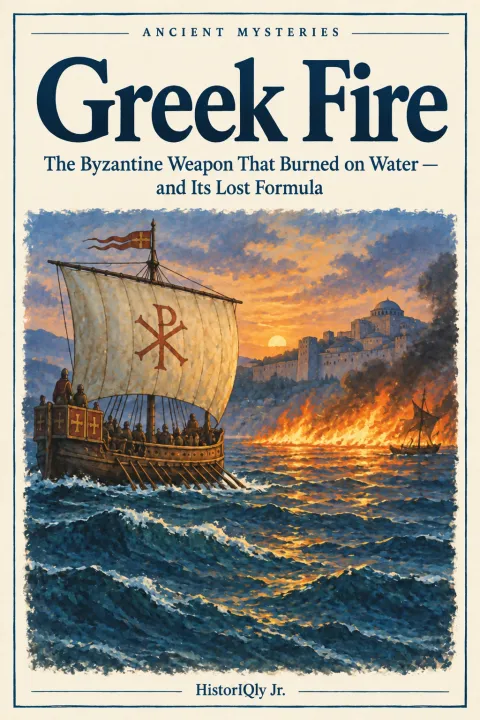
Greek Fire
The Byzantine Weapon That Burned on Water — and Its Lost Formula
Late-seventh-century accounts credit the Byzantine defenders of Constantinople with a projected incendiary often called Greek fire. A later chronicle connects it with Kallinikos, a refugee from Syria. The vivid story must be distinguished from details the sources cannot securely establish.
Greek fire contributed to Byzantine naval defence. Fortifications, supplies, weather and other forces also mattered. Imperial texts emphasise secrecy, but do not document one unchanged formula kept successfully secret for eight hundred years.
No complete, securely identified original formula and apparatus survive for comparison. Reconstructions test possible interpretations; they cannot be judged against five perfectly established properties.
678 AD
Theophanes’s later chronicle credits Kallinikos with sea fire. Historians examine that attribution alongside other sources, rather than treat it as a witnessed invention record.
Imperial secret
Texts demand secrecy; they do not prove exactly who knew each technique or how long it stayed secret.
717–718
A major siege in which Greek fire was one factor in the Byzantine defence; fleet and casualty totals require caution.
Modern tests
Reconstructions explore plausible mechanisms, but the historical benchmark is incomplete.
The Evidence
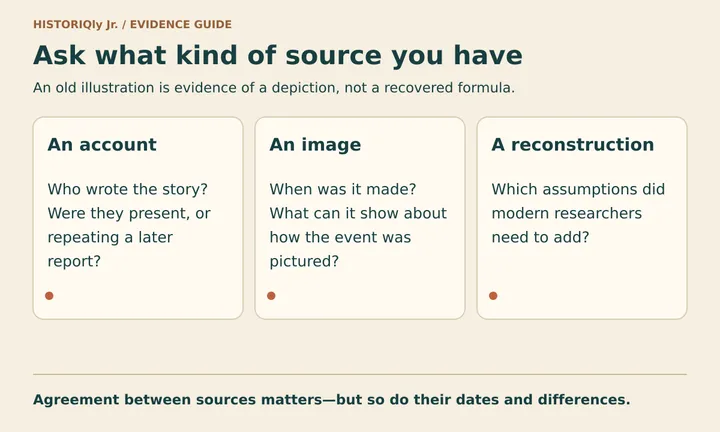
Reading the Madrid Skylitzes
An explanatory source-reading guide, not a page of the Madrid Skylitzes.
A twelfth-century manuscript shows a ship projecting fire toward another vessel. It is a valuable visual source, but the illustration was made long after the earliest reported uses and is not a complete engineering drawing.
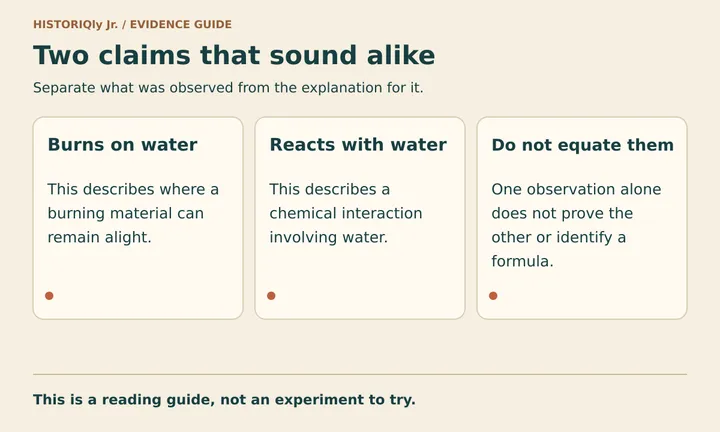
Interpreting the Accounts
The difference between burning on water and reacting with water. Neither phrase by itself identifies the historical mixture.
Historians compare descriptions of burning liquid, projection equipment and imperial secrecy. Before proposing a material, they must ask whether an account reports an observed effect or a later explanation.

Modern Recreations
An imagined modern investigation. Researchers must first decide which reported properties the historical sources actually support. A reconstruction tests those interpretations; it does not provide a recovered Byzantine formula.
John Haldon, Maurice Byrne and others have investigated possible reconstructions. A working modern device can test feasibility, but cannot prove that it duplicates the historical weapon’s mixture or apparatus.
The Rise and Fall of Greek Fire
The Invention
A later chronicle credits Kallinikos, associated with Heliopolis in Syria, with sea fire. The account does not recover every workshop step or the words of an imperial meeting.
The First Siege
Accounts describe Byzantine resistance to Arab naval campaigns in the late seventh century. The familiar 674–678 siege narrative has been debated; Greek fire should not be presented as the only cause of the outcome.
The Second Siege
Arab forces besiege Constantinople in 717–718. Byzantine naval weapons contributed to the defence alongside fortifications, supply difficulties, weather and other military pressures.
The Warning
Constantine VII instructs his son to guard the secret and links it with a tradition of divine revelation. The instruction records imperial policy, not proof of how every workshop operated.
The Disappearance
References become harder to trace in later centuries. Changes in terminology, equipment and practice complicate attempts to identify when particular methods ceased to be used.
Fall of Constantinople
Constantinople falls to the Ottoman Turks. This date does not establish when the last knowledge of Greek fire disappeared; some methods may already have ceased to be used.
The People in This Story
Kallinikos of Heliopolis
A figure credited with sea fire in a later Byzantine chronicle. His exact contribution and the roles of other craftspeople are not fully documented.
Constantine IV
The emperor during the late-seventh-century campaigns associated with early use of Greek fire. The weapon contributed to defence, but no single invention explains the empire’s survival.
Anna Komnene
A Byzantine princess and historian whose Alexiad contains descriptions of incendiary warfare. Her text is evidence to interpret, not a complete technical manual for every weapon called Greek fire.
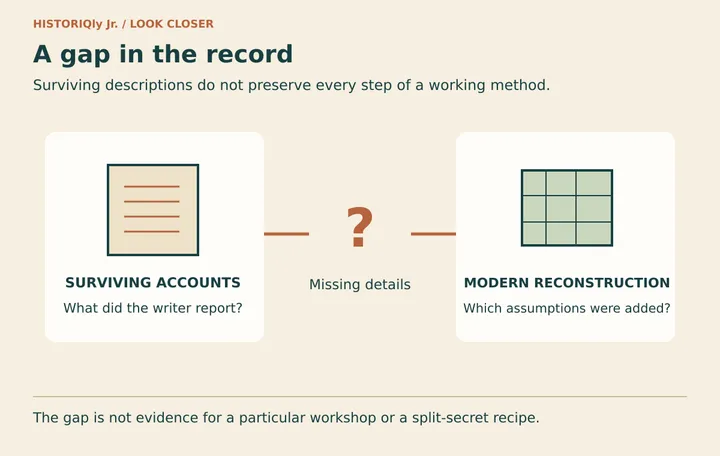
The Question That Remains
The surviving descriptions do not establish one exact recipe and apparatus. Their gaps limit reconstruction, while still leaving useful questions about observation, interpretation and secrecy.
Choose one claim in a historical account. Is it an observed effect, a proposed cause or an instruction to keep a secret? What other source would help test it?
Read the full book to investigate key accounts and interpretations — then decide for yourself.
Get the Full Book
Nine chapters following the accounts, proposed ingredients and practical limits of reconstructing Greek fire.
Part of the Ancient Mysteries Volume
Desert drawings, undeciphered writing, and ingenious ancient machines. Discover what the evidence explains — and which questions remain open.
See all books in this volume →Keep investigating
Check the evidence
What the evidence supports
Byzantine sources describe an incendiary weapon used especially in naval warfare. Accounts emphasise its burning on water.
Where to be careful
Burning on the surface is different from burning underwater. The precise historical mixture and delivery system remain uncertain.
Explore the sources
These selected sources support this guide and offer further reading. Some are written for adults; explore them with a parent or teacher.
The story and illustrations are modern retellings. Imagined scene details are not historical evidence. These sources are a starting point, not citations for every narrative detail.
Evidence guide reviewed 8 September 2026.