
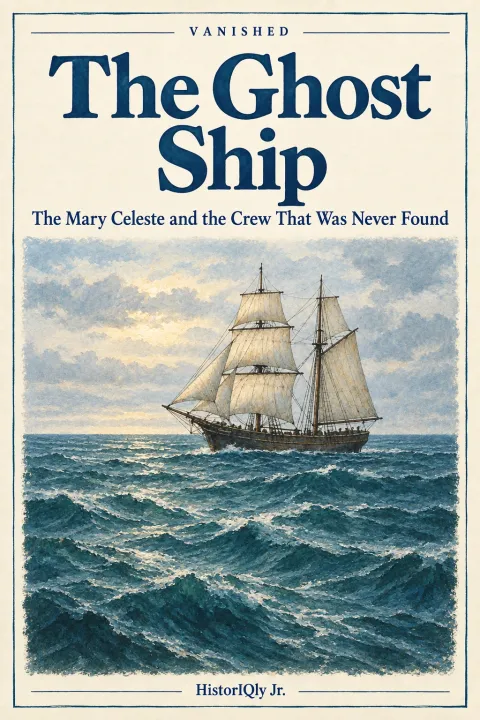
The Ghost Ship
The Mary Celeste and the Crew That Was Never Found
On 4 December 1872, Oliver Deveau boarded the deserted Mary Celeste. Some accounts use 5 December because of sea-time dating; these refer to the same discovery. Ten people had sailed aboard, and none was there.
The cargo was untouched. The food was intact. The crew's belongings were still in their bunks. The ship’s boat was missing. What happened after the people left remains unknown.
They were never found. And the mystery has never been solved.
1872
On November 7, 1872, Captain Benjamin Briggs sailed out of New York with his wife, two-year-old daughter, and a crew of seven. Their cargo: 1,701 barrels of industrial alcohol, bound for Genoa, Italy. Four weeks later, the ship was found drifting with no one on board.
10
Seven crew members, the captain, his wife Sarah, and their two-year-old daughter Sophia.
1,701
All intact. Not one barrel was stolen. Whatever happened, it wasn't pirates.
9 Days
Between the last log entry (Nov 25) and when the ship was found (Dec 4).
The Evidence
The Last Slate Entry
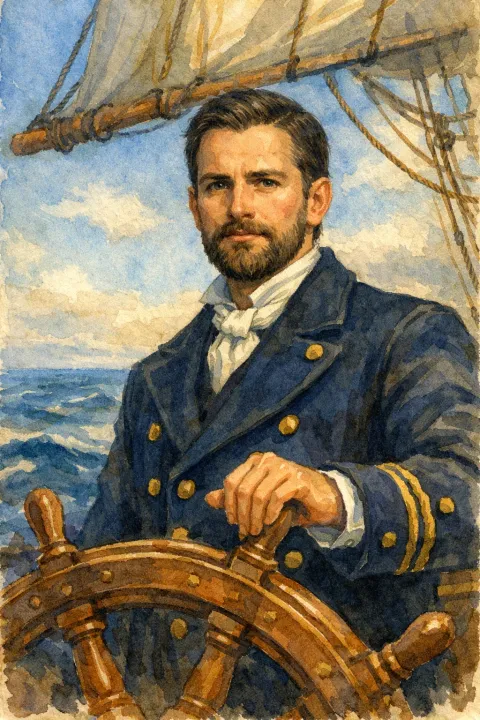
An imagined character illustration of Captain Benjamin Briggs, not an authenticated likeness or a record of his uniform. He was among the people who did not return from the voyage.
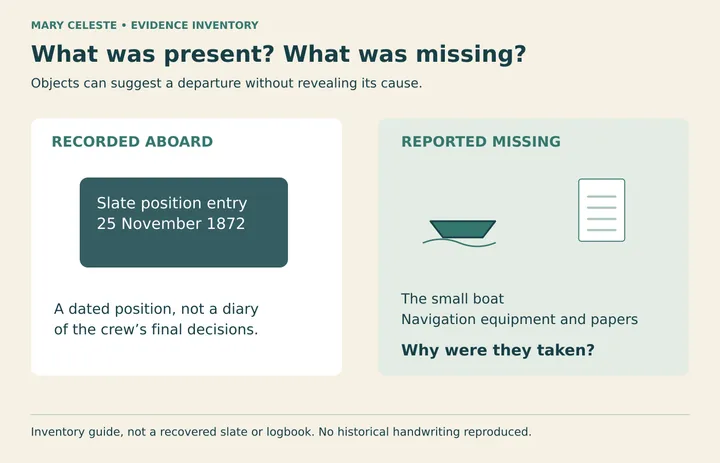
A slate entry recorded a position on November 25. The ship’s papers were missing. The surviving account does not provide a continuous record of the decisions that led to abandonment.
The Missing Lifeboat
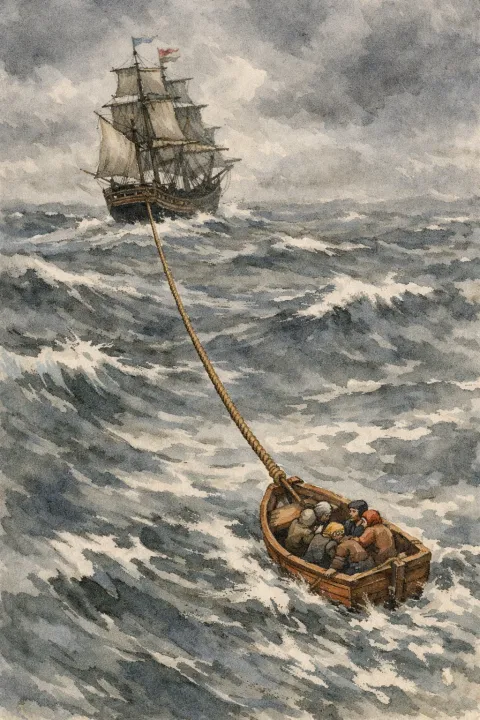
Hypothetical reconstruction: a boat attached by a towline. No witness confirmed this arrangement, the people’s positions or a snapped line; the picture explains a proposal rather than recording the abandonment.
The missing boat suggests the people left the ship in it. A broken towline is one proposed explanation for their separation from Mary Celeste, not a securely established sequence of events.
Present and Missing
An inventory guide distinguishes the slate’s dated position from the missing boat, equipment and papers. It reproduces no recovered logbook or handwriting.
The missing boat and navigation equipment make a departure plausible without establishing its cause. Nine empty barrels have been discussed in support of the alcohol-vapour hypothesis. But the cargo does not establish that a vapour scare caused the people to leave, or that their boat was tied to the ship.
The Voyage and the Mystery
Departure
The Mary Celeste sails out of New York Harbour. On board: Captain Briggs, his wife Sarah, their two-year-old daughter Sophia, and seven crew members. Destination: Genoa, Italy. Cargo: 1,701 barrels of industrial alcohol.
The Last Log Entry
Captain Briggs makes his final logbook entry near Santa Maria Island in the Azores. Everything is normal. The weather is fair. He notes their position and the wind direction. He does not write another word.
Found
The Dei Gratia spots the Mary Celeste drifting erratically 600 miles west of Portugal. First mate Oliver Deveau boards her and finds the ship deserted, the lifeboat gone, and no one aboard.
Gibraltar
Deveau sails the Mary Celeste into Gibraltar harbour. The official inquiry opens. Attorney General Solly Flood suspects murder and conspiracy. He cannot prove it.
No Verdict
The Gibraltar inquiry closes. No criminal charges. The Dei Gratia crew receive their salvage award — far less than expected. The Mary Celeste is repaired and returned to service under new owners.
Still Unsolved
The ten people were never found. Alcohol vapour, worries about flooding and other dangers have been proposed as reasons to abandon ship. The surviving evidence does not identify one complete explanation.
The People in This Story
Benjamin Briggs
Aged 37, from Marion, Massachusetts. Experienced, careful, deeply religious — an experienced captain. His wife and daughter travelled with him. He was never seen again.
Oliver Deveau
First mate of the Dei Gratia. The first person to board the Mary Celeste and document what had been left behind. His detailed testimony to the Gibraltar inquiry is the most reliable account we have of what was actually found.
Arthur Conan Doyle
The creator of Sherlock Holmes wrote a fictional account of the Mary Celeste in 1884 — presenting it as a factual survivor's report. His invented details (the warm breakfast, the blood-stained sword) became so famous that millions of people still believe them today.
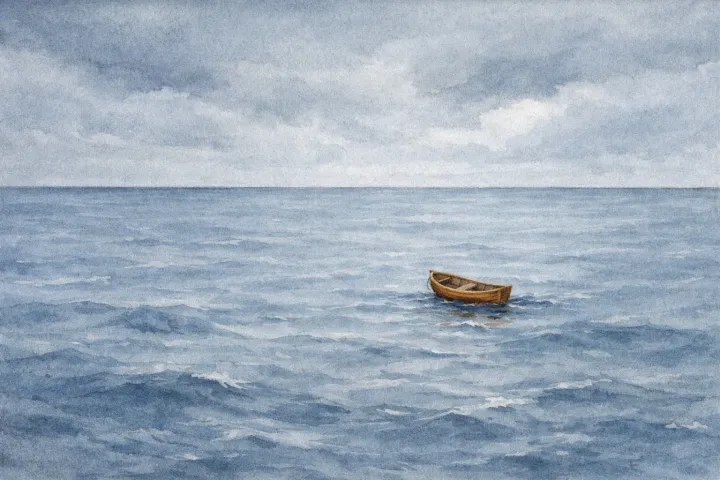
The Question That Remains
The alcohol-vapour theory is one proposed explanation, but no witness confirms it. The missing boat and instruments make abandonment plausible while leaving its cause uncertain.
What danger might have made leaving the ship seem safer than staying? Compare what the boarding party actually recorded with the extra details that later stories supplied.
Read the full book to investigate the key clues and competing explanations — then decide for yourself.
Get the Full Book
The complete Mary Celeste mystery. 9 chapters of evidence, theories, and a question only you can answer.
Part of the Vanished Volume
Ships found empty at sea. Explorers who never came home. Settlements whose people moved on, leaving questions behind. The clues are still out there.
See all books in this volume →Keep investigating
Check the evidence
What the evidence supports
The Mary Celeste was found without its people in December 1872. The later mystery mixes the ship’s records with fictional retellings.
Where to be careful
The reason for abandoning ship and the fate of those aboard remain uncertain. No single proposed scenario is a demonstrated solution.
Explore the sources
These selected sources support this guide and offer further reading. Some are written for adults; explore them with a parent or teacher.
The story and illustrations are modern retellings. Imagined scene details are not historical evidence. These sources are a starting point, not citations for every narrative detail.
Evidence guide reviewed 8 September 2026.