
Lost in the Amazon
A British Explorer, His Son, and the City That Swallowed Them Both
On 29 May 1925, Colonel Percy Fawcett sat in the middle of the Amazon jungle, wrote a letter to his wife, handed it to a messenger — and walked into the trees. He was with his son Jack, twenty-one years old, and Jack's best friend Raleigh Rimell. No one who was not in that jungle ever saw any of them again.
Several expeditions searched for the missing party, sometimes at great risk. Often-repeated claims that more than a hundred searchers died are not a reliable count.
Modern archaeology has revealed substantial ancient Amazonian settlements. That supports a richer history of the region, not proof of Fawcett’s particular city of Z.
1925
Fawcett, his son Jack, and Raleigh Rimell entered the Amazon on 29 May 1925, heading for a lost city Fawcett had spent his entire career searching for. His last letter was written at a camp called Dead Horse Camp. Beyond that point, the jungle gave nothing back.
Several
Into the Amazon before 1925. He survived every one. The jungle couldn't stop him — until it did.
13+ Sent
Search parties followed reports and rumours, but none established what happened to the three men.
100+ Years
No confirmed remains. No verified sightings. No proven explanation. The most famous disappearance in exploration history.
The Evidence
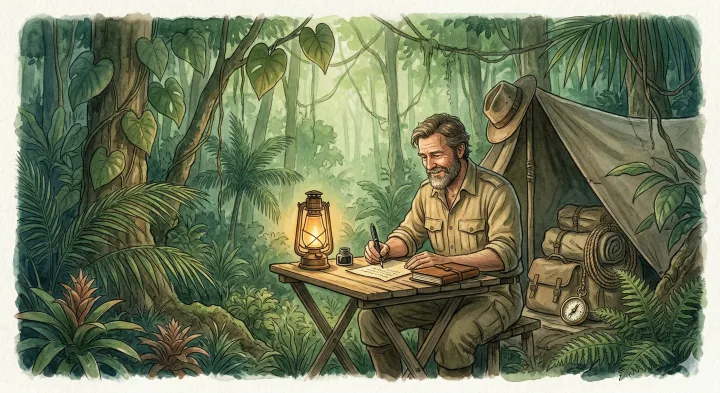
Dead Horse Camp, 29 May 1925
The final written communication from Percy Fawcett. He reported all three men in reasonable health and said they were heading deeper into the Mato Grosso. He told his wife Nina not to worry. He handed the letter to a messenger — and that was the last anyone heard from him.
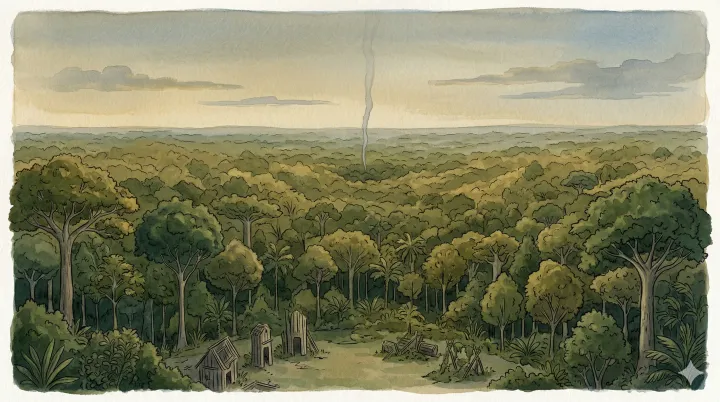
Five Days of Smoke
The Kalapalo — an indigenous group whose territory bordered Fawcett's route — reported watching the three strangers walk past their village. For five days, they saw campfire smoke rising from the direction the men had gone. On the sixth day, no smoke rose. They were never seen again.
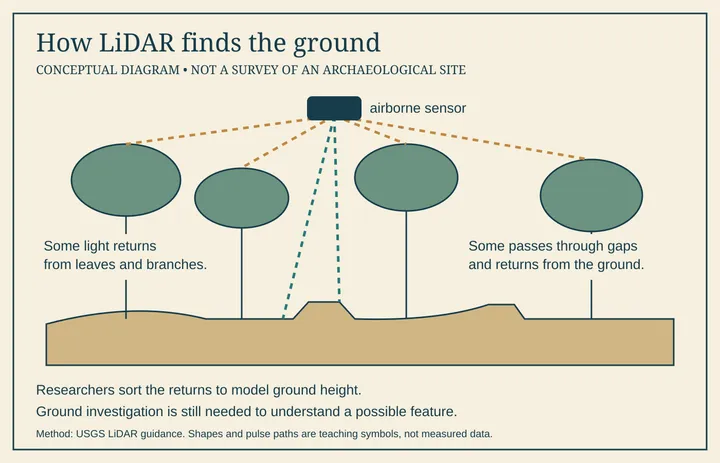
How LiDAR Helps Researchers
A conceptual diagram shows how LiDAR returns can help model ground height beneath trees. These teaching shapes are not a survey of an Amazonian settlement or a map of Fawcett’s route.
Archaeological research reveals substantial ancient settlements in Amazonia. Those discoveries do not identify Fawcett’s imagined city or establish the fate of his expedition.
The Road into the Amazon
Manuscript 512
An unknown Portuguese explorer writes a detailed account of a ruined city in the interior of Brazil. The document is filed in the national library and largely forgotten — until Fawcett reads it.
First Amazon Expedition
The Royal Geographical Society sends Fawcett to survey the Bolivia-Brazil border. He begins eight years of Amazon expeditions — and starts noticing signs of something buried beneath the jungle.
The City of Z
Fawcett presents his theory of a lost Amazon civilisation to the Royal Geographical Society and begins planning the expedition that will define — and end — his life.
The Last Letter
Fawcett writes from Dead Horse Camp. All three men are alive and heading northeast. The letter takes six weeks to reach England. It is the last confirmed evidence of where they were.
The First Search
George Dyott leads a search expedition. He collects information from local communities but does not establish the final fate of the missing party.
Bones — But Not Fawcett's
Bones and personal items are found in the Mato Grosso region. Percy's surviving son Brian has them tested. The bones are not Percy's. The mystery deepens.
Z Is Confirmed
Grann’s account renewed interest in the disappearance. Archaeological discoveries address the region’s settlement history; they do not resolve the expedition’s fate.
The People in This Story
Percy Harrison Fawcett
Born 1867. British Army officer, surveyor, and an experienced Amazon surveyor. He made eight expeditions into the jungle and survived them all. He believed completely in the lost city he called Z — and he walked into the jungle to prove it.
Jack Fawcett
Born 1903. Percy's eldest son, twenty-one years old in 1925. He joined his father’s expedition in 1925. He had grown up on his father's stories of the jungle. He shared the journey, though his private expectations cannot be reconstructed. He was never seen again.
Raleigh Rimell
Jack's closest friend. Twenty-one years old, with no previous jungle experience. He trained hard to join the expedition. Before the final leg began, his leg was already badly swollen from an insect bite — a detail that troubles historians to this day.
David Grann
American journalist who spent years researching the Fawcett disappearance, learned Portuguese, and eventually entered the jungle himself. His 2009 book The Lost City of Z brought the mystery to a new generation and explored the region’s complex history.
Three Theories. No Proof.
Illness, hunger, injury and conflict have all been proposed. Which explanations have evidence behind them? Stories that Fawcett found Z and chose to disappear require evidence that has not emerged.
Kalapalo oral history is valuable evidence about the travellers and their route. It is not proof that the community witnessed their deaths or is hiding an answer.
Read the full book to examine every clue — then give your verdict.
Get the Full Book
The complete Percy Fawcett mystery. 9 chapters of evidence, theories, and a question only you can answer.
Part of the Vanished Volume
Ships found empty at sea. Explorers who never came home. Settlements whose people moved on, leaving questions behind. The clues are still out there.
See all books in this volume →Keep investigating
Check the evidence
What the evidence supports
Percy Fawcett, his son Jack and Raleigh Rimell disappeared on their 1925 expedition in Brazil.
Where to be careful
Later discoveries of ancient Amazonian settlements do not establish the location of Fawcett’s imagined city or the fate of his party.
Explore the sources
These selected sources support this guide and offer further reading. Some are written for adults; explore them with a parent or teacher.
- TIME: The history behind The Lost City of Z
- University of Exeter: Casarabe settlement research (2022)
The story and illustrations are modern retellings. Imagined scene details are not historical evidence. These sources are a starting point, not citations for every narrative detail.
Evidence guide reviewed 8 September 2026.