
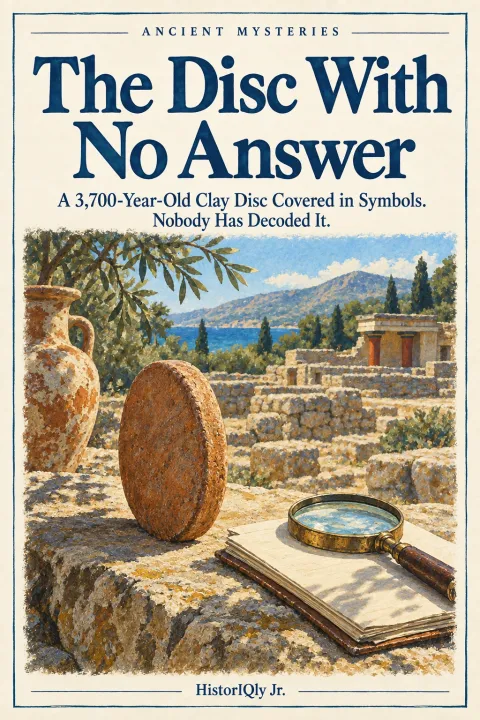
The Disc With No Answer
A 3,700-Year-Old Clay Disc Covered in Symbols. Nobody Has Decoded It.
In 1908, archaeologist Luigi Pernier found a small fired-clay disc at Phaistos on Crete. Its stamped signs follow spirals on both faces. The find area contained disturbed deposits, so the object’s precise date cannot be read directly from a supposed sealed destruction layer.
Repeated impressions show that stamps were used to form the signs. That is different from proving an industry of movable-type printing. Few close comparisons survive, making it difficult to test proposed readings.
Over 100 people have claimed to decode the Phaistos Disc. Not one decipherment has been accepted. It remains one of archaeology's greatest unsolved puzzles.
241 Symbols
The signs were impressed with individual dies. They are separated into 61 groups by incised lines; calling the groups words is an interpretation that still needs testing.
45
Forty-five sign types recur across the disc. Counts of impressions commonly differ between 241 and 242 because of damaged evidence.
~1700 BCE
Middle Minoan period — roughly the same era the first Palace of Phaistos was destroyed and rebuilt.
100+
Over 100 claimed decodings — into Greek, Semitic, Anatolian, and more. None accepted by the scientific community.
The Evidence
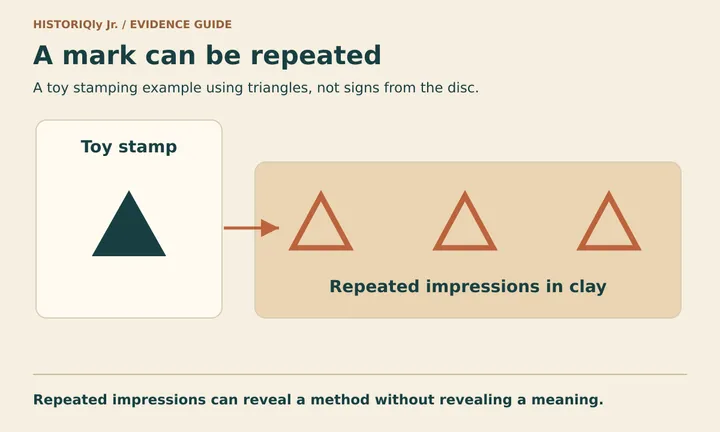
Repeated Stamped Marks
A toy example of a stamp making repeated marks in clay. The triangles are invented teaching shapes, not a transcription of Phaistos signs.
Repeated signs were impressed into wet clay using individual dies. The stamps themselves have not been recovered. Their possible reuse does not establish that many copies were produced.
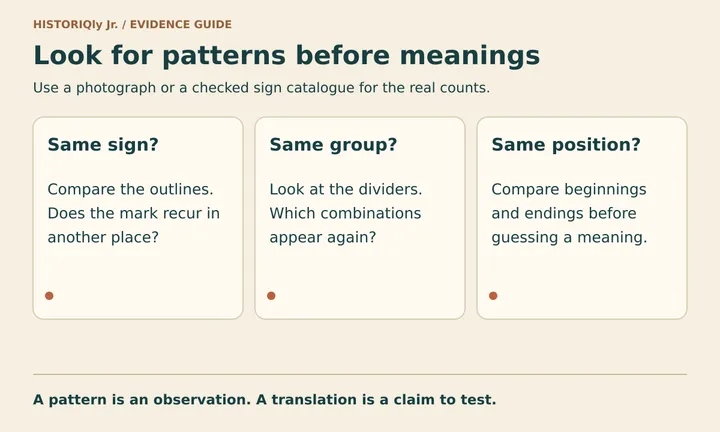
Comparing the Signs
A pattern-finding guide. It avoids invented glyphs and directs the reader to photographs and a checked catalogue for the real signs.
Some impressions were altered while the clay was wet. These corrections reveal choices during manufacture. They do not by themselves prove meaningful language, the maker’s thoughts or the object’s authenticity.
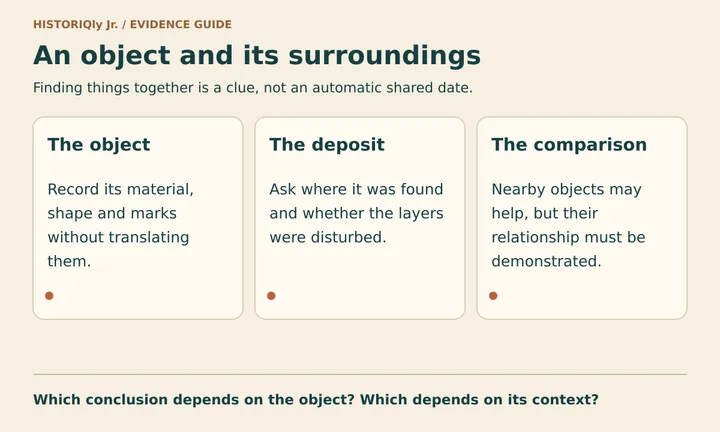
Archaeological Context
An evidence guide, not an excavation plan or measured drawing of the disc.
The find area was disturbed and contained material from different periods. It should not be described as a sealed Bronze Age layer. Context and comparisons still matter, but neither a nearby tablet nor one similar sign establishes a precise date or proves authenticity.
From Creation to Mystery
First Palace Built
The first Palace of Phaistos is constructed in southern Crete — one of the great centres of the Minoan civilisation, with courtyards, storage rooms, and underground chambers.
The Disc Is Created
The disc is generally assigned to the Bronze Age. It bears 241 signs impressed with dies, arranged on both faces. Its precise manufacture and use are reconstructed from the object and its reported find context.
Thera Erupts
Thera erupts during the Bronze Age, affecting settlements in the Aegean. Dating this event is separate from dating the Phaistos Disc; it should not be used as an automatic explanation of the disc’s archaeological layer.
Pernier's Discovery
Luigi Pernier finds the disc at Phaistos. The reported find area contains disturbed material from different periods, complicating attempts to date it through its context.
Linear B Cracked
Michael Ventris deciphers Linear B — proving it is early Greek. But the Phaistos Disc script matches neither Linear B nor the still-undeciphered Linear A.
Comparing Cretan Signs
Researchers compare signs on the disc with other Cretan objects. Resemblances can be useful, but their date, shape and context need scrutiny before they support an identification.
Forgery Theory Published
Eisenberg proposes that the disc is a forgery. Most scholars accept its ancient origin, but the argument must be assessed through context and material evidence—not the claim that one similar sign makes forgery impossible.
Owens's Claimed Reading
Linguist Gareth Owens presents a TEDx talk claiming the disc is a prayer to a Minoan mother goddess — using Linear B sound values. The wider scholarly community remains unconvinced.
The People in This Story
Luigi Pernier
Italian archaeologist who found the disc on July 3, 1908, while directing excavations at the Palace of Phaistos. A student of Federico Halbherr, he later became the first director of the Italian Archaeological School of Athens. He died in 1937.
Sir Arthur Evans
British archaeologist who excavated the Palace of Knossos — 50 km north of Phaistos — from 1900. He discovered Linear A and Linear B, coined the term "Minoan," and noted that the disc's symbols didn't match any known Cretan scripts.
Alice Kober
American classicist whose careful comparison of Cretan signs helped lay the groundwork for the decipherment of Linear B. Her work provides a model of testable analysis, without supplying a reading of this disc.

The Question That Remains
The surviving disc preserves clear impressions that researchers can inspect. Recognising a picture is not the same as knowing its sound or meaning in a text. No generally accepted reading connects all the signs consistently.
Is it a prayer? A story? A calendar? A board game? Or something we haven't even imagined? Over a century of investigation has produced over a hundred theories — and not a single certain answer.
Read the full book to investigate the key clues and competing explanations — then decide for yourself.
Get the Full Book
The complete Phaistos Disc mystery. 9 chapters of evidence, theories, and a question only you can answer.
Part of the Ancient Mysteries Volume
Desert drawings, undeciphered writing, and ingenious ancient machines. Discover what the evidence explains — and which questions remain open.
See all books in this volume →Keep investigating
Check the evidence
What the evidence supports
The clay disc bears stamped signs arranged in spirals and is associated with the site of Phaistos.
Where to be careful
Its language and message have no generally accepted reading. The find came from disturbed deposits, making its date difficult to establish from context alone. Reusable stamps do not prove a mass-production industry.
Explore the sources
These selected sources support this guide and offer further reading. Some are written for adults; explore them with a parent or teacher.
The story and illustrations are modern retellings. Imagined scene details are not historical evidence. These sources are a starting point, not citations for every narrative detail.
Evidence guide reviewed 8 September 2026.