
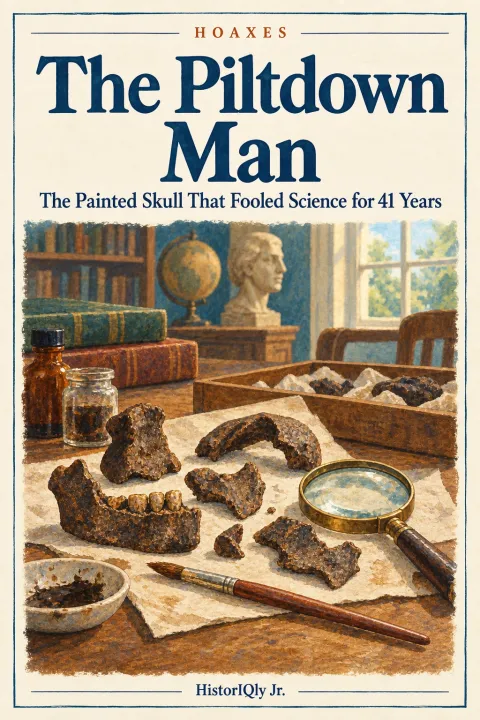
The Piltdown Man
The Painted Skull That Fooled Science for 41 Years
In 1912, a country lawyer walked into the Natural History Museum in London with a bag of brown bones. He said he had found the missing link — the creature that connected humans to their ape ancestors. Scientists believed him. The world celebrated. Britain had its greatest fossil.
Human skull fragments had been combined with orangutan remains. Filed teeth and staining helped the forgery look ancient. Some scientists doubted it early; a series of tests exposed it in 1953.
1912
Charles Dawson — a solicitor and amateur fossil hunter — presented skull fragments to the Natural History Museum. Arthur Smith Woodward declared them a new species: "Dawson's Dawn Man." The bones had been stained with chemicals, the teeth filed with a metal tool, and ancient animal fossils planted at the site.
41 years
The longest a major scientific forgery has ever survived.
600 yrs old
A medieval human cranium — not the 500,000 years claimed.
Orangutan
About 500 years old, from Sarawak. Teeth filed to look human.
The Evidence
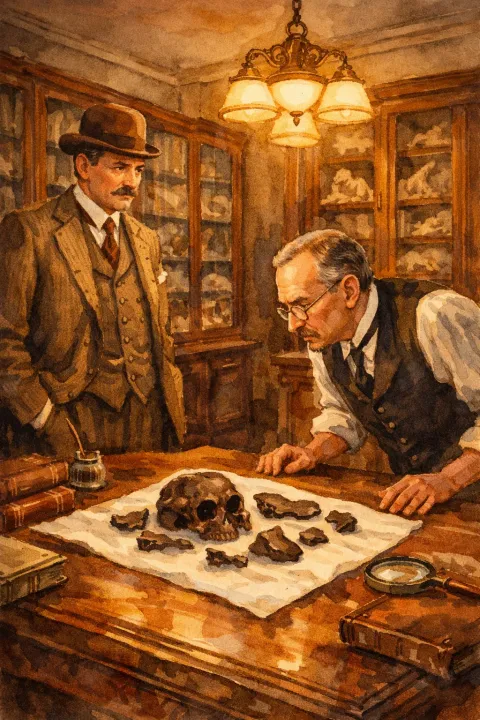
The Painted Skull
A human cranium and orangutan jaw, stained with potassium dichromate and iron solution to look ancient. The bones were brown on the outside but white underneath. The chemical staining could have been detected with tests available in 1912.
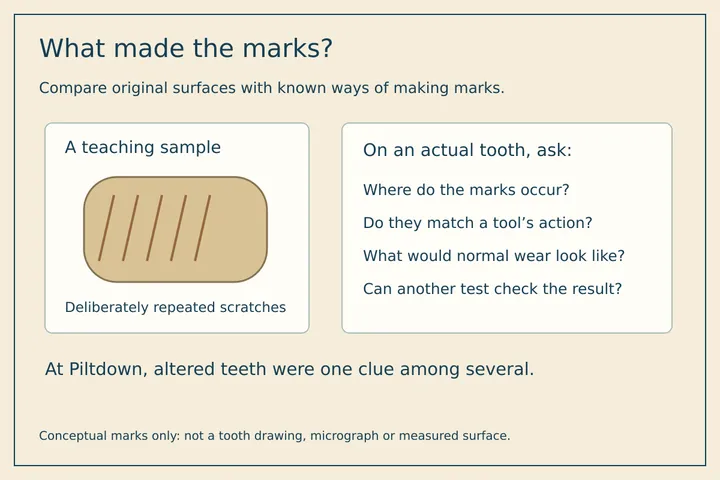
Testing Surface Marks
A conceptual scratch-pattern exercise. The sample is not a tooth or micrograph; original specimens and known comparison surfaces are needed to test the marks.
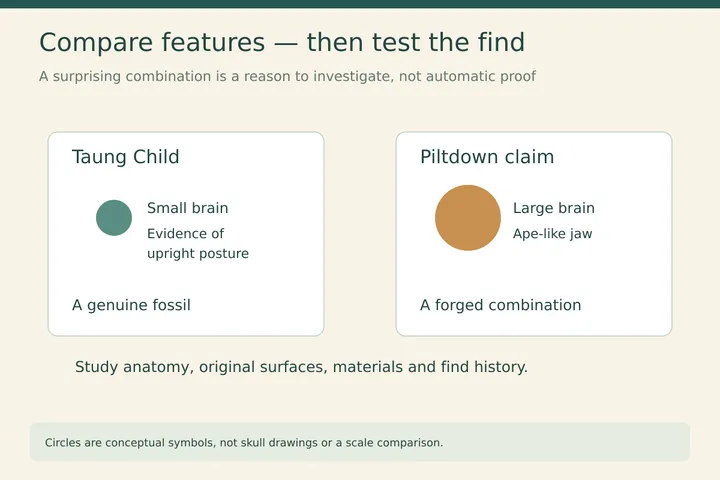
Compare features — then test the find
A surprising combination is a reason to investigate, not automatic proof. Circles are conceptual symbols, not skull drawings or a scale comparison.
How the Hoax Unfolded
The Announcement
Charles Dawson presents skull fragments to Arthur Smith Woodward at the Natural History Museum. Woodward declares it a new species: Eoanthropus dawsoni — "Dawson's Dawn Man."
The Canine Tooth
Pierre Teilhard de Chardin finds a canine tooth at the Piltdown site. DNA analysis later shows it came from the same orangutan as the jaw. It completed the picture — a tooth that was halfway between ape and human.
Piltdown II
Dawson announces a second discovery two miles away. Nobody else ever sees the site. After Dawson's death in 1916, it is never found again.
The Taung Child
Raymond Dart discovers Australopithecus africanus in South Africa. It has a small brain but walked upright — the opposite of Piltdown Man. British scientists dismiss it.
The First Crack
Kenneth Oakley's fluorine absorption tests show the Piltdown bones are far younger than claimed. The skull is not 500,000 years old — it may be only tens of thousands.
The Exposure
Joseph Weiner, Wilfrid Le Gros Clark, and Kenneth Oakley prove the skull is a deliberate forgery. The cranium is medieval human. The jaw is orangutan. The teeth are filed. Every bone is painted.
The People in This Story
Charles Dawson
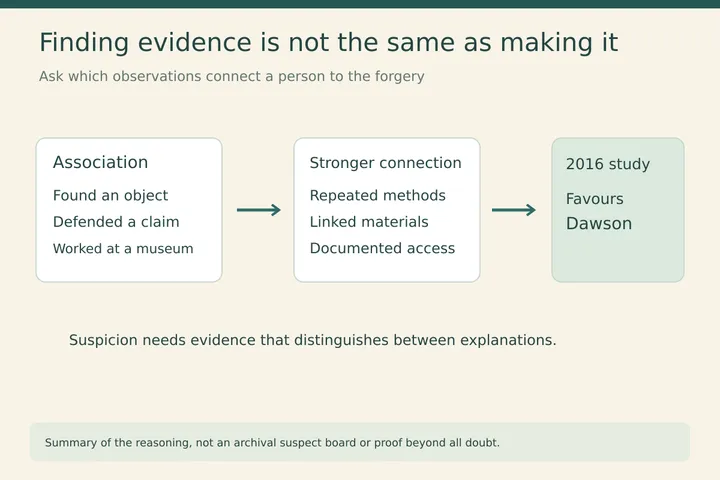
A solicitor and amateur fossil hunter from Sussex. He "discovered" the Piltdown skull and is the prime suspect in the forgery. At least 38 of his other finds were later shown to be fakes.
Kenneth Oakley
A scientist in the geology department at the Natural History Museum who ran the first fluorine absorption tests on the Piltdown bones in 1949 — cracking open a 37-year-old lie.
Joseph Weiner
An Oxford physical anthropologist who realised the jaw looked exactly like a modern orangutan's. He recreated the forgery within days — then proved the original was fake.
The Question That Remains
The combined remains were a forgery. Anatomical comparisons, chemical tests and surface examination eventually exposed it. The case shows why original evidence must remain open to scrutiny.
Who created the Piltdown forgery — and who is more responsible for the hoax lasting so long: the person who faked the skull, or the scientists who refused to question it?
Read the full book to investigate the key clues and competing explanations — then decide for yourself.
Get the Full Book
The complete Piltdown Man mystery. 9 chapters of evidence, theories, and a question only you can answer.
Part of the Hoaxes Volume
From fake fossils to trick photographs, we investigate the greatest hoaxes in history — and ask how clever people were fooled for so long.
See all books in this volume →Keep investigating
Check the evidence
What the evidence supports
The supposed fossil combined human skull material with orangutan remains. Modern analysis links material from both Piltdown sites to one orangutan.
Where to be careful
A 2016 study strongly implicated Charles Dawson as the likely single forger. That is a scientific inference, not a recorded confession.
Explore the sources
These selected sources support this guide and offer further reading. Some are written for adults; explore them with a parent or teacher.
The story and illustrations are modern retellings. Imagined scene details are not historical evidence. These sources are a starting point, not citations for every narrative detail.
Evidence guide reviewed 8 September 2026.