
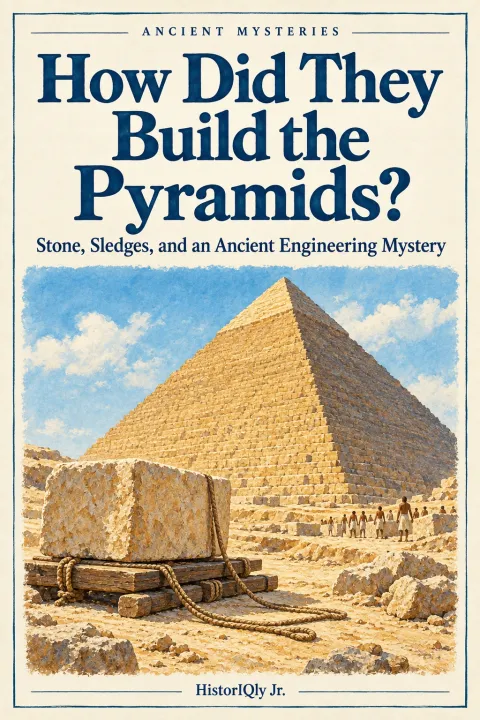
How Did They Build the Pyramids?
Stone, Sledges, and an Ancient Engineering Mystery
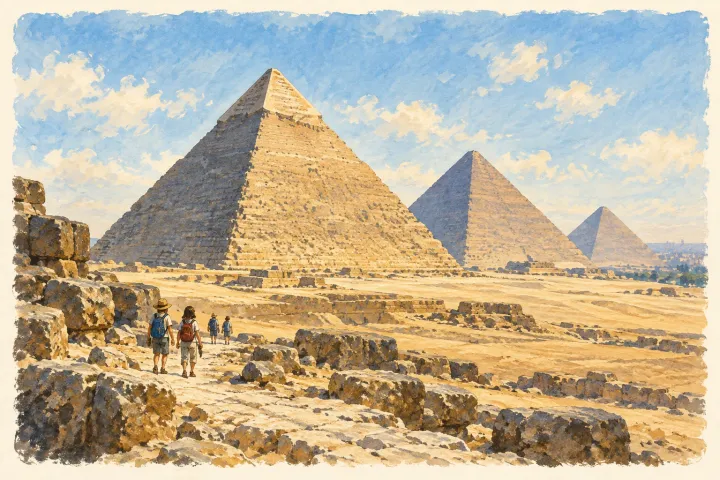
The Great Pyramid of Giza contains an estimated 2.3 million stone blocks. Its builders used stone and copper tools, ropes, sledges and careful organisation. The scale and surveying skill are remarkable; we can investigate them through the remains they left.
No complete building plan survives, but tools, quarries, settlements and written supply records provide clues. Researchers debate particular lifting sequences. That does not mean every proposed method has a fatal flaw.
It is the oldest of the Seven Wonders of the Ancient World — and the only one still standing.
~2560 BC
Built for Pharaoh Khufu of the Fourth Dynasty. Construction took approximately twenty years. It was the tallest structure on Earth for nearly four thousand years.
2.3 million
Each averaging 2.5 tonnes. The heaviest granite blocks weigh up to 80 tonnes.
146.5 metres
Taller than the Statue of Liberty. Now 138.5 m after losing its limestone casing.
20–30k workers
Evidence of organised work crews and provisioning; it does not establish every worker’s legal status.
The Evidence
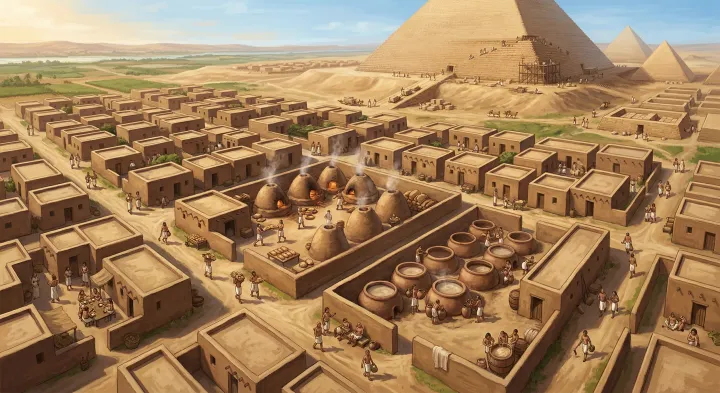
Evidence of the Work Crews
An imagined workers’ settlement near Giza. Archaeological finds help researchers study food, housing and organisation; the appearance of a drawing cannot settle the workers’ legal status or total number.
Excavations at Giza revealed a workers’ settlement with buildings and food-production areas. Nearby burials and skeletal evidence add information about workers’ lives. Food and healed injuries do not prove that every worker was freely paid.
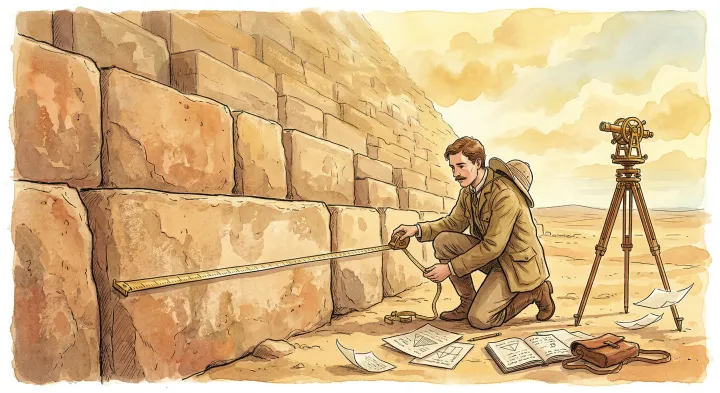
Skilled Surveying
An imagined survey scene inspired by Petrie’s work. Consult his published measurements for the evidence; the ruler and blocks in this drawing are not a measurement record.
The base was carefully levelled and the sides closely aligned with the compass directions. Surveys estimate the original form from surviving features. Precision shows skilled work; it does not establish an impossible technology.
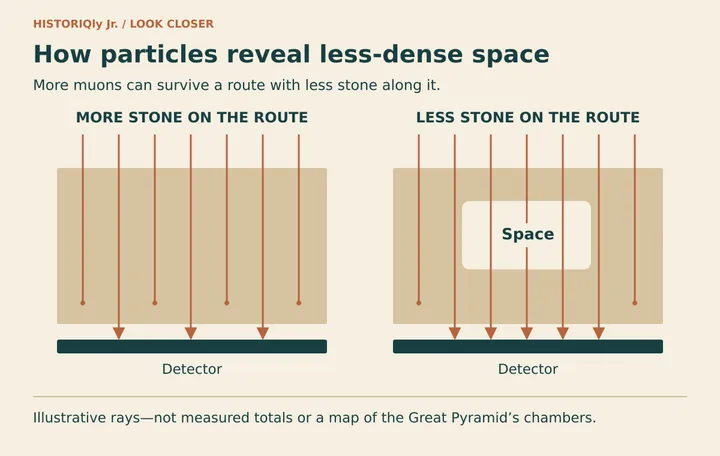
Investigating an Internal Void
The idea behind muon imaging: a route with less stone can allow more particles to reach a detector. These illustrative rays are not measured counts, and the blocks are not a diagram of the Great Pyramid’s chambers.
Muon imaging revealed a large void in 2017. A corridor was examined with a camera in 2023 after earlier detection. Finding a space and explaining its purpose are separate steps.
4,500 Years of Mystery
The Great Pyramid Built
Pharaoh Khufu's architects oversee the construction of the largest pyramid ever built. 2.3 million blocks, 146.5 metres tall, completed in roughly twenty years.
Herodotus Visits
Herodotus writes about pyramid construction around two thousand years after the event. His account is a later source to compare with archaeology, not a record made by an eyewitness to Khufu’s project.
Petrie's Survey
Petrie surveys the pyramid’s surviving features and investigates its dimensions and orientation. Measurements need methods and uncertainty, rather than isolated numbers presented as perfect precision.
The Workers' Village
Excavations of settlement and burial remains help researchers investigate organised workers, food supply and living conditions. These discoveries do not identify every worker’s status or personal experience.
The Internal Ramp Theory
French architect Jean-Pierre Houdin proposes that a spiral ramp hidden inside the pyramid walls was used to raise the upper blocks. A corner notch supports the theory — but it remains unproven.
Wet Sand Discovery
Experiments show that the right amount of water can reduce friction when a sledge crosses sand. This helps test a hauling method; it does not establish every transport operation at Giza.
The Hidden Void
The ScanPyramids project discovers a 30-metre void above the Grand Gallery using cosmic-ray muon tomography. Its purpose remains completely unknown.
The Secret Corridor
A corridor about nine metres long behind the original entrance is examined with an endoscopic camera after non-invasive detection. Its role is investigated alongside the monument’s other features.
The People in This Story
Khufu
The Fourth Dynasty pharaoh associated with the Great Pyramid. Archaeology and written records connect his reign with a large building and supply operation.
Mark Lehner
American archaeologist whose work at Giza helped reveal the settlement and supply systems associated with pyramid building. The evidence shows organisation without recovering every worker’s circumstances.
Jean-Pierre Houdin
French architect who in 2007 proposed the internal ramp theory — that a spiral ramp hidden inside the pyramid walls was used to raise the upper blocks. His theory predicts a tunnel inside the walls, partially supported by a corner notch.
The Question That Remains
Evidence connects the Great Pyramid with Khufu, Egyptian work crews and large supply networks. Sledge experiments show how damp sand can reduce friction, while a later Egyptian image depicts water used in hauling. Neither establishes every journey made at Giza.
Researchers continue to investigate lifting sequences and the purpose of internal spaces. The open questions sit alongside substantial evidence of Egyptian tools, work crews and organisation.
Read the full book to investigate the key clues and competing explanations — then decide for yourself.
Get the Full Book
The complete Pyramids mystery. 9 chapters of evidence, theories, and a question only you can answer.
Part of the Ancient Mysteries Volume
Desert drawings, undeciphered writing, and ingenious ancient machines. Discover what the evidence explains — and which questions remain open.
See all books in this volume →Keep investigating
Check the evidence
What the evidence supports
Excavations at Giza reveal infrastructure that housed and supplied the pyramid workforce. Ancient Egyptians organised these projects.
Where to be careful
Debate about particular ramps or lifting sequences does not make the builders or their human engineering skills mysterious.
Explore the sources
These selected sources support this guide and offer further reading. Some are written for adults; explore them with a parent or teacher.
- Ancient Egypt Research Associates: Fieldwork at Giza
- AERA: Research and the Merer documents
- NOVA: Archaeologists discuss the pyramid workforce
- Research paper: North Face Corridor investigation
The story and illustrations are modern retellings. Imagined scene details are not historical evidence. These sources are a starting point, not citations for every narrative detail.
Evidence guide reviewed 8 September 2026.