
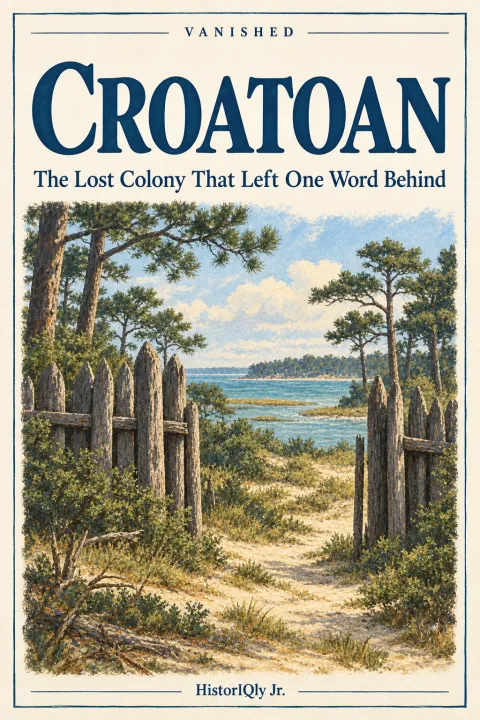
CROATOAN
The Lost Colony That Left One Word Behind
On 18 August 1590, Governor John White stepped ashore on Roanoke Island and called out for the more than a hundred people he had left behind three years earlier. No one answered. The settlement was completely empty — no people or bodies, but a carved message. Just one word carved into a wooden post in capital letters: CROATOAN.
White had sailed back to England for supplies. He had been desperate to return. A war with Spain had kept him away for three agonising years.
Now his daughter, his granddaughter Virginia Dare, and 115 others were simply gone. And nobody has ever found out what happened to them.
1587–1590
117 English men, women, and children — including the first English baby born in the Americas — vanished from Roanoke Island during the three years Governor John White was away. No remains. No graves. No explanation.
100+
Men, women, and children. Including infants.
430 +
The oldest unsolved mystery in American history.
1 Word
"CROATOAN" — carved on a post. "CRO" carved on a nearby tree. That is all.
The Evidence
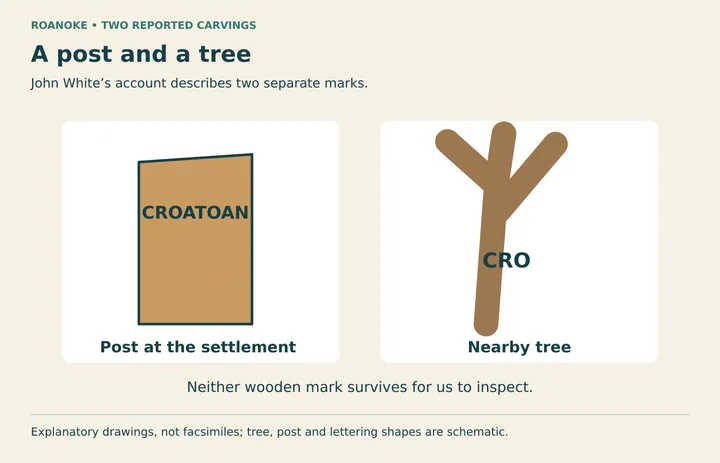
Two Reported Carvings
White reported CROATOAN on a post and CRO on a tree. These schematic drawings separate the two marks; neither is a surviving object or a facsimile.
The letters were carved cleanly and clearly — not scratched in panic. Before White left, the colonists had agreed: if forced to move, they would carve their destination. If they were in danger, they would add a cross. There was no cross. White believed they had moved to Croatoan Island willingly.
The Great Drought
Tree ring data shows that 1587–1589 was one of the worst droughts in 800 years across the region. The colonists had arrived expecting to farm and hunt. Instead, the land itself was dying. This evidence was not discovered until modern scientists studied ancient tree rings centuries later.
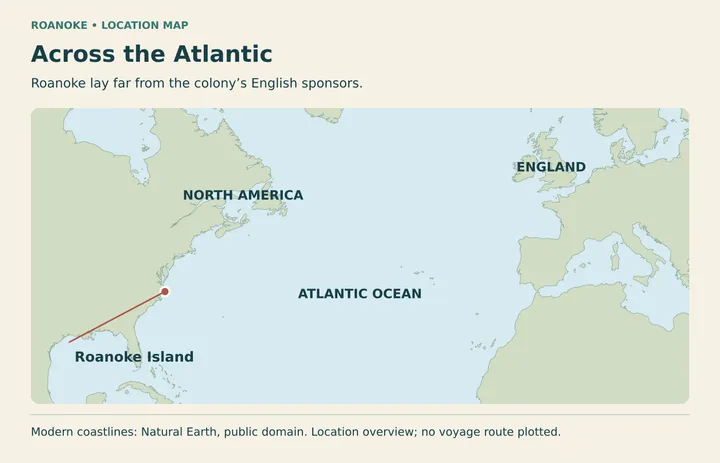
Across the Atlantic
A modern location map places Roanoke off present-day North Carolina and England across the Atlantic. No voyage route is plotted. Coastlines: Natural Earth, public domain.
The Atlantic separated the colony from its English sponsors. More detailed maps help investigate possible movements closer to Roanoke: in 2012, examination of John White’s map revealed a fort-like symbol beneath a patch. It provides a location to investigate, but does not prove the colonists settled there or explain why the patch was added.
How 117 People Disappeared
Raleigh Sends Scouts
Sir Walter Raleigh dispatches two ships to explore the coast of North America. They return with glowing reports of a warm, fertile land — and two Algonquian men named Manteo and Wanchese, who go back with them to England.
The First Colony Fails
107 English soldiers attempt a colony on Roanoke Island. Relations with local tribes collapse. After a brutal winter and raids, they abandon the settlement and sail home with Sir Francis Drake.
117 Colonists Arrive
John White leads 117 men, women, and children to Roanoke. This time families have come — it is meant to be permanent. But their ship captain, Simon Fernandez, refuses to take them further north as planned. They are stuck at Roanoke, the site of the failed first colony.
Virginia Dare Is Born
Eleanor Dare — White's own daughter — gives birth to Virginia Dare, the first English child born in the Americas. Nine days later, the colonists beg White to sail to England for more supplies. He does not want to go. They insist.
The Spanish Armada Blocks His Return
England and Spain are at war. Every available ship is needed to fight the Spanish Armada. White's return voyage is cancelled. He watches, powerless, as another year passes. Then another.
White Returns — to Nothing
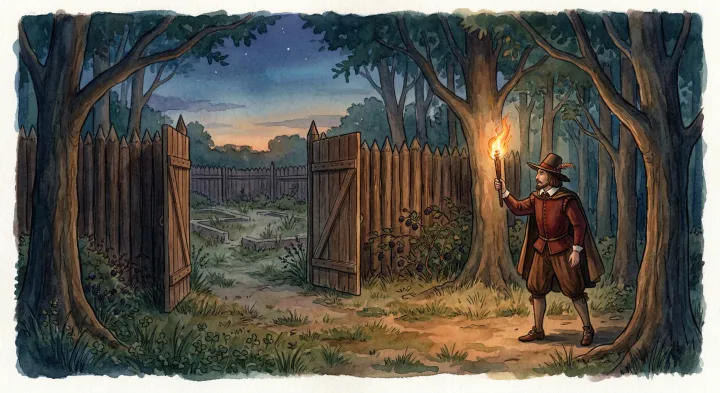
On Virginia Dare's third birthday, White finally lands on Roanoke. The settlement is silent. The houses are gone. The palisade fence stands, overgrown with weeds. Then he finds it: "CROATOAN" carved into a post, and "CRO" on a tree. He never sees his daughter or granddaughter again.
What Happened to Them?
They Joined the Croatoan People
The Croatoan were a friendly tribe on Hatteras Island, 50 miles south. The colonists may have moved there voluntarily — especially during the drought — and been absorbed into the community. Some Lumbee traditions include connections with the colonists. Surnames alone cannot prove that ancestry, and Lumbee history is not dependent on solving this English mystery.
They Moved Inland
The map has encouraged investigation of an inland destination near Albemarle Sound. That location is distinct from Chesapeake Bay, the colony’s original intended destination. Finds must be dated and linked to the colonists before they can settle the question.
They Were Attacked
Earlier English violence had damaged relations with local communities. Conflict is therefore part of the background, but no clear evidence establishes an attack on the departing colonists. The absence of a distress cross cannot prove their later safety.
The People in This Story
John White
Artist and cartographer appointed governor of the Roanoke Colony. His detailed watercolour paintings of the Algonquian people remain some of the most important historical records of Native American life. He never found out what happened to his family.
Virginia Dare
Born on 18 August 1587, Virginia Dare was the first English child born in the Americas. She was three years old when her grandfather returned to find her gone. She has never been found — not a single bone, not a single trace.
Manteo
A Croatoan man who travelled to England and back twice, acting as interpreter and guide for the English. In August 1587 he was baptised into the English church and given an English title. If anyone could have helped the colonists survive among the Croatoan people, it was Manteo.
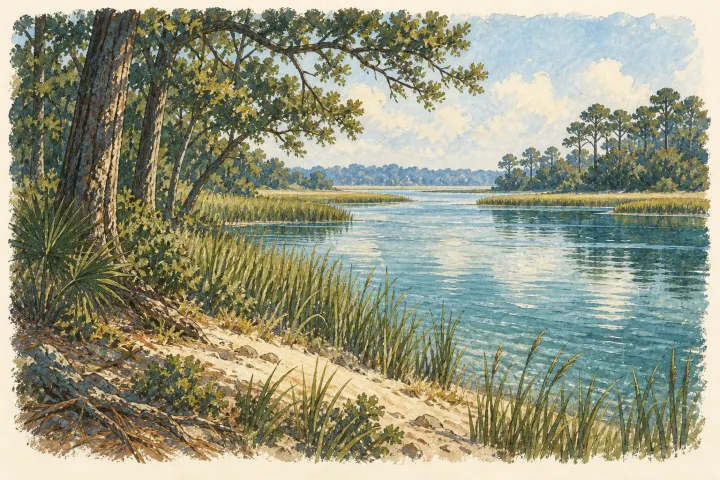
The Question That Remains
The carving said "CROATOAN." White believed it. He tried to sail to Croatoan Island to find them — but a storm forced his fleet back to England. He never returned.
The carving fits the agreed signal for a destination. What other evidence would distinguish a move to Croatoan from a split into several groups? A message can guide a search without explaining everything that happened afterwards.
Read the full book to investigate the key clues and competing explanations — then decide for yourself.
Get the Full Investigation
CROATOAN: The Lost Colony That Left One Word Behind. 9 chapters of evidence, theories, and a question only you can answer.
Part of the Vanished Volume
Ships found empty at sea. Explorers who never came home. Settlements whose people moved on, leaving questions behind. The clues are still out there.
See all books in this volume →Keep investigating
Check the evidence
What the evidence supports
John White found CRO and CROATOAN carved at the abandoned settlement in 1590. Weather prevented him from completing his search at Croatoan.
Where to be careful
The carving is a clue to a destination, not a complete account of what happened to every colonist.
Explore the sources
These selected sources support this guide and offer further reading. Some are written for adults; explore them with a parent or teacher.
The story and illustrations are modern retellings. Imagined scene details are not historical evidence. These sources are a starting point, not citations for every narrative detail.
Evidence guide reviewed 8 September 2026.