
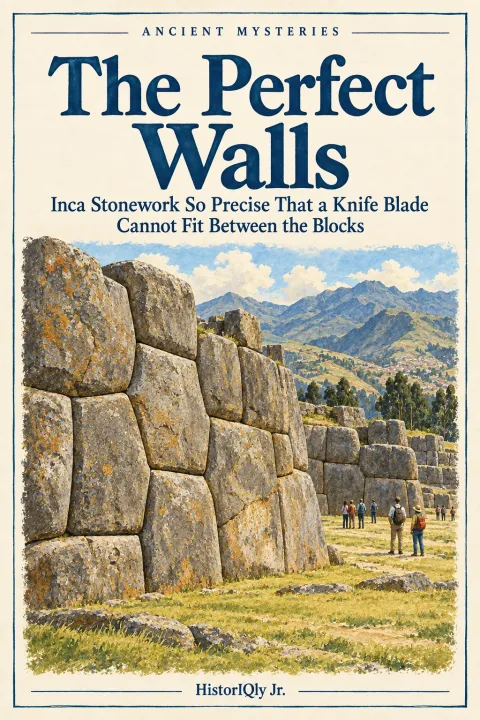
The Perfect Walls
Inca Stonework So Precise That a Knife Blade Cannot Fit Between the Blocks
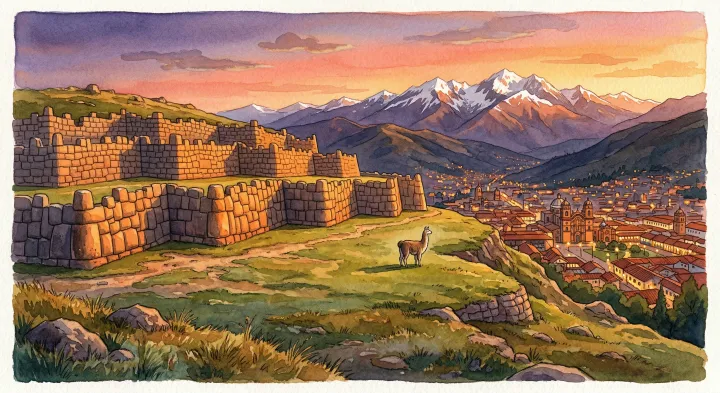
Above Cusco in Peru, huge stones form zigzag walls. Many joints are extremely close, even though the blocks have irregular shapes. Studying the marks, quarries and joints helps researchers investigate how the builders worked.
The Inca developed Sacsayhuamán as part of their imperial capital. Stone tools, transport routes and experiments help explain possible methods. The exact sequence for shaping, moving and fitting every giant block is not recorded.
Substantial walls survive after centuries of earthquakes, dismantling and weathering. Their close-fitting stones show remarkable skill, but do not make them indestructible.
Sacsayhuaman
An Inca stone complex above Cusco. Its large, irregular blocks and close joints preserve evidence of skilled quarrying, shaping and fitting.
Large blocks
Mass estimates depend on reconstructed dimensions, including hidden parts of a block.
Close joints
Many visible joints are extremely close — no mortar was used.
500+ years
Substantial walls survive centuries of weathering, earthquakes and dismantling; conservation remains necessary.
The Evidence
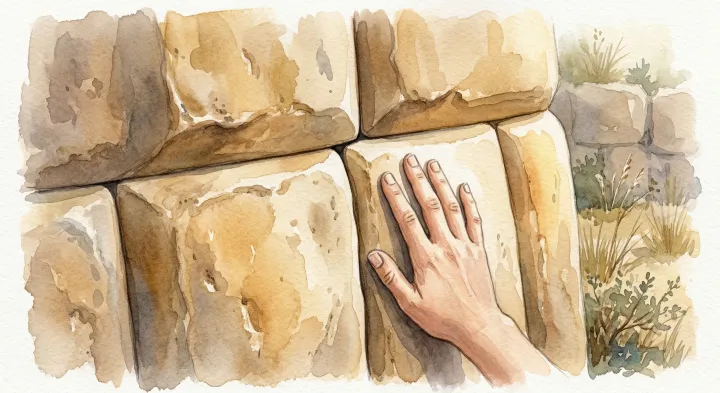
Close-Fitting Stonework
An illustrated close view of fitted stones. The actual joints can be studied at the site; this drawing cannot measure their gaps or prove that every stone fits equally closely.
Irregularly shaped blocks meet in close visible joints. The exposed seam does not reveal every hidden contact surface, so it cannot prove a perfect fit through the whole wall.
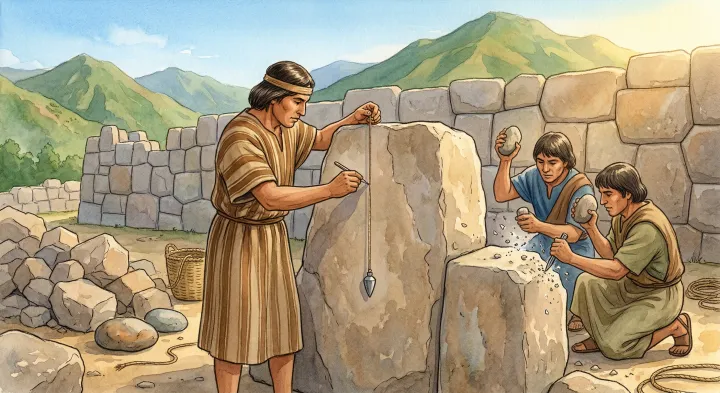
Checking and Shaping
An illustration of a proposed checking-and-shaping method. Experiments support repeated fitting, but the particular marking tools and lifting arrangement shown are a reconstruction.
Repeated checking and shaping can produce close joints. Experiments support this principle, while the exact marking tools, lifting arrangements and number of trials at a particular wall remain uncertain.
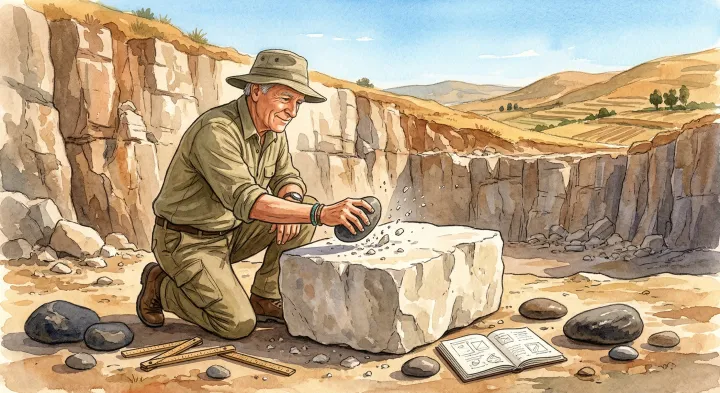
Protzen’s Experiments
An imagined scene inspired by Protzen’s stone-working experiments. The cobbles illustrate the type of tool he tested; the picture does not record a particular session or its measured precision.
In the 1980s, Jean-Pierre Protzen tested stone-working methods using hammerstones. His experiments demonstrated workable techniques without proving that every original block was made in exactly the same way.
From Empire to Enigma
Pachacuti Orders Construction
The ninth Inca ruler transforms his small kingdom into an empire and orders the construction of Sacsayhuaman on the hilltop above Cusco. Tens of thousands of workers begin quarrying stone.
Construction Continues
Three generations of rulers oversee the work. The zigzag walls grow to three massive tiers. The largest stones — weighing over 100 tonnes — are dragged from quarries kilometres away.
The Spanish Arrive
Spanish forces reach Cusco in 1533. Pedro Cieza de León visits Peru later and describes Inca buildings; he was not an eyewitness entering the city with Pizarro.
The Battle of Sacsayhuaman
The Inca rebel against Spanish rule. Sacsayhuaman becomes a fortress in the conflict. After the battle, the Spanish begin dismantling the upper walls to build churches and mansions in Cusco.
Ancient Aliens Theory
Erich von Däniken promotes claims of alien help at ancient monuments. Such claims do not replace archaeological evidence for the people and tools that made them.
Protzen's Experiments
Jean-Pierre Protzen studies quarry marks and tests methods of shaping stone. Experiments help assess what is possible; archaeological evidence is needed to connect a method to a particular wall.
UNESCO World Heritage Site
Sacsayhuaman forms part of Cusco’s heritage. Festivals, research and conservation connect the surviving walls with living communities and the work of protecting the site.
The People in This Story
Pachacuti
The ninth Inca ruler who transformed his people from a small kingdom into the largest empire in the Americas — and ordered the construction of Sacsayhuaman around 1438.
Pedro Cieza de León
A Spanish chronicler who described Inca buildings after the conquest. His admiration is a historical response to the masonry, not a measurement of every joint.
Jean-Pierre Protzen
A Berkeley architect who studied Inca quarrying and published experiments in 1985 showing that stone tools could shape and fit blocks — by doing it himself with nothing but river cobbles.
The Question That Remains
The site, quarry marks and practical experiments help explain Inca stoneworking. Moving and fitting the largest blocks also required organisation, but surviving evidence does not recover every work crew or lifting sequence.
These walls show the importance of skilled workers, practical experiments and the resources of an empire. Which traces of that work can still be seen in the stones?
Read the full book to investigate the key clues and competing explanations — then decide for yourself what "advanced" really means.
Get the Full Book
The complete Sacsayhuaman mystery. 10 chapters of evidence, theories, and a question only you can answer.
Part of the Ancient Mysteries Volume
Desert drawings, undeciphered writing, and ingenious ancient machines. Discover what the evidence explains — and which questions remain open.
See all books in this volume →Keep investigating
Check the evidence
What the evidence supports
Inca builders created closely fitted stonework and planned water management at Saqsaywaman.
Where to be careful
Demonstrating one possible carving method does not reconstruct every stage of a building project. A missing instruction manual is not evidence for aliens.
Explore the sources
These selected sources support this guide and offer further reading. Some are written for adults; explore them with a parent or teacher.
The story and illustrations are modern retellings. Imagined scene details are not historical evidence. These sources are a starting point, not citations for every narrative detail.
Evidence guide reviewed 8 September 2026.