
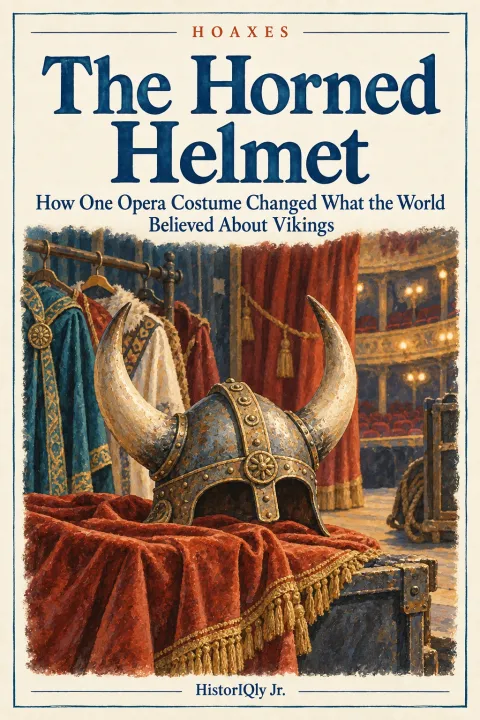
The Horned Helmet
How One Opera Costume Changed What the World Believed About Vikings
Close your eyes and picture a Viking. You probably see a fierce warrior with a horned helmet. That image is one of the most famous in all of history — and it is completely wrong.
The surviving Gjermundbu helmet is a plain iron cap with no horns. The myth was popularised by artists and stage costumes in the 1870s — and it was so vivid that it replaced a thousand years of reality.
This is the story of how a costume became a "fact."
1876
Costume designer Carl Emil Doepler put horned helmets on characters in Wagner's Ring Cycle opera at Bayreuth, Germany. The image spread worldwide through newspapers and illustrations — and never stopped.
~2
Only a tiny number of Viking helmets survive. None have horns.
0 Viking
Zero horned helmets from the Viking Age have ever been found.
150+ Years
The myth has persisted since 1876 despite every historian and museum correcting it.
The Evidence
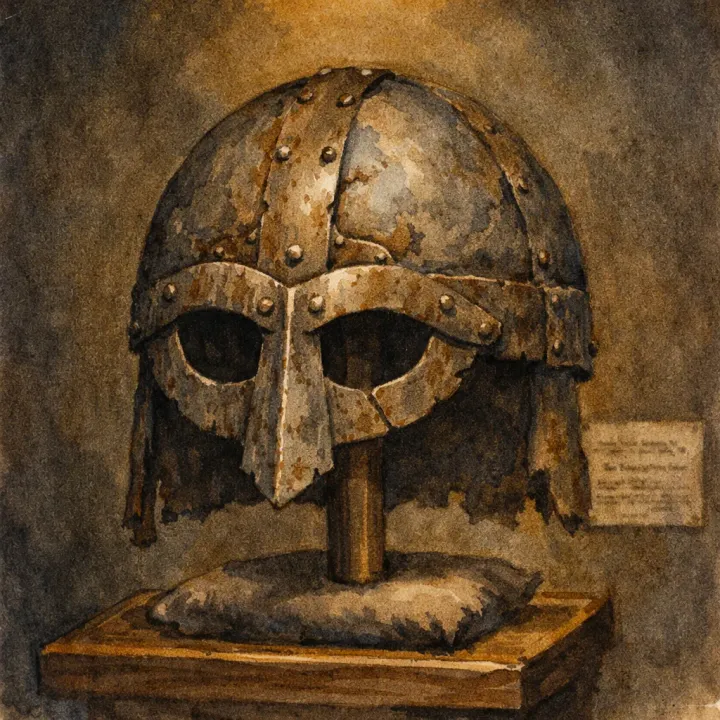
The Gjermundbu Helmet
The best-preserved Viking Age helmet ever found. Plain iron, nose guard, spectacle-shaped eye holes. Found in Norway, dated to c. 950-975 AD. No horns.
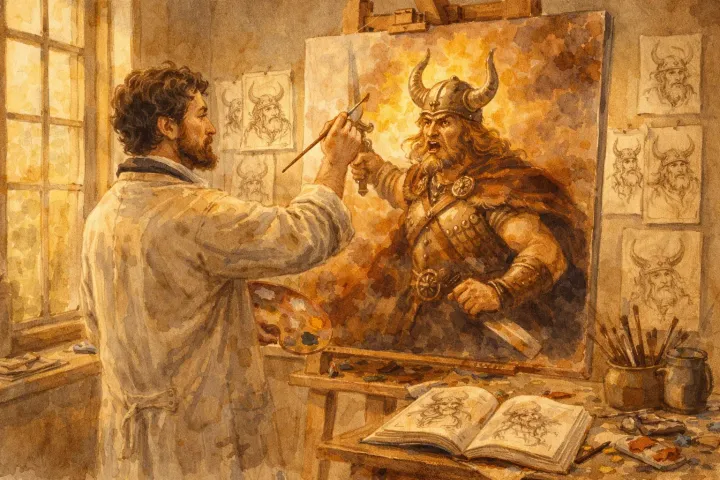
The Painter's Mistake
Swedish artist Johan August Malmström helped shape a romantic image of Norse life through illustrations. Such pictures were artistic interpretations, not records of excavated Viking equipment.
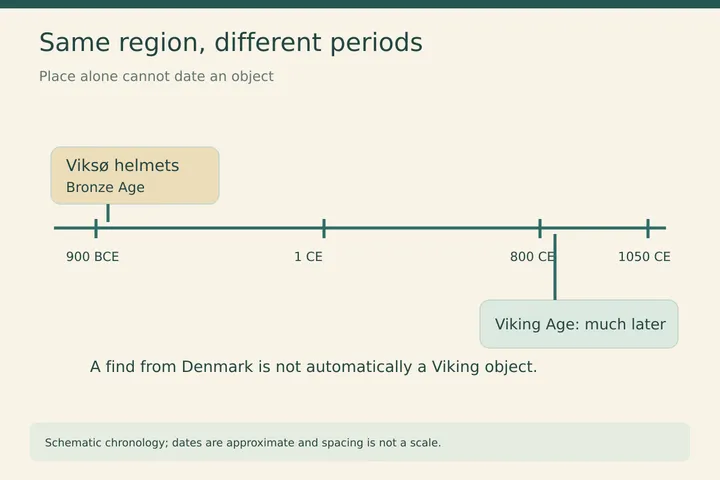
Same region, different periods
Place alone cannot date an object. Schematic chronology; dates are approximate and spacing is not a scale.
How the Myth Was Made
The Real Horns
Bronze Age horned helmets are made in Scandinavia — nearly 2,000 years before the Viking Age. They are ceremonial, not for battle.
The Poem
Swedish bishop Esaias Tegnér begins publishing Frithiof's Saga (completed 1825), romanticising Viking heroes. The poem is translated dozens of times. But even Tegnér does not put horns on his Vikings.
The Painting
Swedish artist Johan August Malmström illustrates Tegnér’s poem, contributing to a romantic visual tradition that should be distinguished from archaeological evidence.
The Opera
Wagner's Ring Cycle premieres at Bayreuth. Costume designer Carl Emil Doepler gives Norse characters horned helmets. Every major newspaper covers it. The image goes worldwide.
The Real Helmet
The Gjermundbu helmet is found in Norway — the best-preserved Viking helmet ever discovered. It has no horns.
The Detective
Yale scholar Roberta Frank publishes "The Invention of the Viking Horned Helmet," tracing the myth back to Doepler's 1876 costumes. The case is solved — but the myth endures.
The People in This Story
Carl Emil Doepler
Designed costumes for Wagner's Ring Cycle in 1876. He put horned helmets on Norse characters based on artistic convention — not history. His designs changed how the world sees Vikings.
Richard Wagner
Created the Ring Cycle — four operas lasting sixteen hours. The premiere was the cultural event of 1876. Wagner's opera gave Doepler's horned helmets the biggest stage in Europe.
Roberta Frank
A Yale professor who traced the horned helmet myth back to its source. Her 2000 paper is the definitive account of how the lie was born.

The Question That Remains
Every historian agrees the horned helmet is a myth. Every museum corrects it. Every piece of archaeological evidence contradicts it.
And yet it persists. If a lie is useful enough and repeated often enough, can it become more powerful than the truth?
Read the full book to investigate the key clues and competing explanations — then decide for yourself.
Get the Full Book
The complete Horned Helmet mystery. 9 chapters of evidence, theories, and a question only you can answer.
Part of the Hoaxes Volume
From fake fossils to trick photographs, we investigate the greatest hoaxes in history — and ask how clever people were fooled for so long.
See all books in this volume →Keep investigating
Check the evidence
What the evidence supports
Surviving Viking Age helmets do not support the familiar horned battle helmet. The Yarm helmet joins Gjermundbu as an important surviving example.
Where to be careful
Costumes helped popularise the image, but one designer did not invent every version of the myth. Rare finds cannot tell us what every person wore.
Explore the sources
These selected sources support this guide and offer further reading. Some are written for adults; explore them with a parent or teacher.
The story and illustrations are modern retellings. Imagined scene details are not historical evidence. These sources are a starting point, not citations for every narrative detail.
Evidence guide reviewed 8 September 2026.