
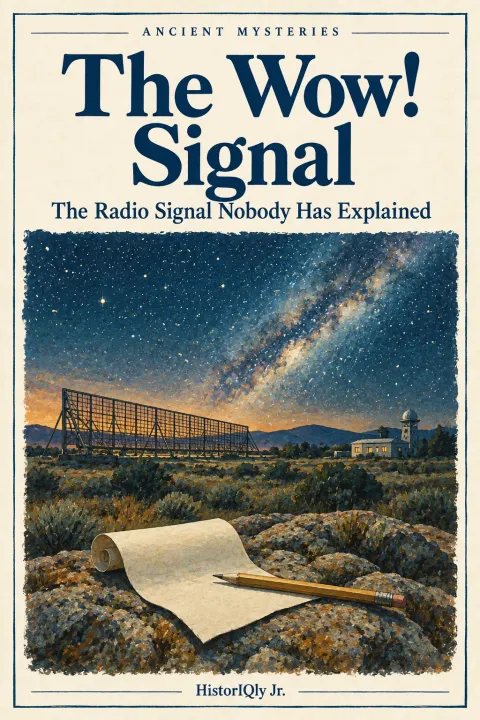
The Wow! Signal
The Radio Signal Nobody Has Explained
On August 15, 1977, Big Ear recorded an unusual radio signal over about seventy-two seconds. Jerry Ehman spotted the measurements later and wrote “Wow!” beside them. The observation interval does not establish the source’s full lifespan.
The signal was strong, narrowband and near the hydrogen line, making it interesting to SETI researchers. Those features did not establish a distance, a transmitter or an alien civilisation.
It has never been detected again. Despite more than a hundred searches over nearly fifty years, nobody has ever explained what sent it.
6EQUJ5
6EQUJ5 records six measurements, each occupying roughly twelve seconds including processing. U represents a value of 30–31 on the instrument’s signal-to-noise scale; the characters are not a decoded message.
72 sec
The approximate recorded interval as the sky crossed the observing beam; the source may have lasted longer.
1420 MHz
Near a familiar natural frequency suggested as one useful place to search for transmissions.
100+ attempts
Not one has ever detected the signal again.
The Evidence
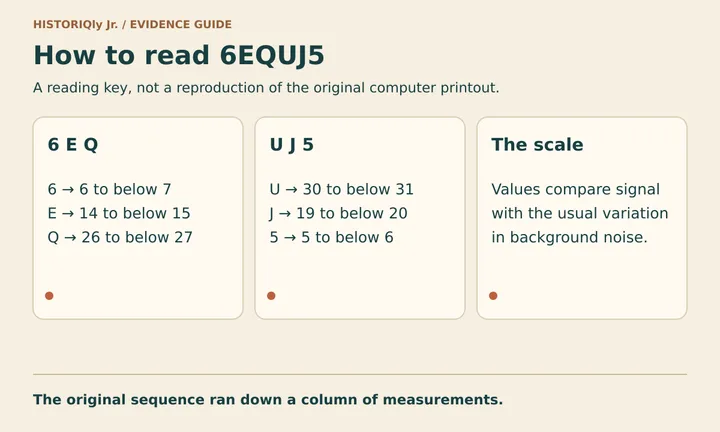
Reading the Six Characters
A typeset reading key for the six characters. These numbers encode instrument measurements; they are not words from the source.
Jerry Ehman’s marked printout preserves six signal-strength measurements. The detection was near the hydrogen line; later analysis has revisited the calibration. The printout is a measurement record, not an alien message.
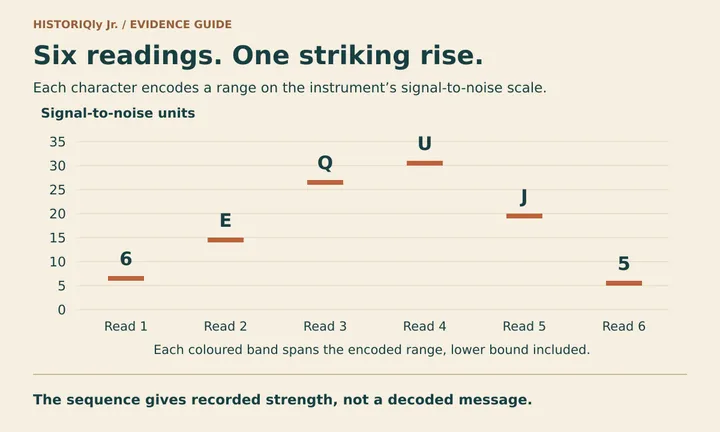
The Recorded Pattern
The six recorded character ranges, shown in order. Each mark spans one unit; it is not an exact measured value. The samples were about twelve seconds apart.
The rise and fall fitted the telescope’s response to a point source. That is a useful constraint on explanations, but it does not rule out every possible source of interference.
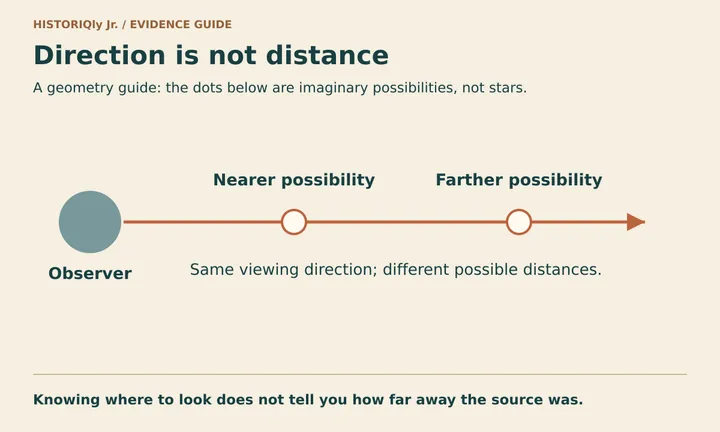
A Direction on the Sky
An abstract direction-and-distance diagram. It is not a star map and does not mark the signal’s position in Sagittarius.
Sagittarius gives a direction on the sky. It does not identify a host star, a distance or the source’s nature.
The Story of the Wow! Signal
The Prediction
Cocconi and Morrison suggest searching near the hydrogen line as one possible strategy. A recognisable natural frequency offers a place to look, not a rule that an extraterrestrial transmitter must follow.
Project Ozma
Frank Drake conducts an early radio search toward two stars. It does not establish a signal from extraterrestrial intelligence.
Big Ear Joins SETI
Big Ear joins the search for artificial signals. Jerry Ehman helps examine the recorded measurements.
The Wow! Signal
Big Ear records the unusual signal on the evening of August 15. Ehman’s later annotation gives the detection its enduring name.
The Search
Researchers including Robert Gray conduct follow-up observations with several telescopes. They do not recover a confirmed repeat from the source.
Big Ear Demolished
The telescope is dismantled after Ohio Wesleyan University sells the land for development. Preserved data allows later researchers to revisit the observation even after the instrument is gone.
The Comet Theory
Antonio Paris proposes a comet explanation. It has not become accepted: a proposed source must account for the direction, strength, narrow frequency range and single-horn detection.
The People in This Story
Jerry Ehman
A volunteer astronomer who identified the unusual sequence in the printout. His later reports explain both the measurements and the limits of the detection.
Robert Gray
A data analyst from Chicago who became obsessed with finding the signal again. He conducted multiple search campaigns, including one using the Very Large Array — one of the most powerful radio telescopes on Earth. He never found it.
Frank Drake
The astronomer who conducted the first SETI search in 1960 and created the Drake Equation — a formula for estimating the number of detectable civilisations in the Milky Way. His work made the Wow! Signal search possible.

The Question That Remains
Big Ear recorded an unusual signal. A 2025 preprint reanalysis proposed revised positions, brightness and a frequency near 1420.726 MHz. These revisions need independent checking; they do not identify the source.
Which proposed explanation fits the recorded pattern, frequency and missing repeat detection together? What new observation would help distinguish it from the alternatives?
Read the full book to investigate the key clues and competing explanations — then decide for yourself.
Get the Full Book
The complete Wow! Signal mystery. 9 chapters about the detection, follow-up searches and what an unidentified signal can tell us.
Part of the Ancient Mysteries Volume
Desert drawings, undeciphered writing, and ingenious ancient machines. Discover what the evidence explains — and which questions remain open.
See all books in this volume →Keep investigating
Check the evidence
What the evidence supports
Big Ear recorded an unusual narrowband signal in 1977. Jerry Ehman’s report explains the observations and instrumental limits.
Where to be careful
The 72 seconds describe the recorded passage through the telescope’s beam, not a proven total transmission length. No decoded message or alien origin was established. Later reanalyses, including a 2025 preprint, propose revised measurements; these do not confirm a source.
Explore the sources
These selected sources support this guide and offer further reading. Some are written for adults; explore them with a parent or teacher.
- Jerry Ehman: Wow! Signal, 30th Anniversary Report
- Gray and Ellingsen: Follow-up searches and their limits
- 2025 preprint: revised Wow! measurements (provisional)
- 2024 paper: proposed hydrogen-cloud explanation
The story and illustrations are modern retellings. Imagined scene details are not historical evidence. These sources are a starting point, not citations for every narrative detail.
Evidence guide reviewed 8 September 2026.