
Atlantis
The Island That Swallowed Itself — Or Did Plato Make It Up?
In 360 BC, the Greek philosopher Plato described an island civilisation so powerful it threatened the entire ancient world. It had concentric rings of water and land, temples covered in silver, and a navy of twelve hundred warships. Then the gods destroyed it — in a single day and night.
For 2,400 years, explorers have searched for Atlantis in the Atlantic, the Mediterranean, the Caribbean, and even under Antarctic ice. Governments have funded expeditions. Scientists have published papers. More than forty locations have been proposed.
Nobody has ever found it. The entire story comes from one man — and his own student said he made it up.
2,400 Years
The Atlantis story has persisted since Plato first wrote it down around 360 BC — making it one of the longest-running mysteries in human history.
1
Plato supplies the earliest surviving detailed Atlantis account.
40+
From the Atlantic to Antarctica — none confirmed.
~1600 BC
The real volcanic disaster that may have inspired the legend.
The Evidence
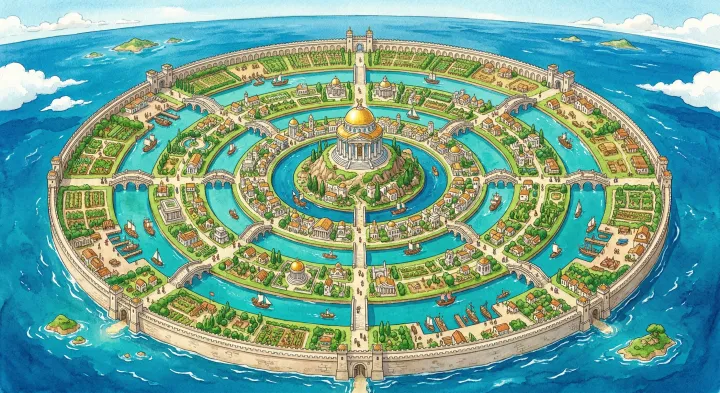
The Dialogues
Plato described Atlantis in two philosophical texts — Timaeus and Critias. No other ancient writer independently confirms the story. Plato describes earlier retellings, but that chain is not independently confirmed.
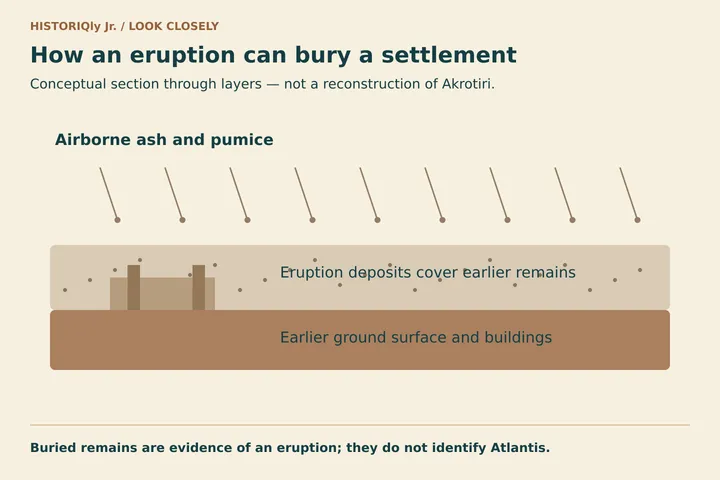
The Thera Catastrophe
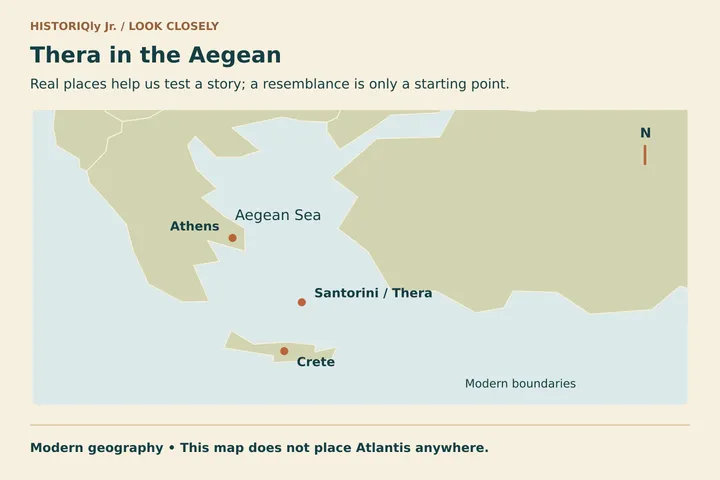
Around 1600 BC, Thera erupted and buried Akrotiri. Minoan life continued on Crete. Whether memory of the eruption influenced Plato is unproved.
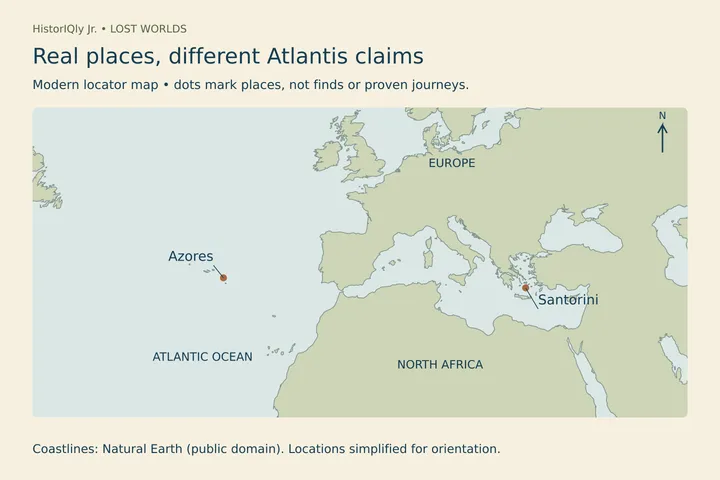
40+ Locations, Zero Proof
Proposals place Atlantis in many different regions. Seafloor geology rules out Donnelly’s recently sunken Atlantic continent, but a claim about any smaller site must be tested separately.
2,400 Years of Searching
Solon Visits Egypt
The Athenian statesman Solon supposedly hears the story of Atlantis from Egyptian priests at the temple of Saïs. He brings it back to Athens.
Plato Writes It Down
Plato describes Atlantis in Timaeus and Critias. A familiar quotation attributed to Aristotle is disputed and cannot settle its truth.
Donnelly's Bestseller
U.S. congressman Ignatius Donnelly publishes Atlantis: The Antediluvian World, arguing Atlantis was a real continent in the mid-Atlantic. The book sparks a global obsession.
The Minoans Discovered
Sir Arthur Evans begins excavating at Knossos on Crete, uncovering the Minoan civilisation — an advanced society nobody knew had existed.
The Minoan Hypothesis
Greek archaeologist Spyridon Marinatos proposes that the Thera eruption destroyed the Minoans and inspired the Atlantis legend.
Akrotiri Excavated
Marinatos begins digging at Akrotiri on Santorini, uncovering a Bronze Age town preserved under volcanic ash — like a Minoan Pompeii.
The People in This Story
Plato
Greek philosopher (c. 428–348 BC). The source of the earliest surviving detailed Atlantis account. He wrote it in two dialogues — Timaeus and Critias. Was he recording history or inventing a parable?
Ignatius Donnelly
U.S. congressman from Minnesota (1831–1901). His 1882 bestseller revived the Atlantis myth and launched a global search. Brilliant — but his central theory was wrong.
Spyridon Marinatos
Greek archaeologist (1901–1974). He proposed the Minoan hypothesis and excavated Akrotiri on Santorini — a real Bronze Age town whose connection to Plato’s story remains unproved.
The Question That Remains
Large-scale seafloor maps help test claims about vanished continents. They do not mean every patch of ocean floor has been examined closely. No accepted archaeological evidence identifies Plato’s Atlantis.
Was Atlantis a real place destroyed by a real catastrophe — or the greatest piece of philosophical fiction ever written? And if it was fiction, why can't the world let it go?
Read the full book to investigate the key clues and competing explanations — then decide for yourself.
Get the Full Book
The complete Atlantis mystery. 9 chapters of evidence, theories, and a question only you can answer.
Part of the Lost Worlds Volume
Ancient cities, remarkable structures, and the communities who built them. Explore the evidence and the living histories behind the ruins.
See all books in this volume →Keep investigating
Check the evidence
What the evidence supports
Plato tells the Atlantis story in his dialogues. These texts are the starting point for investigating the legend.
Where to be careful
A real place with a resemblance to the story does not establish Plato’s island empire as historical fact. Later writers also discussed Atlantis.
Explore the sources
These selected sources support this guide and offer further reading. Some are written for adults; explore them with a parent or teacher.
The story and illustrations are modern retellings. Imagined scene details are not historical evidence. These sources are a starting point, not citations for every narrative detail.
Evidence guide reviewed 8 September 2026.