
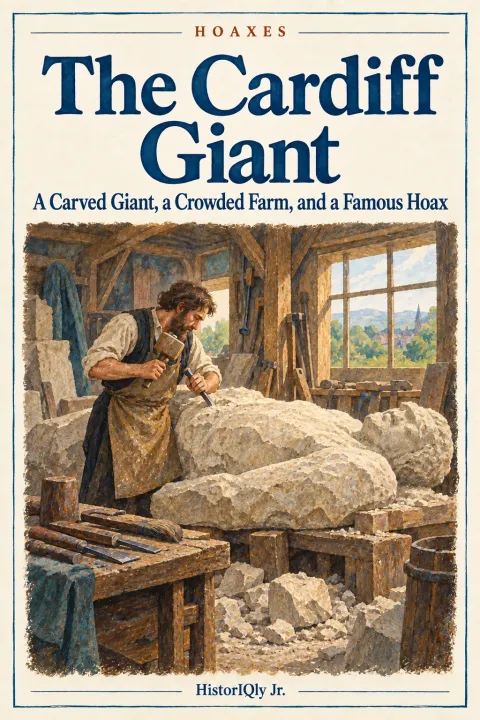
A Carved Giant, a Crowded Farm, and a Famous Hoax
On October 16, 1869, two men digging a well on a quiet farm in Cardiff, New York, struck something hard beneath the clay. They kept digging. What they uncovered was a stone figure roughly ten feet long, often described as weighing about three thousand pounds.
Visitors offered different explanations: a petrified person, an old statue or a modern trick. P.T. Barnum added a competing plaster copy to the spectacle.
Some visitors were convinced; others doubted it from the start. George Hull had paid stoneworkers to carve a gypsum figure and arrange its discovery. Reports exposed the hoax within months.
1869
George Hull paid stoneworkers to carve a gypsum giant in Chicago. The organisers planted it on Newell’s farm in 1868 and arranged its “discovery” the following year.
3,000 lbs
Nearly as heavy as a small car. It took ropes and a crane to lift it out.
50 cents
The price rose from 25 cents as the exhibit attracted crowds.
Dec 1869
Press reports described Hull’s part in making and planting the giant.
The Evidence
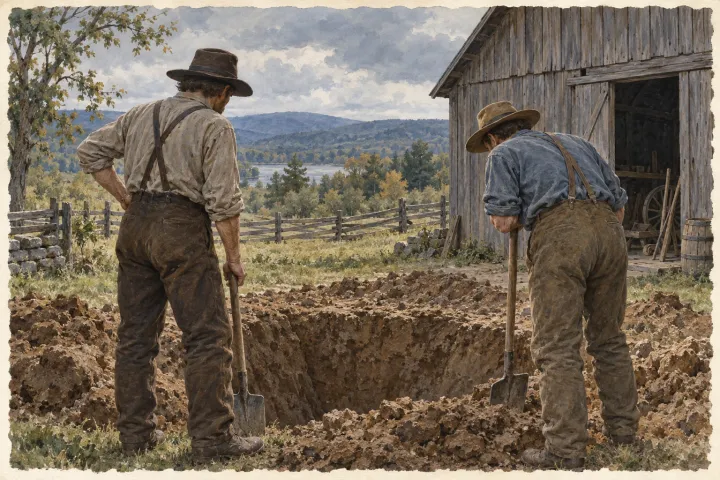
The Stone Giant
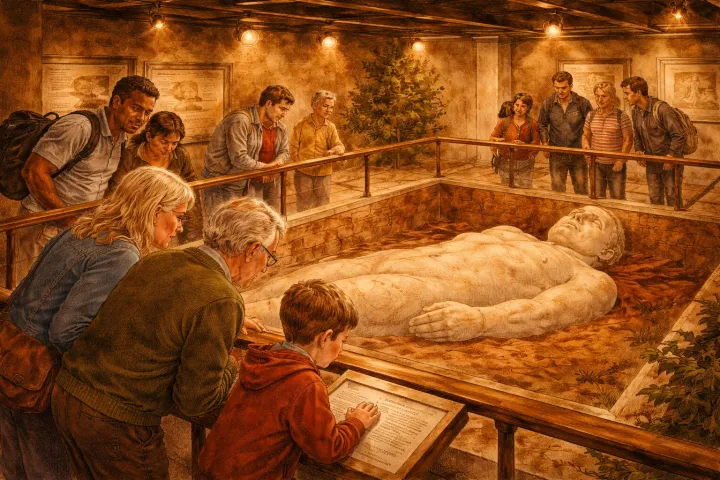
An imagined pause during the farm excavation. The discovery itself remains outside the frame; this is not a measured view of the pit or statue.
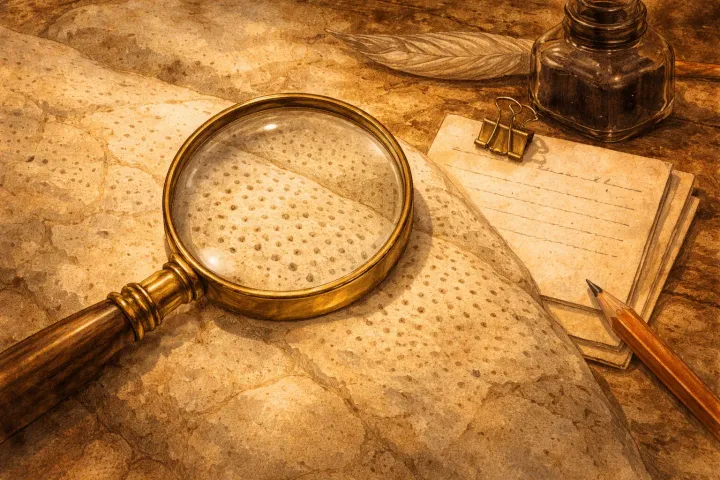
The Chisel Marks
Yale professor Othniel Charles Marsh identified tool marks on the surface. He called it "a most decided humbug." Surviving marks on soft gypsum challenged the claim of a long burial in damp ground.
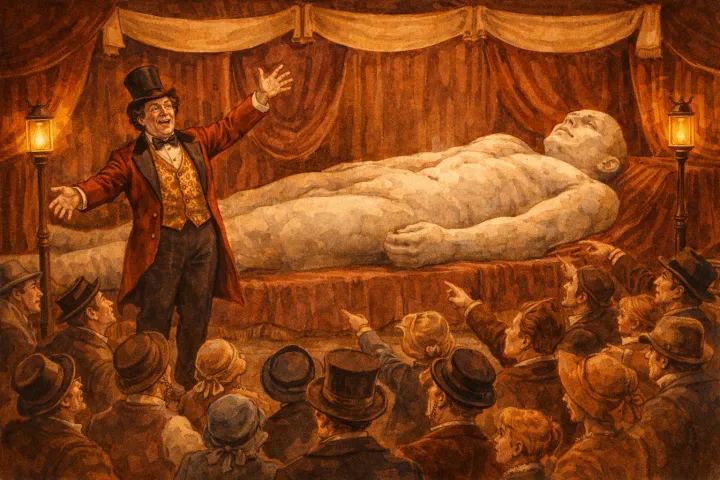
Barnum's Fake of a Fake
When P.T. Barnum couldn't buy the original, he made a plaster copy and displayed it as the "real" giant. The rival exhibit created a business dispute. A copy of a modern carving is still not an ancient human body.
How the Hoax Unfolded
The Argument
George Hull attends a Methodist revival meeting in Iowa and argues with Reverend Turk about whether the Bible's giants were real. Hull later said the dispute helped give him the idea. The exact exchange is not recorded here.
The Quarry
Hull hires men to cut a large block of gypsum near Fort Dodge, Iowa. He tells them it is for a monument to Abraham Lincoln. That claim serves as his cover story.
The Secret Carving
In Chicago, stoneworkers carve the figure in secret. Accounts describe needle marks and surface treatments intended to imitate skin and age.
The Burial
Under cover of darkness, the 3,000-pound giant is buried behind the barn on Stub Newell's farm in Cardiff, New York. The organisers leave it buried until the following October.
The "Discovery"
Workers hired to dig a well uncover the figure on October 16. Visitors pay to see it, but a crowd cannot establish that a carving is ancient.
The Confession
Reports describe George Hull’s admission that the giant was made and planted. He describes the quarry, the carving, the needles, the acid, and the burial. The crowds keep coming anyway.
The People in This Story
George Hull
A cigar maker and atheist from Binghamton, New York. He arranged the carving and planting. He later described a religious argument as his inspiration, and he also made money from the deception.
Othniel Charles Marsh
A Yale palaeontologist who examined the giant and identified surviving tool marks. He called it "a most decided humbug" — and he was right.
P.T. Barnum
A showman who exhibited a plaster copy as the real giant. His rival display added another claim for investigators to check.
The Question That Remains
Hull confessed, and reports explained how the giant had been made. People still came to see the famous hoax.
Hull said he wanted to challenge careless belief, and he profited from deceiving visitors. How should a museum explain both facts? What evidence makes the hoax clear?
Read the full book to investigate the key clues and competing explanations — then decide for yourself.
Get the Full Book
The complete Cardiff Giant mystery. 9 chapters of evidence, theories, and a question only you can answer.
Part of the Hoaxes Volume
From fake fossils to trick photographs, we investigate the greatest hoaxes in history — and ask how clever people were fooled for so long.
See all books in this volume →Keep investigating
Check the evidence
What the evidence supports
The giant is a carved gypsum figure uncovered on 16 October 1869. Accounts trace its manufacture and planting; the Farmers’ Museum has held it since 1947.
Where to be careful
Retrospective accounts differ on dates, weights, treatments, money and Hull’s relationship to Newell. The evidence supports manufacture and planting without a precise workshop recipe. Crowds and ticket sales show interest, not every visitor’s belief; a sale price is not net profit.
Explore the sources
These selected sources support this guide and offer further reading. Some are written for adults; explore them with a parent or teacher.
- The Farmers’ Museum: 2019 collection highlights
- Stockwell: The Cardiff Giant, and Other Frauds (1878 transcription)
- White eyewitness memoir and 1869 broadside, transcribed by Donald Simanek
The story and illustrations are modern retellings. Imagined scene details are not historical evidence. These sources are a starting point, not citations for every narrative detail.
Evidence guide reviewed .