
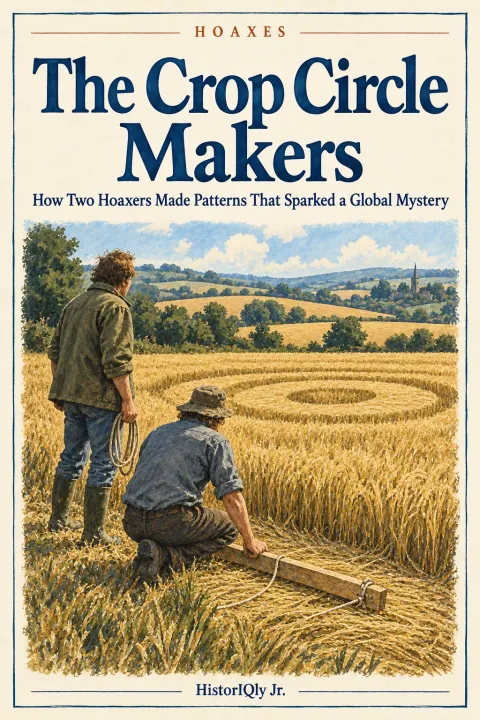
How Two Hoaxers Made Patterns That Sparked a Global Mystery
Beginning in the 1970s, Doug Bower and Dave Chorley made formations with simple tools. Over the following years, they created hundreds of mysterious circles that baffled scientists, filled newspapers, and inspired an entire field of study called cereology.
When Doug Bower and Dave Chorley finally confessed in 1991, the expert who had declared crop circles impossible to fake examined their test circle — and couldn't tell the difference.
Their demonstration showed that simple tools could make convincing patterns. It did not identify the maker of every formation.
1970s – 1991
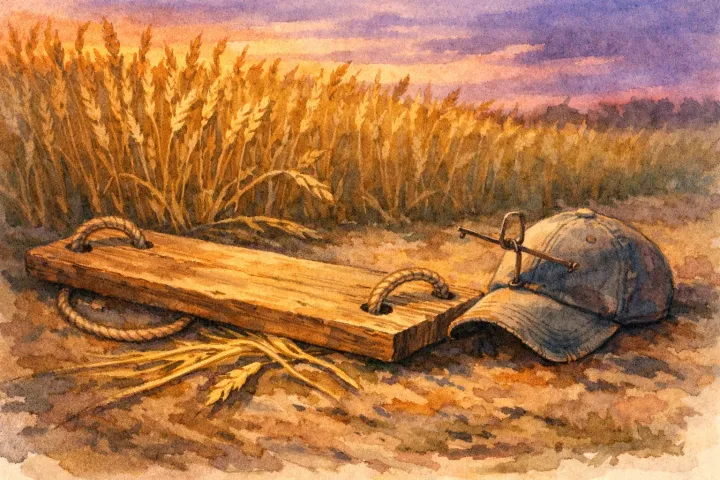
Doug Bower and Dave Chorley made crop circles in southern English fields over several years using wooden "stomper boards," rope, and a wire sight on a baseball cap. They worked by moonlight, entering fields via tractor tramlines to avoid leaving footprints.
1970s
Their reported starting decade. Accounts differ between 1976 and 1978.
3
A plank, a piece of rope, and a wire sight. That was the entire technology.
1991
A public demonstration let observers check a human method rather than rely on a confession alone.
The Evidence
The Formations
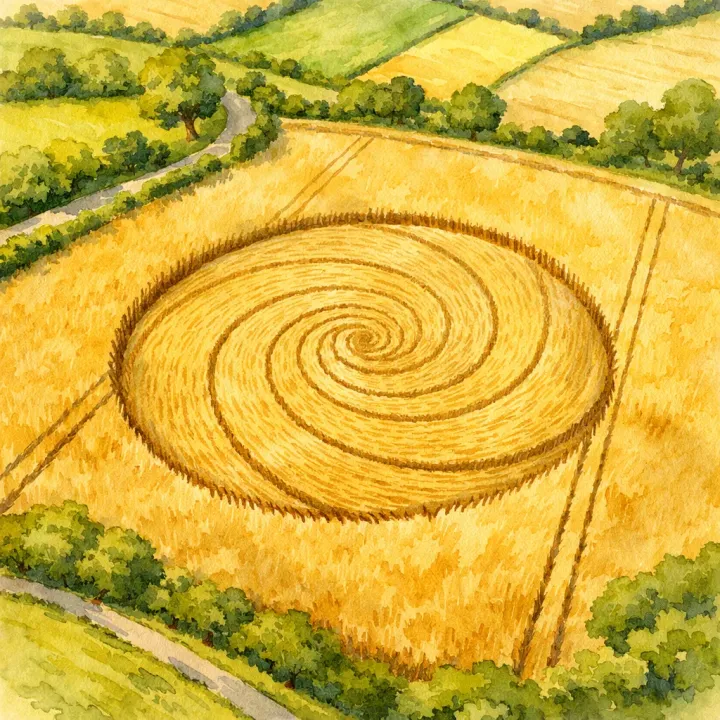
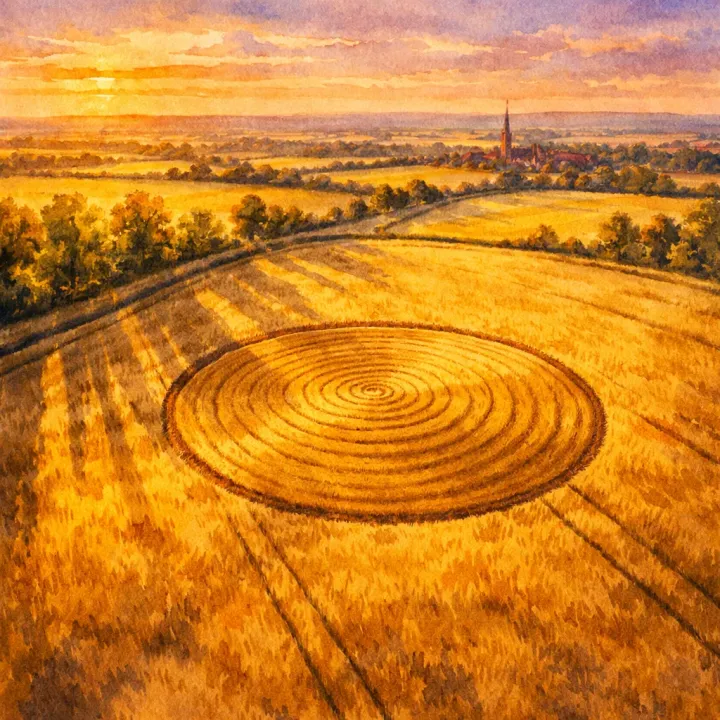
Hundreds of crop circles appeared in southern English wheat fields during the 1970s and 1980s. They grew from simple circles to elaborate geometric patterns. Bent stems alone do not reveal a maker. Investigators need comparisons with patterns whose construction is known.
The Stomper Board
A four-foot wooden plank with rope threaded through holes at each end. Stand on it, hold the rope like reins, and walk forward. The plank can press stalks flat; the amount of damage depends on the plants and how the tool is used.
The Demonstration
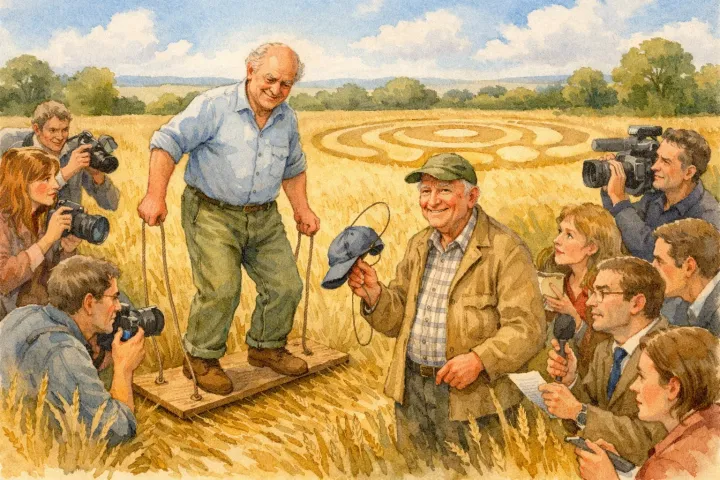
In September 1991, Doug and Dave demonstrated their technique for journalists. Expert Pat Delgado examined their test circle and declared it genuine — before learning who made it.
How the Story Unfolded
The Inspiration
A farmer in Tully, Queensland, Australia discovers a circular flattened area in a swamp. Newspapers call it a "flying saucer nest." Doug Bower reads the story and remembers it.
The First Circle
Doug Bower and Dave Chorley later describe beginning their circle-making in southern England. Published accounts give different starting years.
The Stomper Board
Doug invents the "stomper board" — a plank with rope handles — and a wire sight attached to a baseball cap. The circles become precise and clean.
Circles Go Viral
Crop circles become front-page news across England. Scientists, TV crews, and researchers flock to the fields. "Cereology" is born. Doug and Dave keep scrapbooks of their press coverage.
Circular Evidence
Pat Delgado and Colin Andrews publish their bestselling book declaring crop circles impossible to fake. Dr Terence Meaden proposes the "plasma vortex" theory.
The Confession
Doug and Dave contact the Today newspaper and confess. They demonstrate their technique in front of cameras. Pat Delgado examines their test circle and declares it genuine — before being told the truth.
The Legacy
Other teams take over, creating even more complex formations. Makers have documented formations created as art and advertising. A design's complexity is not evidence of an alien maker.
The People in This Story
Doug Bower
A picture framer and watercolour painter from Southampton who remembered the Australian "saucer nest" photograph and decided to recreate it in an English field. He invented the stomper board and the baseball cap sight.
Dave Chorley
Doug's Friday-night pub companion who helped create the circles over several years. Together, they went from rough attempts with an iron bar to elaborate formations that baffled the world.
Pat Delgado
A retired engineer who had worked on NASA tracking stations and co-authored Circular Evidence (1989), declaring crop circles impossible to fake. He examined Doug and Dave's test circle and couldn't tell it was man-made.
The Question That Remains
Doug and Dave demonstrated a human method. Accounts describe Pat Delgado initially accepting their test formation as mysterious. That challenged his identification method, while leaving the maker of any other formation a separate question.
Was the real hoax the circles themselves — or was it the story people built around them?
Read the full book to investigate the key clues and competing explanations — then decide for yourself.
Get the Full Book
The complete Crop Circle Makers mystery. 9 chapters of evidence, theories, and a question only you can answer.
Part of the Hoaxes Volume
From fake fossils to trick photographs, we investigate the greatest hoaxes in history — and ask how clever people were fooled for so long.
See all books in this volume →Keep investigating
Check the evidence
What the evidence supports
Doug Bower and Dave Chorley demonstrated that people could make convincing crop circles using simple tools. Makers describe boards, rope and use of existing tractor tracks.
Where to be careful
Accounts differ over 1976 or 1978 as their start; this book uses the 1970s. Their demonstration does not identify every formation’s maker. An unidentified maker is not evidence of an alien maker.
Explore the sources
These selected sources support this guide and offer further reading. Some are written for adults; explore them with a parent or teacher.
- Crop Circles: The Art of the Hoax (co-written by circle maker Rob Irving)
- Circlemakers: Beginners’ Guide
- Circlemakers: The Black Arts (Mike J’s account)
The story and illustrations are modern retellings. Imagined scene details are not historical evidence. These sources are a starting point, not citations for every narrative detail.
Evidence guide reviewed .