
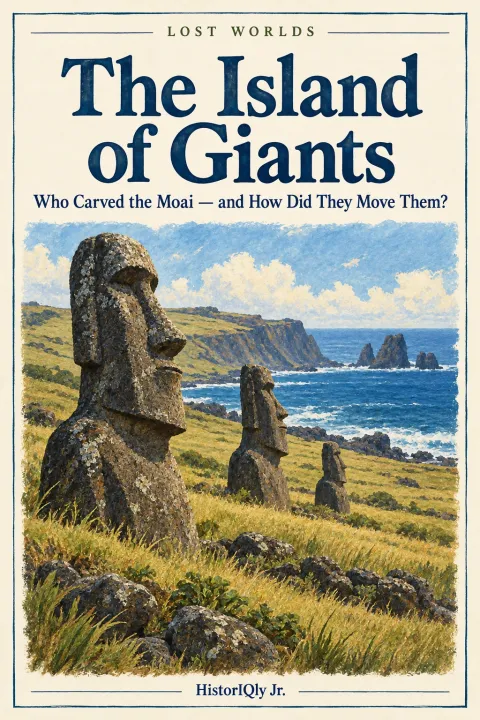
The Island of Giants
Who Carved the Moai — and How Did They Move Them?
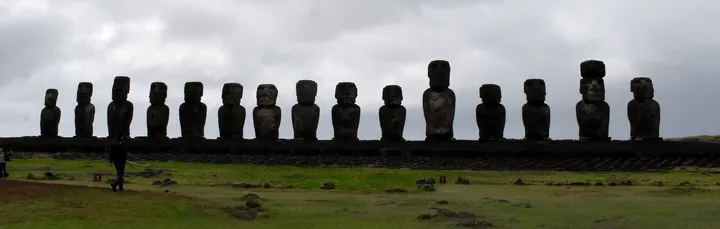
In 1722, Dutch visitors reached Rapa Nui and saw enormous stone statues. Many stood on platforms near the coast. Today, nearly a thousand moai are known across the island, including unfinished and fallen statues; that total is not the number the visitors saw standing.
Nobody could explain who built them or how. The islanders had no metal, no wheels, and almost no trees. But they had an answer: the statues walked.
A 2011 experiment showed that a replica could be moved upright with ropes, supporting a possible walking method.
~900 Moai
Nearly a thousand colossal stone figures, carved from volcanic rock at a single quarry called Rano Raraku and transported across the island by teams using nothing but rope and ingenuity.
10 metres
Paro — the tallest moai ever erected — weighed 82 tonnes.
21 metres
Te Tokanga — still attached to the quarry. As tall as a seven-storey building.
18 people
All it took to "walk" a moai 100m. Three ropes, no wheels, no logs.
The Evidence
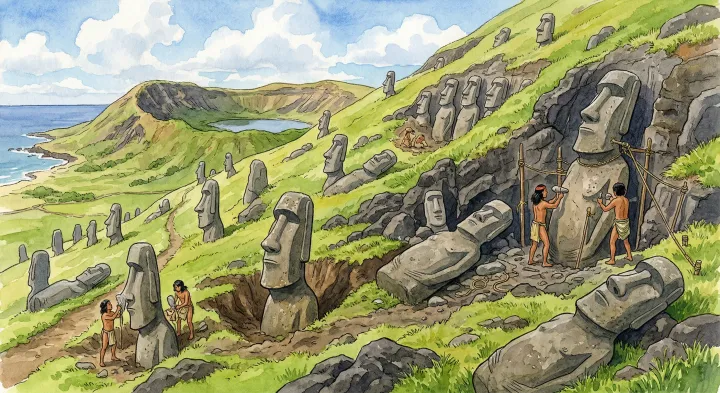
Rano Raraku
Nearly 400 moai remain at this volcanic quarry — some finished, some half-carved into the cliff. 95% of all moai were carved from this single location. Unfinished carvings preserve clues to quarrying; they do not establish one sudden stop.
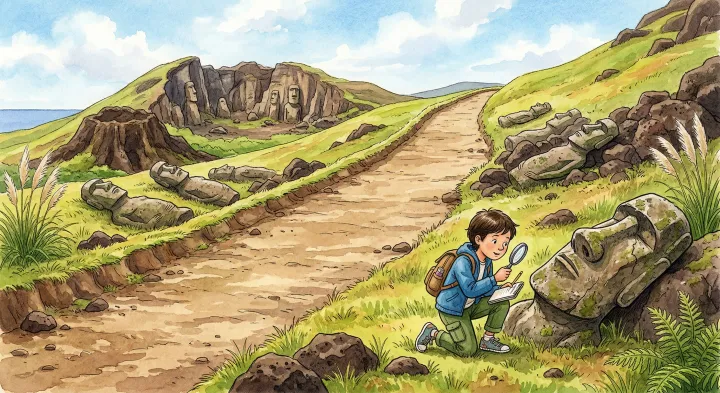
The Fallen Road Moai
Over 25 km of ancient roads lead from the quarry to the coast. Along them, ~60 fallen moai show a telling pattern: face-down on downhill slopes, on their backs going uphill. Consistent with upright "walking," not flat dragging.
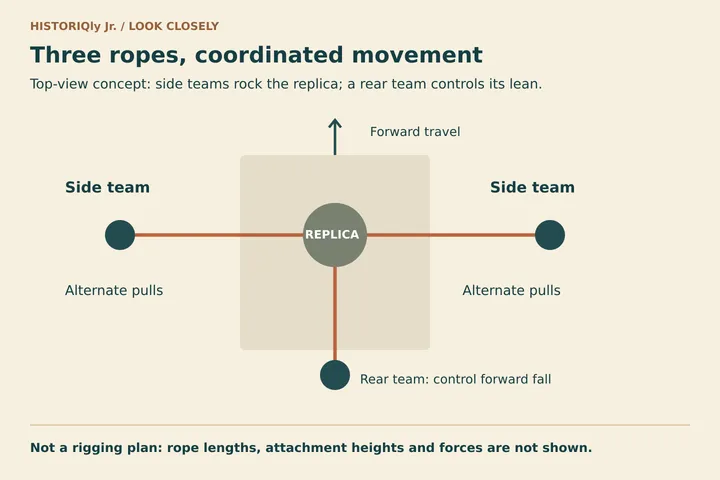
The Walking Experiment
In 2011, scientists built a replica moai and proved 18 people with 3 ropes could rock it forward in a controlled waddle — 100 metres in under an hour. Its shape helped the experiment work; ancient transport must also be tested against the roads and statues.
The Story of Rapa Nui
First Settlers Arrive
Polynesian navigators reach Rapa Nui in double-hulled canoes after sailing thousands of kilometres across open ocean. They find a forested, uninhabited island.
The Age of the Moai
Peak construction period. Hundreds of moai are carved, and many are transported to platforms around the coast. The largest — Paro — stands almost 10 metres tall.
The Forests Disappear
The island's native palm trees vanish — likely due to a combination of human clearing and Polynesian rats eating palm seeds. The Rapa Nui adapt with rock garden farming.
Roggeveen Arrives
Dutch explorer Jacob Roggeveen spots the island on Easter Sunday and names it Easter Island. He finds 2,000–3,000 people and moai still standing. His crew tragically opens fire, killing at least 10 islanders.
The Slave Raids
Peruvian ships capture roughly 1,500 Rapa Nui people for forced labour in Peru. Returning survivors bring smallpox. By 1877, 111 residents are recorded on the island.
Routledge's Expedition
English archaeologist Katherine Routledge conducts an extensive archaeological survey of the island, cataloguing moai, excavating sites, and recording oral histories over 17 months.
Heyerdahl Digs Deeper
Thor Heyerdahl's expedition excavates buried moai, revealing that the famous "heads" have full bodies hidden beneath centuries of soil.
The Statues Walk
Scientists Carl Lipo and Terry Hunt prove 18 people with 3 ropes can "walk" a moai — confirming what the Rapa Nui always said. The islanders were right all along.
The People in This Story
Katherine Routledge
English archaeologist who spent 17 months on Easter Island in 1914–1915, conducting an extensive archaeological survey. She catalogued the moai, excavated sites, and recorded oral histories that would prove invaluable decades later.
Thor Heyerdahl
Norwegian explorer whose 1955–56 expedition investigated statues and other remains. A brilliant adventurer who was wrong about where the Rapa Nui came from — but right that the statues held more secrets.
Carl Lipo & Terry Hunt
The archaeologists who proved the moai could "walk" in 2011. Their experiment — 18 people, 3 ropes, 100 metres — supported one physical interpretation of walking traditions.
.jpeg)
The Question That Remains
For decades, Easter Island was held up as history's greatest example of self-destruction. A civilisation that built too much and lost everything.
But newer evidence tells a different story — of a resilient people whose real tragedy came not from within, but from slave ships, disease, and colonisation.
Read the full book to investigate the key clues and competing explanations — then decide for yourself.
Get the Full Book
The complete Easter Island mystery. 9 chapters of evidence, theories, and a question only you can answer.
Part of the Lost Worlds Volume
Ancient cities, remarkable structures, and the communities who built them. Explore the evidence and the living histories behind the ruins.
See all books in this volume →Keep investigating
Check the evidence
What the evidence supports
Rapa Nui people created the moai, and their descendants maintain a living culture.
Where to be careful
Research published in 2024 challenges the familiar story of a huge population destroying its resources before European contact. A demonstrated transport method is not proof that every statue moved that way.
Explore the sources
These selected sources support this guide and offer further reading. Some are written for adults; explore them with a parent or teacher.
The story and illustrations are modern retellings. Imagined scene details are not historical evidence. These sources are a starting point, not citations for every narrative detail.
Evidence guide reviewed 8 September 2026.