
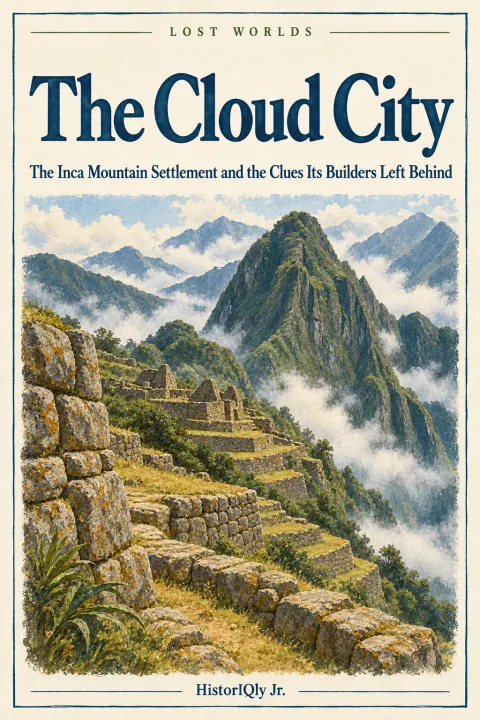
The Cloud City
The Inca Mountain Settlement and the Clues Its Builders Left Behind
In 1911, an American history professor climbed through dense jungle in Peru and emerged above the clouds to find an ancient city — about 200 stone buildings, sixteen fountains, and walls so perfectly fitted that a knife blade cannot pass between the stones. The Inca built it around 1450 with no wheels, no iron tools, and no mortar.
Then, sometime in the 1530s, they walked away. The site escaped much of the destruction suffered by other Inca centres. Local farmers always knew it was there — one visited nine years before the man who claimed to have "discovered" it.
After 600 years, the walls still stand, the fountains still carry water, and carefully fitted stonework continues to impress engineers.
~600 Years Old
Emperor Pachacuti ordered the construction of Machu Picchu around 1420–1450. An estimated 750 people may have lived there — royals, priests, servants, and workers. It functioned for roughly a century before being abandoned.
2,430 m
Nearly 1.5 miles above sea level — literally above the clouds.
~200
Temples, houses, fountains, and terraces — all built without mortar.
16
All fed from a single mountain spring through a 749-metre canal.
The Evidence
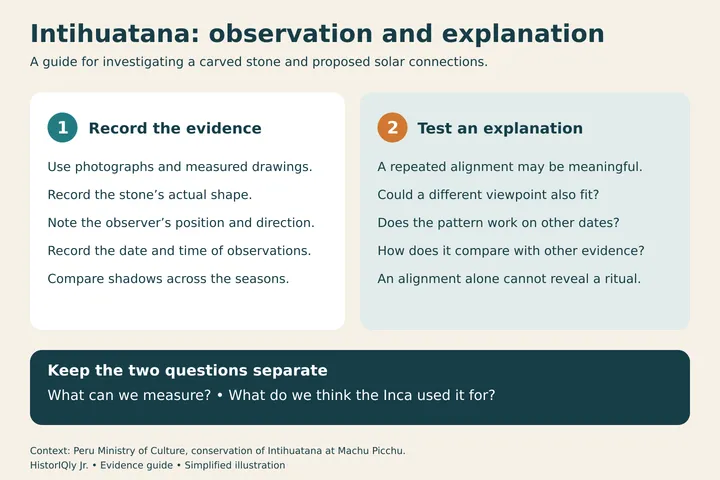
The Intihuatana
A carved stone generally interpreted in a ritual context. Proposed astronomical functions require careful measurement and comparison with its setting.
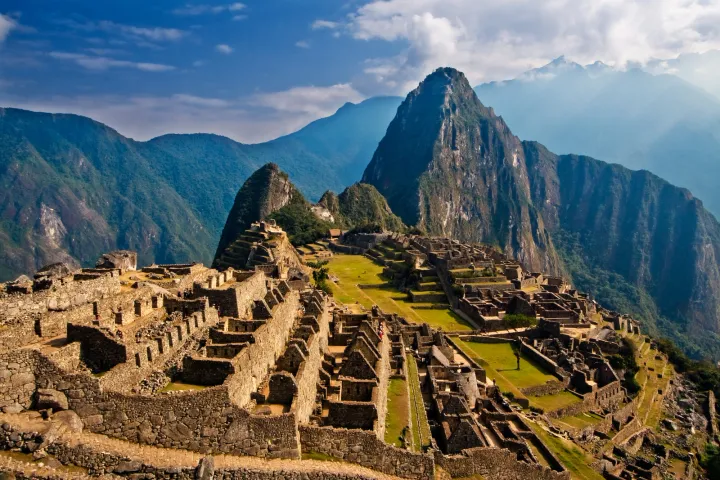
Machu Picchu’s surviving buildings photographed in morning light in 2007, with Huayna Picchu beyond. Photo: Pedro Szekely / Wikimedia Commons, CC BY-SA 2.0; prepared for publication without cropping.

Dancing Stones
The walls were built without mortar using ashlar masonry — stones cut so precisely a knife blade cannot fit between them. Closely fitted stones and inward-sloping walls help resist shaking, but the masonry is not indestructible.
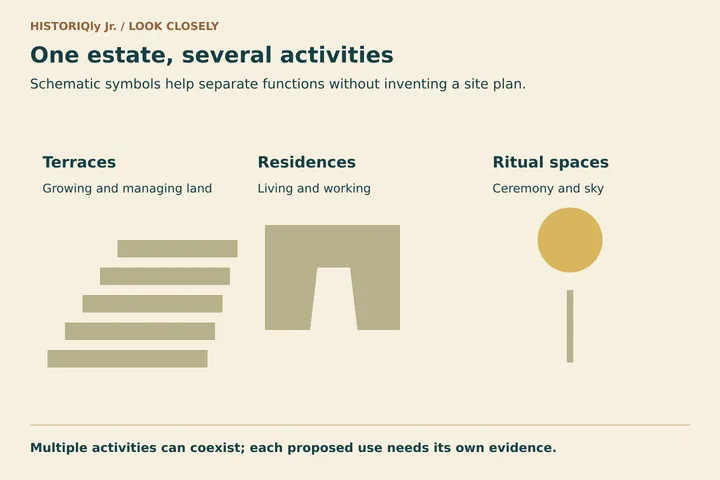
One Place, Several Uses
The diagram uses simple symbols for terraces, residences and ritual spaces. These activities could coexist at a royal estate. The symbols do not depict specific buildings or prove every proposed astronomical use.
From Empire to Jungle to World Wonder
Pachacuti Takes Power
Cusi Yupanqui becomes the 9th Sapa Inca, takes the name Pachacuti ("Earth-Shaker"), and begins transforming a small kingdom into the largest empire in pre-Columbian America.
The Cloud City Built
Pachacuti orders the construction of Machu Picchu as a royal estate on a ridge between two peaks. Workers quarry stone from the mountain itself. Its population is estimated in the hundreds.
Abandoned
Disease, civil war and conquest disrupted the Inca world. These changes provide context for Machu Picchu’s declining use, but do not establish one cause or a precise departure date for all its residents.
Lizárraga Visits
Peruvian farmer Agustín Lizárraga visits the ruins and writes his name and date on the Temple of the Three Windows. This recorded visit preceded Bingham’s by nine years.
Bingham Arrives
Hiram Bingham III, guided by local farmer Melchor Arteaga, climbs to the ruins. He finds two Quechua farmers already living there — and Lizárraga's inscription on the wall.
Artifacts Returned
After a decades-long dispute, Yale University returns thousands of artefacts to Peru. They are now displayed at the Casa Concha museum in Cusco.
The People in This Story
Pachacuti
The 9th Sapa Inca who transformed a small kingdom into the largest empire in pre-Columbian America. Most archaeologists believe he commissioned Machu Picchu as his private royal estate around 1420–1450.
Agustín Lizárraga
A Peruvian farmer who visited the ruins in 1902 — nine years before Bingham. He left his name on the wall. Bingham acknowledged the visit in his 1922 book, though Lizárraga remained far less internationally famous.
Hiram Bingham III
A Yale history professor who brought Machu Picchu to the world's attention in 1911. He misidentified the site as Vilcabamba and shipped thousands of artefacts to Yale — where they stayed for nearly 100 years.
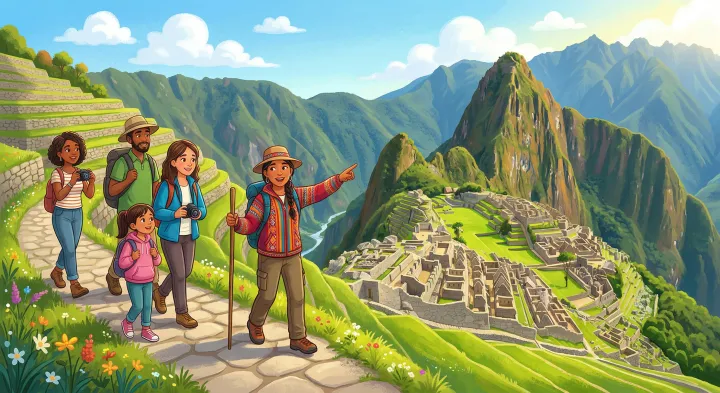
The Question That Remains
The walls still stand. The fountains still run. Researchers compare the buildings and objects with historical accounts; no surviving plan explains every feature.
Was Machu Picchu a palace, a temple, an observatory — or something nobody has thought of yet? And who deserves to be called its discoverer — the man who told the world, the farmer who got there first, or the people who never left?
Read the full book to investigate the key clues and competing explanations — then decide for yourself.
Get the Full Book
The complete Machu Picchu mystery. 9 chapters of evidence, theories, and a question only you can answer.
Part of the Lost Worlds Volume
Ancient cities, remarkable structures, and the communities who built them. Explore the evidence and the living histories behind the ruins.
See all books in this volume →Keep investigating
Check the evidence
What the evidence supports
Machu Picchu is an Inca site with carefully planned architecture, terraces and water management.
Where to be careful
Its precise uses and the circumstances of its abandonment remain topics of research. “Lost” describes outsiders’ awareness, not the knowledge of local people.
Explore the sources
These selected sources support this guide and offer further reading. Some are written for adults; explore them with a parent or teacher.
The story and illustrations are modern retellings. Imagined scene details are not historical evidence. These sources are a starting point, not citations for every narrative detail.
Evidence guide reviewed 8 September 2026.