
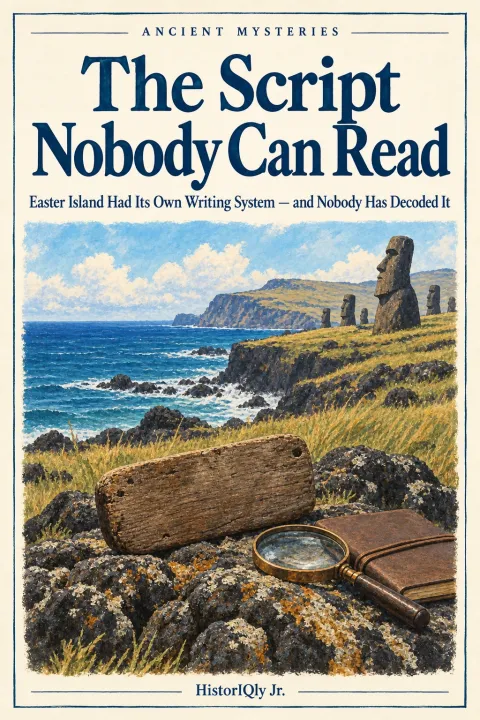
The Script Nobody Can Read
Easter Island Had Its Own Writing System — and Nobody Has Decoded It
In 1864, missionary Eugène Eyraud reported wooden objects covered in carved signs in Rapa Nui homes. Birds, people and other shapes repeat in rows. The system is called rongorongo, and researchers still debate exactly how it recorded information.
Slave raids, disease and colonial disruption devastated Rapa Nui communities in the 1860s. Knowledge of reading the signs was lost. Only a few dozen inscribed objects survive; exact counts depend on which fragments and disputed objects are included.
Many readings have been proposed without gaining general acceptance. A convincing explanation must work consistently across the surviving signs.
15,000 Glyphs
Thousands of carved signs survive on a small collection of objects. They were made on different woods, including reused wood. The objects preserve patterns, but no complete reading is generally accepted.
~52
Statistical analysis reduced 600 catalogued forms to about 52 core glyphs — consistent with a syllabary.
27
Only a few dozen inscribed objects survive in collections around the world.
1493
One tablet’s wood was dated to the late fifteenth or early sixteenth century. Establishing when it was carved is a separate challenge.
The Evidence
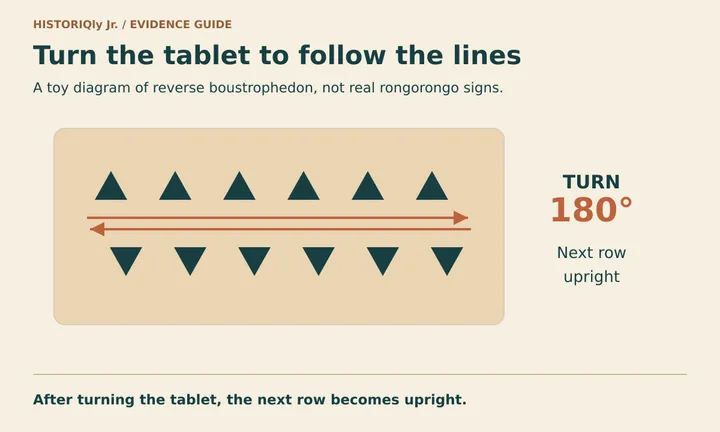
Turning the Lines
The alternating orientation of adjacent lines, illustrated with invented triangular shapes. This is not a glyph transcription or a verified reading.
Adjacent lines reverse orientation, so a reader would rotate the tablet to follow them. This distinctive arrangement is evidence about layout, not proof by itself of an independent invention of writing.
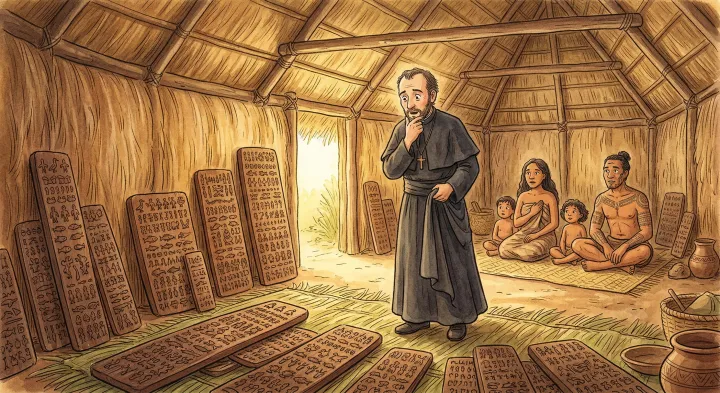
Comparing Texts
An imagined scene inspired by Eyraud’s report of inscribed wooden objects. The number of boards and their placement in this room are not a census or a documented interior.
Tablets H, P and Q preserve closely parallel sign sequences. Repetition supports the study of copying and structure, but does not by itself tell us each sign’s meaning.

Dating Wood and Carving
An imagined conservation study. Radiocarbon tests concern sampled wood; examining a tablet under a microscope is a different task and does not date the carving itself.
A 2024 study dated the wood of one tablet to before European contact. Wood can be older than the signs carved into it, so this is evidence to investigate, not a direct date for the inscription.
From Invention to Silence
Oldest Tablet Wood
One tablet’s wood was dated to the late fifteenth or early sixteenth century. Establishing when it was carved is a separate challenge.
Spanish Treaty
Spanish explorers visit Easter Island. Chiefs sign a treaty using marks that some historians think resemble rongorongo — possibly the earliest European witness of the script.
The Slave Raids
Slave raids, disease and colonial disruption devastate Rapa Nui communities in the 1860s. These losses damaged the transmission of knowledge; the surviving record does not identify the fate of every person who could interpret the signs.
Eyraud's Discovery
Eyraud reports inscribed wooden objects in homes in 1864. His report documents their presence, but does not establish exactly how many knowledgeable readers remained.
The Jaussen-Metoro Sessions
Bishop Jaussen works with Metoro Tau'a Ure in Tahiti, recording his chanting over four tablets. Later analysis shows Metoro was likely improvising, not truly reading.
Barthel's Catalogue
Thomas Barthel catalogues rongorongo signs and proposes a lunar-calendar interpretation for part of the Mamari tablet. Identifying a likely subject is different from translating the entire passage.
Radiocarbon Breakthrough
A 2024 study dates one tablet’s wood to before European contact, raising new questions about the age of its carving.
The People in This Story
Brother Eyraud
French Catholic missionary who arrived on Easter Island in January 1864 and was the first outsider to report the existence of rongorongo tablets. He saw hundreds in nearly every home. He died on the island in 1868.
Bishop Jaussen
Bishop of Tahiti who recognised the tablets' significance in 1868. He collected several tablets and spent years working with Metoro Tau'a Ure, producing the famous "Jaussen List" of glyph meanings.
Silvia Ferrara
Italian philologist at the University of Bologna whose 2024 radiocarbon dating study placed tablet wood at 1493-1509 — evidence relevant to its age, although the carving could be later than the wood.
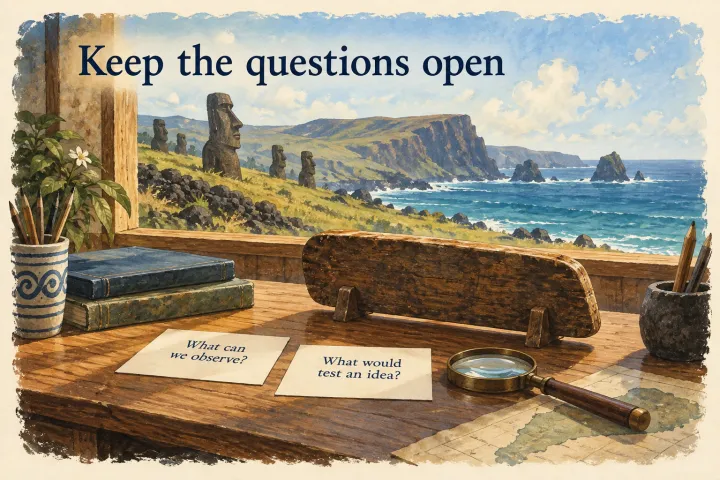
The Question That Remains
The surviving objects differ in condition and completeness. Their repeating signs can be studied, but no complete reading is generally accepted.
Did the Rapa Nui people independently invent one of the rarest achievements in human history — true writing? Or is rongorongo something else entirely? And will anyone, ever, crack the code?
Read the full book to investigate the key clues and competing explanations — then decide for yourself.
Get the Full Book
The complete rongorongo mystery. 9 chapters of evidence, theories, and a question only you can answer.
Part of the Ancient Mysteries Volume
Desert drawings, undeciphered writing, and ingenious ancient machines. Discover what the evidence explains — and which questions remain open.
See all books in this volume →Keep investigating
Check the evidence
What the evidence supports
Rongorongo signs survive on a small collection of objects from Rapa Nui. Museums preserve originals and copies.
Where to be careful
There is no generally accepted full reading. The system’s origin and relationship to spoken language remain debated.
Explore the sources
These selected sources support this guide and offer further reading. Some are written for adults; explore them with a parent or teacher.
The story and illustrations are modern retellings. Imagined scene details are not historical evidence. These sources are a starting point, not citations for every narrative detail.
Evidence guide reviewed 8 September 2026.