
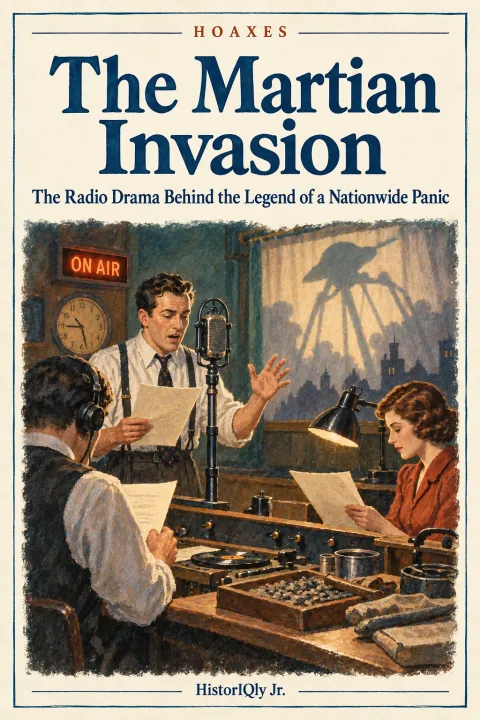
The Martian Invasion
The Radio Drama Behind the Legend of a Nationwide Panic
On the night before Halloween, 1938, a twenty-three-year-old named Orson Welles sat down at a CBS radio microphone and performed a play about Martians invading New Jersey. The next morning, newspapers across America reported that millions had panicked.
But modern historians have discovered something extraordinary: the "mass panic" was largely invented by the newspapers themselves — who were locked in a bitter war with radio for survival.
The real hoax wasn't the broadcast. It was the story about the broadcast.
October 30, 1938
Orson Welles and the Mercury Theatre performed a radio adaptation of H.G. Wells's The War of the Worlds, using fake news bulletins that mimicked real CBS breaking-news coverage. The broadcast included four separate disclaimers that it was fiction.
60 min
The broadcast ran for exactly one hour on CBS Radio.
~2 %
According to the C.E. Hooper rating, the standard measure of the era. Most listeners were tuned to NBC.
0
No deaths, serious injuries, or hospital spikes were ever documented.
The Evidence
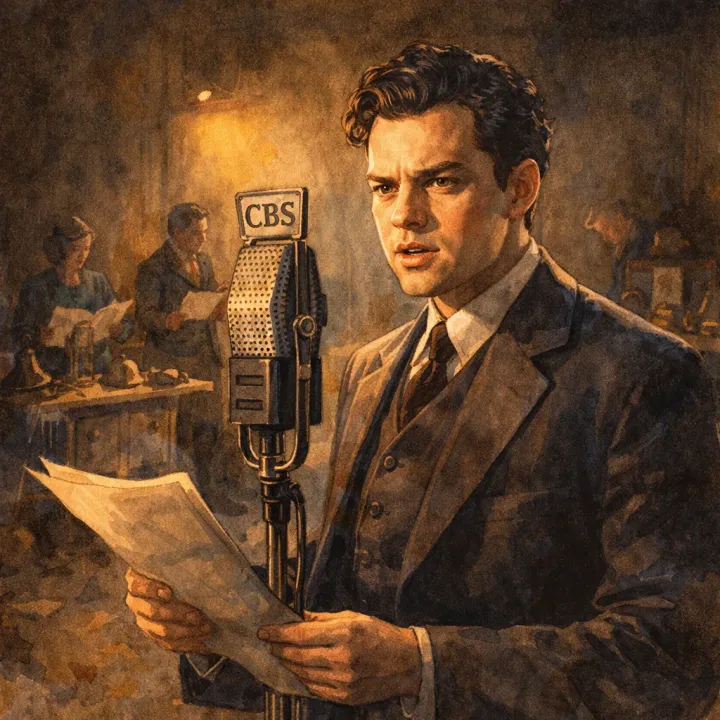
The Recording
The complete 60-minute broadcast survives. It includes four clear disclaimers that the programme is fiction. Fake news bulletins, performed by actors, describe a Martian invasion of New Jersey with escalating urgency.
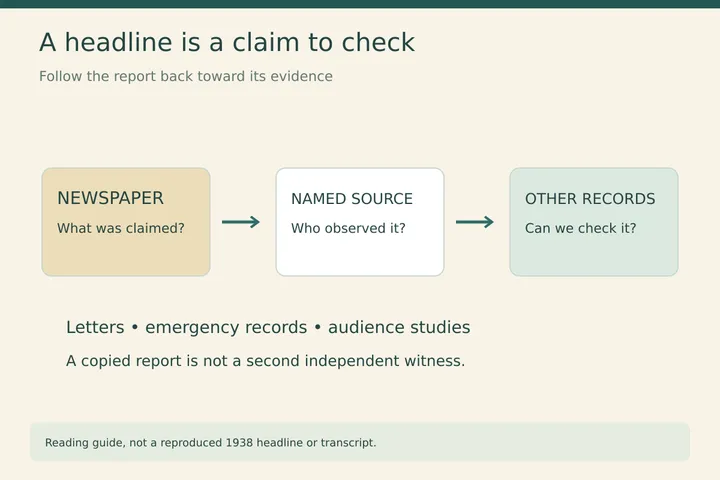
A headline is a claim to check
Follow the report back toward its evidence. Reading guide, not a reproduced 1938 headline or transcript.
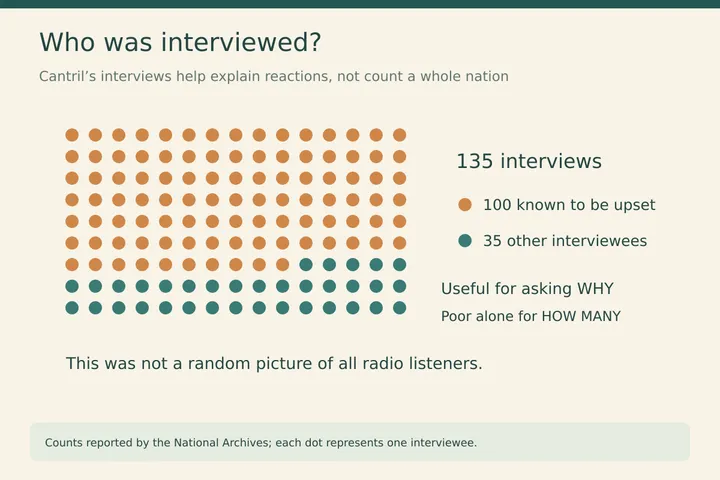
Who was interviewed?
Cantril’s interviews help explain reactions, not count a whole nation. Counts reported by the National Archives; each dot represents one interviewee.
How the Story Unfolded
The Novel
H.G. Wells publishes The War of the Worlds, a novel about a Martian invasion of England with tripod war machines and heat rays.
The Munich Crisis
Europe nearly goes to war. Americans spend weeks glued to their radios, hearing real breaking-news bulletins about Hitler's threats. The experience primes them to trust urgent radio bulletins.
The Broadcast
At 8:00 PM Eastern, the Mercury Theatre airs its adaptation on CBS. Fake news bulletins describe a Martian landing in Grover's Mill, New Jersey. Listeners who tune in late miss the disclaimer.
The Headlines
Newspapers run front-page stories about "mass panic." Welles holds an apologetic press conference. CBS issues a formal apology and pledges not to use fake-news formats again.
The FCC Verdict
The FCC investigates and imposes no penalties. Campbell Soup signs on as sponsor. Welles's fame skyrockets. All lawsuits are dismissed.
The Reassessment
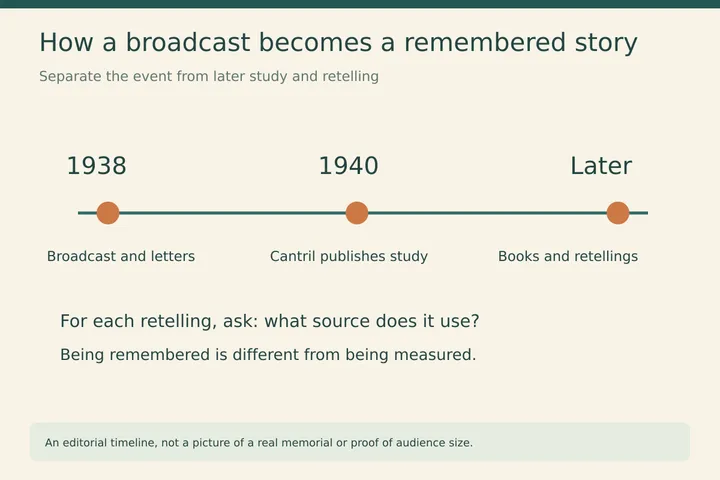
Historians Pooley and Socolow publish "The Myth of the War of the Worlds Panic," demonstrating that the mass panic was largely a newspaper exaggeration driven by the press's rivalry with radio.
The People in This Story
Orson Welles
A twenty-three-year-old theatre prodigy who directed and starred in the broadcast. He played Professor Pierson. Two years later, he made Citizen Kane.
Howard Koch
The scriptwriter who adapted H.G. Wells's novel into fake news bulletins. He set the invasion in real New Jersey towns and used a format designed to sound like real CBS breaking news.
Pooley & Socolow
Media historians who proved in 2013 that the "mass panic" was largely a newspaper invention. Only about 2% of households were even tuned to CBS that night.
The Question That Remains
The broadcast was fiction. The four disclaimers made that clear. But some people were fooled — and the newspapers turned it into the greatest panic story in American history.
Was Orson Welles irresponsible — or were the newspapers the real hoaxers?
Read the full book to investigate the key clues and competing explanations — then decide for yourself.
Get the Full Book
The complete Martian Invasion mystery. 9 chapters of evidence, theories, and a question only you can answer.
Part of the Hoaxes Volume
From fake fossils to trick photographs, we investigate the greatest hoaxes in history — and ask how clever people were fooled for so long.
See all books in this volume →Keep investigating
Check the evidence
What the evidence supports
Orson Welles’s company broadcast a fictional invasion on 30 October 1938. Letters to the FCC document varied reactions.
Where to be careful
Some listeners were frightened. That does not establish the later claim that the whole country panicked; audience estimates and newspaper accounts need scrutiny.
Explore the sources
These selected sources support this guide and offer further reading. Some are written for adults; explore them with a parent or teacher.
The story and illustrations are modern retellings. Imagined scene details are not historical evidence. These sources are a starting point, not citations for every narrative detail.
Evidence guide reviewed 8 September 2026.